In August 1966, a council house on a new estate in Pontefract began behaving as though something old had entered it. White powder fell inside rooms whose ceilings remained intact. Pools of water appeared without a leaking pipe. A chest of drawers seemed to shudder, then move. The family searched walls, floors and cupboards because ordinary explanations still felt possible. Two years later, when the disturbances returned with greater force, that hope collapsed. Furniture crossed rooms, doors opened against resistance, and twelve-year-old Diane Pritchard became the centre of attacks that witnesses described as deliberate. Long before the hooded figure was given a name, the house at 30 East Drive had learned how to frighten everyone who entered it.
A New House Above an Older Landscape
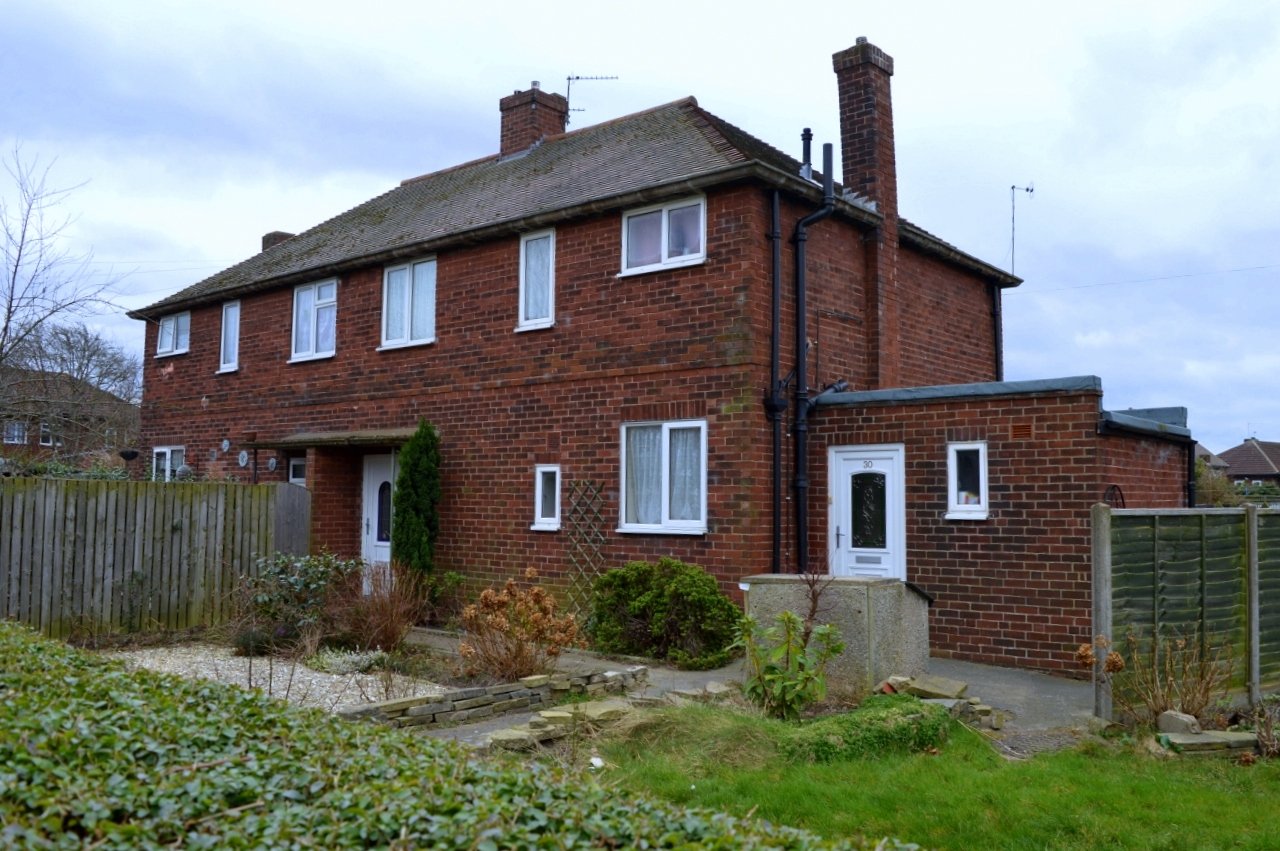
The property stood on the Chequerfield estate, part of the post-war expansion around Pontefract in West Yorkshire. It was not a crumbling rectory, ruined abbey or isolated manor. It was an ordinary semi-detached council house occupied by the Pritchard family, with neighbours close enough to hear raised voices and visitors arriving through a familiar front door. That normality is essential to the case. The story did not begin in a place already prepared for legend. It began amid domestic routines, school days, work, washing, meals and the small pressures of family life.
Pontefract itself, however, carried a much older religious and judicial geography. The town had once contained a Cluniac priory, a castle associated with imprisonment and execution, and roads shaped by centuries of traffic between market, church and gallows. Later retellings would draw heavily upon that past, eventually identifying the apparition as a monk executed for religious crimes. Historical research has not established that identity. The figure and the disturbances belong to the witness record; the biography attached to it belongs to the legend that grew afterwards.
The First Disturbance
Accounts preserved by researcher Colin Wilson and later investigators place the first outbreak in August 1966. Members of the family reported a fine white substance appearing in the house. Water gathered where no obvious source could be found. The events were irritating before they became frightening, because they suggested a practical fault that refused to reveal itself. Plumbing could be examined. Ceilings could be checked. Dust could be traced. What unsettled the household was the way the signs appeared to evade every attempt to reduce them to one mechanism.
Objects then began to move. A chest of drawers reportedly trembled and shifted. Small items crossed surfaces or were found where no one remembered placing them. The family did not immediately invent a spectral monk. They watched for tricks and faults, and they argued about causes. In poltergeist cases, the first witness is often not the believer but the person trying to prove that the house is merely damaged. At East Drive, the ordinary explanations did not end the activity. Then, as abruptly as it had begun, the house became quiet.
The Return in 1968
The silence lasted long enough to suggest that the episode had ended. In August 1968, the disturbances returned. This second phase became the foundation of the Black Monk legend because it was more violent, involved more witnesses and appeared increasingly focused upon Diane. Footsteps and knocks moved through the rooms. Doors behaved as if pushed from the other side. Furniture shifted under observation. The activity was no longer a collection of stains and misplaced objects. It had acquired the appearance of intention.
The Pritchards sought help from neighbours, clergy and anyone willing to enter the house. The more people gathered, the less private the haunting became. Reports describe objects moving before visitors, sounds answering attention, and incidents occurring while several observers were present. Police officers and local officials have been named among those who saw disturbances, though surviving accounts vary in precision. The case therefore rests upon a broad but uneven body of testimony: family recollections, interviews, recordings, later books and the memories of people who entered a house already under strain.
Diane at the Centre
Diane was not merely said to hear the entity. She was described as its chosen target. One of the most disturbing episodes involved a heavy piece of furniture pressing her against a wall or pinning her in place. In another, a mattress was thrown or dragged over her. The violence escalated beyond airborne objects into direct bodily assault.
The incident most often repeated occurred on the staircase. Diane was reportedly pulled upward by an unseen force while family members struggled to hold her. The scene became a tug-of-war across the steps, with the child as the contested weight between human hands below and something pulling from above. Bruising was later described. Whether every remembered detail can be independently confirmed is impossible to determine, but the emotional structure of the testimony is consistent: the family no longer believed the force was performing tricks. They believed it wanted possession of space, attention and, at moments, the child herself.
That focus has led later writers to classify the case as a classic adolescent-centred poltergeist. Psychical researchers have often noted that reported object movement clusters around a young person experiencing emotional pressure. Such theories do not require conscious fraud; they propose an unknown expression of human stress. The Pritchards did not experience the attacks as an unconscious projection. They described an exterior intelligence that watched, selected and returned.
The Hooded Figure
The apparition entered the narrative after the physical disturbances had already established themselves. Family members and at least one neighbour, May Mountain, were said to have seen a tall dark figure resembling a hooded monk. It appeared in or near rooms without approaching through a door. Its face was obscured. The garment was interpreted as a black robe, and the figure’s silent presence gave a visual body to months of sound and violence.
The name “Black Monk of Pontefract” solved one problem and created another. It gave the haunting a memorable identity, but it also encouraged later accounts to treat an interpretation as a historical discovery. Stories emerged of a monk hanged near the property, sometimes identified as a Cluniac brother punished for murder or corruption. Researchers who examined local records did not find a secure match. Pontefract certainly had monastic history and places of execution, yet the precise dead monk attached to East Drive remains unverified.
The distinction makes the apparition more unsettling, not less. A named ghost can be placed inside a biography, given a motive and contained by the past. The figure at East Drive resists that containment. Witnesses saw something that resembled a monk. History does not tell us who stood inside the hood.
Priests, Neighbours and the Failure of Authority
Clergy were invited to bless or pray within the house. In popular retellings, religious intervention often functions as a final confrontation, but the East Drive accounts describe no clean victory. Prayers could coincide with silence, agitation or renewed disturbance. The family’s problem was not a single dramatic appearance that could be commanded to leave. It was recurrence. The house could wait.
Neighbours became important because they weakened the idea that all reports originated inside one family system. May Mountain’s alleged sighting of the dark figure is central. Other visitors reportedly witnessed movement or heard sounds. Yet multiple witnesses do not automatically produce a laboratory record. People entered with expectations, fear and knowledge of previous events. Statements were gathered at different times, sometimes years later. The case is powerful because so many people reported something; it remains disputed because their evidence was not preserved under consistent conditions.
Colin Wilson and the Recorded Memory of the House
The writer Colin Wilson learned of the case through local historian Tom Cunliffe near the end of the 1970s. Wilson visited and interviewed members of the family around 1980, when the most violent period was already in the past. He listened to recollections and to recordings associated with the disturbances. His work helped move the story from local memory into the literature of psychical research.
That delay matters. Memory does not remain untouched. Repetition arranges events into patterns, removes uncertainty and strengthens the scenes that listeners find most compelling. At the same time, delayed testimony is not worthless. The Pritchards had lived through years in which their home became a public spectacle. Their accounts preserve details unlikely to survive in official records because no official institution accepted responsibility for documenting the case from beginning to end.
Wilson treated the haunting seriously while considering psychokinetic and poltergeist explanations. Later writers moved more decisively toward a conscious spirit. Film, television and paranormal tourism then transformed 30 East Drive into an address recognized far beyond Pontefract. The house became a destination where new investigators entered with cameras, trigger objects and the expectation that the monk might return.
The House After the Pritchards
A haunting attached to a private family can fade when the family leaves. The Black Monk story did the opposite. The address became the fixed point of the legend. Visitors have since reported knocks, footsteps, shadows, displaced objects and feelings of pressure. Some accounts reproduce the older pattern so closely that suggestion cannot be ignored. Others introduce new phenomena, creating a second archive made by people who arrived because they already knew the first.
The transformation raises a difficult question. Is the modern house still producing the same presence, or has the legend become an instrument that teaches every visitor how to interpret darkness, old plumbing and the movements of companions? Paranormal tourism can preserve a site while also overwhelming its original evidence. At East Drive, the historical family case and the later investigation industry must be read separately.
Fraud, Folklore and the Unresolved Core
No universally accepted physical proof demonstrates that an external entity moved furniture or dragged Diane. Some incidents may have been exaggerated, misunderstood or reconstructed through memory. The absence of controlled documentation leaves room for trickery, family dynamics, environmental causes and the contagious force of expectation. Those possibilities belong in any serious account.
They do not erase the unresolved core. A family reported recurring disturbances over years. Visitors said they encountered events they could not explain. A hooded figure was described before the later biography of a criminal monk hardened around it. The case survived because its principal images are not abstract: a child pulled on a staircase, a mattress closing over her, a dark robed form standing where no one had entered.
The strongest version of the story does not insist that every later claim is true. It asks why the earliest witnesses remained convinced that the house was occupied by a will other than their own.
What Remains
The Black Monk of Pontefract is often advertised as Britain’s most violent poltergeist. That title is impossible to measure, but it reflects the case’s unusual combination of domestic object movement, alleged bodily attack, multiple witnesses and a recurring apparition. Its power also comes from the contrast between the building and the story. Nothing about the red-brick exterior prepares the visitor for the violence described inside.
The monk’s invented biography should be set aside. The unverified gallows narrative should not be allowed to replace the testimony. What remains is darker: something was seen, but not identified; something seemed to pull, but left no handprint; and a house built for an ordinary family became remembered as a place where the staircase led toward a figure waiting above.
Sources and Further Reading
The article draws on Alan Murdie’s reconstruction of the case and the interviews associated with Colin Wilson’s investigation, the official history maintained by 30 East Drive, later psychical-research discussions, and the authentic exterior photograph credited below. Extraordinary claims are attributed to the witnesses who reported them, while the supposed historical identity of the monk is treated as later folklore rather than established fact.