On the Grand Canal, Ca’ Dario appears less like a haunted palace than a jewel placed among stone. Coloured marble circles brighten its narrow Renaissance façade. The windows are balanced, the proportions elegant, the surface almost delicate beside the massive Venetian houses around it. Yet the building has accumulated a reputation for death, ruin, suicide and violent reversal so persistent that its beauty is now read as camouflage. Owners, tenants and would-be purchasers have been gathered into a chain of misfortune extending across five centuries. The palace does not need a visible ghost. Its legend offers something colder: possession of Ca’ Dario is said to place the living inside a pattern already waiting for them.
The Palace of Giovanni Dario
The building was created in the late fifteenth century for Giovanni Dario, a Venetian diplomat and merchant whose career connected him to the Republic’s negotiations with the Ottoman world. Sources vary over the exact beginning and completion dates, commonly placing the project between 1479 and 1487. Its design is associated with Pietro Lombardo or his architectural circle, though attribution is not entirely secure.
Ca’ Dario stands in Dorsoduro, facing the Grand Canal near the mouth of the Rio delle Torreselle. The façade is one of Venice’s most recognizable private elevations: Istrian stone, coloured marble medallions, quatrefoils and asymmetrical windows adjusted to the older structures incorporated into the palace. Its slight lean and irregular interior only strengthen the impression of a beautiful object under pressure.
Giovanni Dario was not remembered as the first victim of a curse. The fatal pattern was constructed retrospectively, after later events had accumulated. This matters because the palace did not enter Venetian history with a documented warning. The warning was written backward through the lives of people associated with it.
Marietta and the Barbaro Family
The earliest chapter of the legend concerns Dario’s daughter Marietta, who married into the Barbaro family. Popular accounts claim that her husband, Vincenzo Barbaro, suffered financial collapse and was murdered, while Marietta died by suicide and their son met a violent end in Crete. Versions differ in names, sequence and documentary support.
These family tragedies are often presented as the moment the curse announced itself. Yet early modern Venetian families lived amid commercial risk, political conflict, disease, maritime violence and sudden death. To call every misfortune supernatural requires evidence that the later legend does not provide.
Still, the narrative structure was formed here: acquisition of the palace, prosperity, collapse, death. Once that sequence existed, later owners could be placed within it even when they survived for years or suffered troubles unrelated to the building.
A Curse Built from Selection
Curses grow through selection. The dead are remembered; the unharmed disappear from the story. A person who owns the palace briefly and lives quietly afterward contributes nothing to the legend. A person who loses money, becomes ill or dies dramatically becomes evidence.
Historians and modern journalists have noted that many people connected with Ca’ Dario did not meet extraordinary fates. The palace passed through families, tenants, restorers and visitors over centuries. The curse narrative isolates a smaller group and arranges their lives into a deliberate sequence.
That does not make the legend meaningless. It reveals how a place becomes feared. Repetition creates expectation, and expectation changes decisions. Potential buyers withdraw. Owners hesitate to sleep there. Journalists search every new death for a connection. The curse acquires real social force even when supernatural causation remains unproved.
Rawdon Brown and the Nineteenth-Century Palace
In the nineteenth century, the British historian Rawdon Brown became closely associated with Ca’ Dario. Brown was a major scholar of Venetian archives and lived in the city for decades. Popular curse lists sometimes describe him as ruined or destroyed by the palace. The historical reality is more complex. He occupied and cared for Ca’ Dario, conducted scholarship and lived to old age.
His presence exposes one of the legend’s distortions: a long life can be reduced to a misfortune if the palace requires another victim. Brown’s financial pressures and eventual departure are folded into the curse even though they do not resemble the violent deaths attached to later owners.
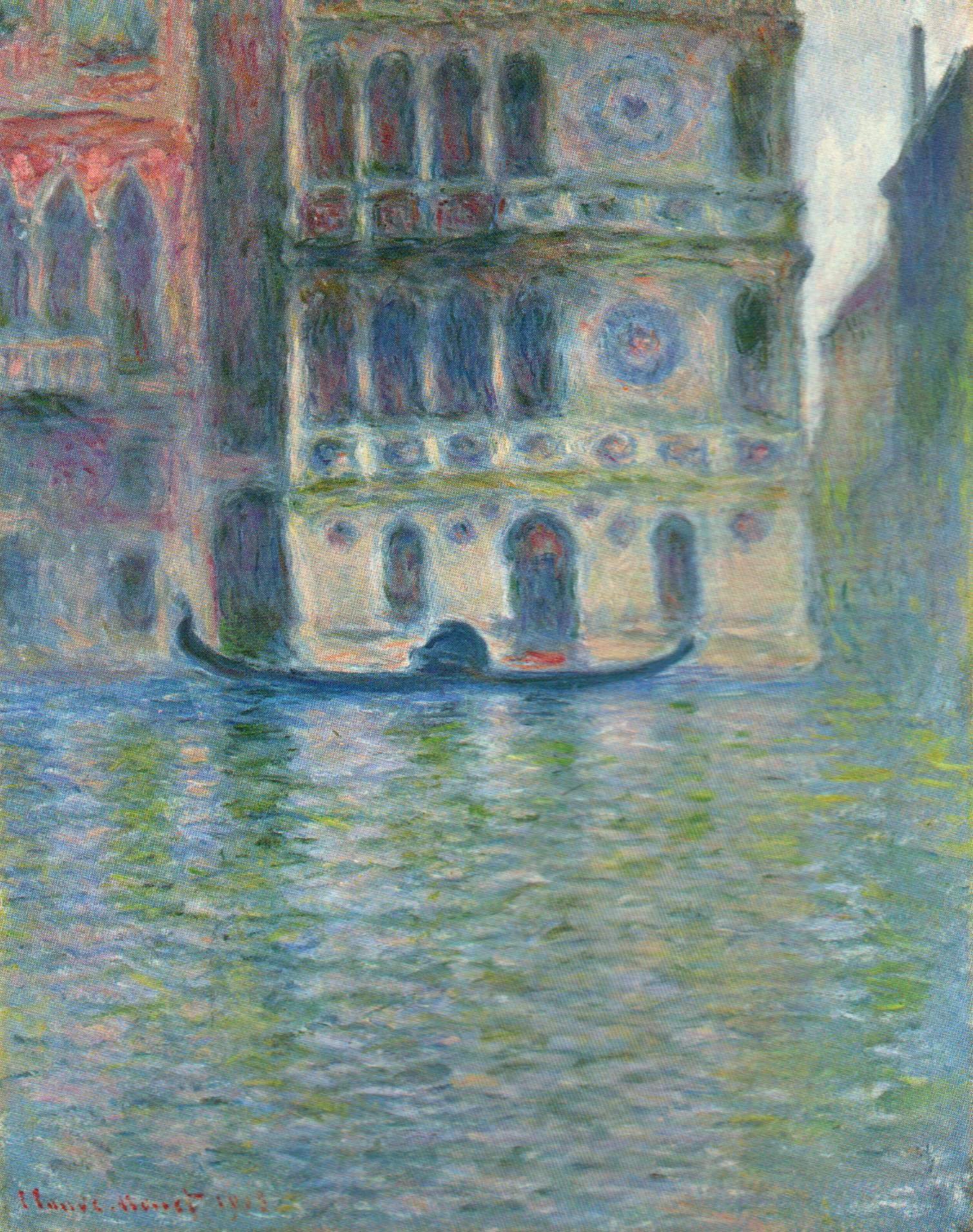
The palace also attracted artists and writers. Henry James described Venetian interiors with an eye for decay and possession. John Ruskin drew and studied architecture in a city where beauty seemed inseparable from loss. Claude Monet painted Ca’ Dario in 1908, dissolving the façade into water, light and colour. His canvas is now one of the palace’s most famous images. None of these encounters produced a documented curse. Yet their art helped make the building visible to people who would later learn to see menace in the same façade.
Henri de Régnier and the House That Repelled
The French poet Henri de Régnier stayed at or was associated with Ca’ Dario and later left Venice because of illness. Curse narratives interpret his departure as rejection by the palace. Illness becomes evidence that the house could not be inhabited safely.
The pattern is characteristic. A temporary resident falls sick—a common event in any life—and the illness gains supernatural meaning because of location. The palace does not need to kill everyone. It only needs to appear to push them away.
In the language of haunting, Ca’ Dario behaves less like a residence occupied by a ghost than an object that resists ownership. It can be admired, painted and viewed from water. The danger begins when admiration becomes possession.
Filippo Giordano delle Lanze
The twentieth-century legend darkened decisively with the death of Count Filippo Giordano delle Lanze. In 1970, he was murdered inside the palace by a young man with whom he had a relationship. The killer fled and was later arrested abroad. This was not a vague misfortune or a death elsewhere. Violence entered the rooms of Ca’ Dario and left a body within the building.
The murder gave the curse a modern crime around which older stories could gather. It also introduced themes of secrecy, desire, exploitation and betrayal that tabloids could repeat more easily than architectural history. Because the death occurred inside the palace, later writers treated it as proof that the building did not merely accompany tragedy; it produced it.
No evidence demonstrates that the property caused the crime. The circumstances belonged to human relationships and choices. But once blood had been spilled inside Ca’ Dario, the façade’s beauty could no longer protect it from the imagination of violence behind closed shutters.
Kit Lambert
Kit Lambert, the manager and producer associated with The Who, acquired Ca’ Dario in the early 1970s. His life later descended through addiction, financial conflict and declining health. He died in London in 1981 after a fall and cerebral haemorrhage.
Curse accounts compress those years into a simple line: Lambert bought the palace and was destroyed. The actual history unfolded across music-industry pressures, substance dependence and events far from Venice. The palace became a symbol within a life already moving toward crisis.
Lambert reportedly spent limited time at Ca’ Dario and may have avoided sleeping there, depending on the source. Such details are difficult to verify but have become central to the supernatural narrative. Fear of the palace is interpreted as recognition, as though an owner sensed the danger before it fully arrived.
Fabrizio Ferrari and the Weight of Ownership
The Venetian businessman Fabrizio Ferrari later owned the palace. Accounts connect his period of ownership with financial problems and the death of his sister in a road accident. Again, the relationship between property and tragedy is asserted through proximity rather than evidence.
Bankruptcy is especially useful to curse legends because a valuable palace is expensive to maintain. Structural repairs, taxes, restoration and legal complications can damage an owner’s finances without supernatural intervention. Venice itself makes ownership difficult. Water, salt, age and regulation turn beauty into obligation.
Ca’ Dario’s curse may therefore conceal an ordinary but severe truth: possessing a fragile historic palace can consume wealth, attention and health. The legend gives that burden a personality.
Raul Gardini
The most frequently cited modern victim is industrialist Raul Gardini, a figure at the centre of Italian business and political scandal. In 1993, amid the Tangentopoli investigations and the collapse of his corporate world, Gardini died by suicide in Milan. His connection to Ca’ Dario was enough for the palace to enter the reporting around his death.
Gardini’s suicide had a documented political and financial context. To attribute it to the palace erases the forces visibly closing around him. Yet the timing strengthened the curse narrative because the fall from wealth to death repeated the pattern already assigned to earlier owners.
In the same period, valuable artworks and furnishings associated with Ca’ Dario were involved in theft and dispute. Every loss appeared to confirm that the palace could not be safely possessed, sold or emptied.
The Buyers Who Withdrew
The reputation affected people who never completed a purchase. Prospective owners, including prominent artists and business figures, were reported to have considered Ca’ Dario and then withdrawn. Some stories say they feared the curse; others cite practical issues. Each refusal feeds the legend. A palace avoided by the powerful seems more dangerous than one merely blamed after death.
This is the stage at which folklore changes economic behaviour. The curse becomes part of the property’s market identity. It may reduce interest, increase publicity or attract buyers fascinated by notoriety. In either case, the belief acts upon the building’s future.
Recent sale efforts have again brought the story into international news. Reports repeat the linked deaths while also noting that historians dispute the pattern and that many occupants lived without catastrophe. The palace is marketed simultaneously as architectural treasure and cursed object.
The Inscription and the Temptation of Hidden Warnings
An inscription on the façade records Giovanni Dario’s name and honour. Popular writers have rearranged or reinterpreted letters to create ominous Latin messages about ruin. These anagrams are later inventions, not warnings carved by the builder.
The desire to find a coded curse in the architecture is revealing. A sequence of deaths feels incomplete without an origin. Viewers search the marble for a sentence that explains why the palace harms its owners. The building’s decorative circles become eyes; its lean becomes instability; its name becomes a cipher.
No historical document establishes a ritual curse upon the site. The supernatural reputation is an accumulation, not a recovered spell.
Why Ca’ Dario Feels Alive
Venice makes buildings appear animate. Water reflects façades until stone seems to move. Foundations sink unevenly. Floors tilt. Light enters from canals and travels across ceilings. At night, the city’s silence is broken by footsteps, water against walls and boats passing unseen below windows.
Ca’ Dario intensifies these effects because its façade is both exquisite and slightly wrong. The windows do not align with modern expectations. The coloured marble resembles ornament on a reliquary. The palace looks preserved, but the water beneath it is always working.
A haunted house usually contains a story of someone who refuses to leave. Ca’ Dario contains a story of the house refusing everyone else.
What Remains
The curse of Ca’ Dario cannot be demonstrated as a causal force. Its lists contain disputed details, selective memory and tragedies with clear human explanations. The earliest victims are poorly documented. Later deaths occurred within political, financial, medical and criminal circumstances that require no supernatural mechanism.
Yet the legend has become inseparable from the palace. It influences how the façade is photographed, how sales are reported and how each owner’s fate is remembered. A person may reject the curse and still enter a building where centuries of fear have already arranged the future into one question: what will happen next?
The palace remains beautiful because the curse does not stain the marble. That is its deepest power. Ca’ Dario does not look ruined. It looks desirable. The door into the legend is not terror but the wish to own what everyone else can only see from the water.
Sources and Further Reading
This article draws on architectural and property reporting from ANSA, recent international coverage that includes historians’ objections to the curse narrative, museum records for Claude Monet’s 1908 painting, Venetian historical studies and documented accounts of the modern owners most frequently associated with the legend. Deaths and financial reversals are not presented as proof of supernatural causation, and disputed early stories are identified as folklore. The featured image is Monet’s authentic public-domain painting of the palace.