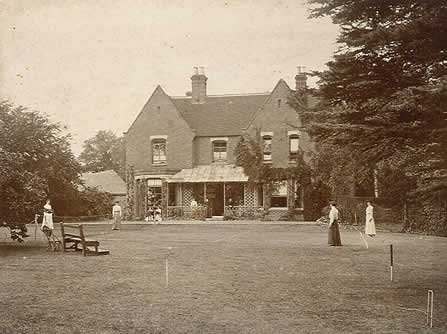
Borley Rectory was already a haunted house before Harry Price made it famous. The red-brick building stood near the church of St Mary in a small Essex village, its windows looking across grounds where a spectral nun was said to walk. Families who lived there reported footsteps, bells and apparitions. Visitors arrived expecting manifestations. Then Price gave the house a title—“the most haunted house in England”—and transformed a local accumulation of stories into an international case. The rectory burned in 1939 and was later demolished, but the controversy did not disappear with the walls. It became the final haunting: witnesses, investigators and critics continuing to argue inside a building that no longer existed.
A Rectory Built for a Large Family
The house was constructed in 1862 for the Reverend Henry Dawson Ellis Bull and his family. It was substantial, irregular and larger than the needs of many rural clergy. Later accounts described confusing corridors, service spaces, stairs and bell systems capable of producing sounds whose causes were difficult to locate.
The Bull family occupied the rectory for decades. Their period supplied much of the foundational folklore: a horse-drawn coach appearing without earthly passengers, unexplained footsteps and a nun seen walking through the grounds. The story of the nun acquired a tragic romance. She was said to have loved a monk from a nearby religious house, been murdered or immured after their discovery, and returned along a path visible from the rectory.
No secure historical evidence proves this biography. The tale resembles other Victorian and Edwardian haunted-convent legends, combining forbidden love, religious punishment and a female ghost condemned to repeat one journey. The apparition reports belong to the case; the medieval romance is a later explanation attached to them.
The Nun’s Walk
The path associated with the nun became one of Borley’s most powerful locations. Witnesses described a female figure in dark or grey religious dress moving along the grounds, sometimes visible from a window and sometimes encountered outside. She did not always react to observers. Her silence made her seem less like a visitor than a preserved action.
A repeated path gives a haunting geography. People know where to look, and expectation concentrates attention. It also creates the possibility of misidentification. A pedestrian, tree shadow or person staging a joke can occupy the expected route. Students later demonstrated how easily a false nun could impress observers already prepared to see one.
Yet the legend preceded many of the investigations that exploited it. The nun’s walk was not invented by the last tourist. It was inherited by each new resident and became part of the psychological architecture of the property.
The Smiths and the Daily Mirror
In 1928, the Reverend Guy Eric Smith and his wife moved into the rectory. Mrs Smith reportedly found a human skull in a cupboard or parcel while cleaning. The couple experienced unexplained sounds, bell ringing, lights and possible apparitions. Seeking help, they contacted the Daily Mirror, which brought Borley to Harry Price.
Price was a prominent investigator with a gift for public communication. He visited the rectory and reported phenomena, including the movement or appearance of objects. His presence changed the scale of the case. A private clerical house became a public experiment, and newspaper attention ensured that every new event would arrive inside a story already in progress.
The Smiths later expressed doubts about some claims and did not endorse every dramatic version Price published. Their position illustrates a recurring Borley problem: witnesses could believe unusual events occurred while rejecting the investigator’s interpretation or the publicity attached to them.
The Foyster Years
The Reverend Lionel Foyster, his much younger wife Marianne and their adopted daughter Adelaide occupied the rectory from 1930 to 1935. This period produced the densest and most controversial catalogue of phenomena. Bells rang without obvious cause. Stones and bottles were reportedly thrown. Doors locked or opened. Marianne described physical attacks and apparitions.
The wall writings became the most famous evidence. Words appeared on interior surfaces, some apparently addressing Marianne by name and asking for help. The messages looked less like ancient script than contemporary handwriting. To believers, they suggested an intelligence using the house itself as paper. To critics, their personal address and accessibility pointed toward fabrication.
Marianne stood at the centre of suspicion. Later investigators argued that she produced some phenomena to attract attention or conceal personal matters. She gave her own accounts and disputed the hostile portrait created by others. The evidence cannot be separated from the gendered assumptions of the period: a young rector’s wife under scrutiny became both principal witness and easiest suspect.
Bells, Wires and Rats
The rectory’s bell system offered a natural mechanism for unexplained ringing. Old wires could react to temperature, movement, structural vibration or animals. Rats were repeatedly proposed as the cause of sounds and disturbances. Mrs Smith herself considered ordinary explanations for some events.
Harry Price argued that no adequate infestation or mechanical fault explained the full pattern. Critics replied that a large old house did not need one cause. Rodents could account for movement in walls; loose objects and settling could produce knocks; suggestion could interpret ambiguous sounds; and deliberate tricks could supply the remainder.
This multi-cause explanation is less dramatic than a single ghost, but it matches the way real cases develop. A legend can absorb natural noise, human performance, memory error and possibly unexplained events without requiring every report to share one origin.
Harry Price Takes the House
From 1937 to 1938, Price rented Borley Rectory and recruited a group of observers after appealing through The Times. Forty-eight people were associated with the project. They received instructions and recorded experiences during visits.
The experiment appeared systematic, but important weaknesses remained. There was no complete official log maintained under one consistent protocol. Observers knew the house’s reputation. Many stayed for limited periods, and the absence of continuous control left opportunities for misunderstanding or interference.
Reports included knocks, thrown objects, footsteps, temperature changes and séance communications. Through mediumistic sessions, a spirit identifying herself as Marie Lairre was connected with the nun legend. Another communication predicted that the house would burn and that bones would be found.
The prophecy later became central because fire did come. But prediction and fulfillment were not exact in every detail, and the communications emerged in a context saturated with the expectation of tragedy. Price presented the material as part of a cumulative case rather than one decisive proof.
The Fire of 1939
William Hart Gregson bought the rectory after Price’s tenancy. On 27 February 1939, an oil lamp overturned and fire spread through the building. The event destroyed much of the interior and created photographs of a blackened ruin that seemed to confirm the house’s fatal reputation.
Observers claimed that a figure appeared in an upper window during the fire. As with many apparition photographs, interpretation depends upon seeing a face or body in an ambiguous shape. The image became part of the legend because it placed a watcher inside a structure being consumed.
Later excavation reportedly produced human bones. Their age and relationship to the nun story remained uncertain. Burial grounds, disturbed soil and the proximity of a church complicate any attempt to identify them as a murdered religious woman. Nevertheless, the discovery allowed the séance narrative to attach itself to physical remains.
The ruins survived for several years before demolition. Once the rectory was gone, every room became reconstructable only through plans, testimony and imagination.
The Most Haunted House in England
Price’s books established the title that still defines Borley. He assembled decades of incidents into a continuous haunting and wrote with the confidence of a man who understood that evidence also required narrative. The phrase “most haunted” cannot be measured, but it transformed comparison into fact for the public.
His skill created a problem for later researchers. Price preserved testimonies, correspondence and observations that might otherwise have vanished. He also selected, arranged and publicized them in ways critics considered misleading. The investigator became inseparable from the phenomenon.
The Harry Price archive at the University of London contains reports, diaries, correspondence, plans, legal papers and materials relating to Borley. Its existence prevents the case from being dismissed as one newspaper story. It also exposes how complicated the record is: hundreds of documents rather than one clean file.
The 1956 SPR Report
After Price’s death, investigators associated with the Society for Psychical Research re-examined the case. Eric Dingwall, Kathleen Goldney and Trevor Hall published a long critical survey in 1956. They questioned the reality of much of the activity and accused Price of distortion. The Foyster phenomena were treated with particular suspicion, and many later incidents were attributed to suggestion, exaggeration or hoaxing.
The report appeared devastating because it came from within psychical research rather than from outsiders mocking the field. It argued that the legend had grown through weak observation and publicity.
The case did not end. Other SPR members criticized the report’s methods and certainty. Robert Hastings later published a detailed examination rebutting many accusations against Price. The Society’s own history acknowledges that the evidence remains disputed within its archives.
This internal conflict matters. Borley cannot be divided neatly into believers and sceptics. Investigators who accepted the possibility of paranormal events disagreed about this particular house, this particular investigator and the fairness of the later attack.
Fraud Without a Final Fraudster
Several people have been accused of producing phenomena: Marianne Foyster, mischievous visitors, local children, students and Price himself. Individual incidents have plausible explanations. A thrown coin, a wall message or a staged nun can be fraudulent without proving that every report across decades came from one conspiracy.
Conversely, the survival of unexplained incidents does not prove one coherent ghost. The label “Borley Rectory haunting” joins events separated by residents, motives and years. Some witnesses may have been honest but mistaken. Others may have embellished. A few may have encountered something genuinely anomalous.
The search for one verdict can obscure the structure of the case. Borley was a machine that produced testimony. Its old fabric, clerical occupants, inherited legend, public attention and repeated investigations ensured that ambiguous events would rarely remain ordinary.
The Haunting After Demolition
The physical rectory no longer exists, yet reports continued around the churchyard, road and former grounds. Visitors arrived because the house had been destroyed, not despite it. Absence became another feature of the site. A witness could stand where a corridor once ran and imagine footsteps crossing a room erased from the landscape.
The nun’s path retained its power because a path can survive a building. The church continued to provide a visible anchor. Books and photographs reconstructed the exterior so completely that readers felt they knew the house without entering it.
Borley therefore became a media haunting: an entity sustained by archives, plans, accusations, images and repetition. This does not make it unreal. It changes the location of the phenomenon. The most active room is now the record itself.
What Remains in the Evidence
A serious account should resist both extremes. It should not treat every bell as a spirit or every critic as a destroyer of mystery. It should not claim that one exposed trick dissolves the testimony of every family.
The strongest facts are historical. The rectory existed. Generations reported unusual events. Price investigated and publicized it. The building burned. The SPR issued a hostile report, and other researchers challenged that report. Large archives preserve the conflict.
The supernatural conclusion remains open because the evidence is uneven and contaminated by expectation. That uncertainty is not a failure of the story. It is why Borley endures. A solved hoax would close the door. A proven haunting would establish what stood behind it. Borley offers neither comfort.
The house is gone, but the footsteps continue through testimony. Each reader enters by a different doorway, hears the bells according to a different theory and encounters the nun on a path where no witness has ever been able to stop her and ask who she was.
Sources and Further Reading
This article draws upon the Society for Psychical Research’s case summaries and institutional history, the University of London descriptions of the Harry Price archive, Robert Hastings’s published critique of the Borley report and the surviving historical photograph. It preserves the major witness claims while presenting the 1956 criticism and later rebuttal as an unresolved research dispute.
- https://psi-encyclopedia.spr.ac.uk/articles/borley-rectory
- https://psi-encyclopedia.spr.ac.uk/articles/society-psychical-research
- https://archives.libraries.london.ac.uk/Details/archive/110006865
- https://archives.libraries.london.ac.uk/Details/archive/110007211
- https://openlibrary.org/books/OL13895559M/An_examination_of_the_%27Borley_report%27
- https://commons.wikimedia.org/wiki/File:BorleyRectory1892.jpg