
Historical Ritual Archive
A Goetic operation of burning memory, enemy-making and the peace that comes only after hidden hatred is exposed.
This rebuilt dossier preserves the entire operative substance of the earlier SatanWorld draft: the tools, sigil work, timings, purifications, chants, offerings, petitions, manifestations, dismissals and warnings remain present. The material has been reorganized so the rite unfolds as one deliberate descent rather than a loose list of instructions.
The Power Being Addressed
Amon is approached as Seventh spirit of the Ars Goetia, a Great Marquis commanding forty legions. The operation is structured around that rank, office and manifestation.
Amon is proud, volatile and mercilessly perceptive of resentment. He is believed to understand how conflict is created because he governs both feud and reconciliation. His answers are direct, but the peace he offers may require confrontation first.
Daemonology profile: Read the complete Daemonology profile of Amon
Why the Rite Exists
The rite creates a threshold between ordinary life and the domain attributed to Amon. Preparation separates the practitioner from distraction. The sigil, name and chant establish a centre. The petition shapes the encounter. The offering acknowledges exchange. Dismissal restores the chamber to ordinary time.
A summoning without preparation is only demand. A summoning without closure is pressure without boundary.
Personality and Ritual Conduct
Amon is proud, volatile and mercilessly perceptive of resentment. He is believed to understand how conflict is created because he governs both feud and reconciliation. His answers are direct, but the peace he offers may require confrontation first.
The practitioner should speak with precision and avoid contradictory motives. The entity's traditional temperament determines the tone of the operation. Royal spirits are not approached like marquises, teachers are not addressed like destroyers, and powers of love, invisibility, storm, war or revelation do not answer through the same atmosphere.
The Atmosphere of Manifestation
Heat gathers in the throat and face. The imagined smell of scorched hair or smoke may arise, black birds appear in dreams, and manifestation may begin as a wolf with a serpent's tail breathing flame before becoming human.
Manifestation may begin through changes in sound, heat, dream, pressure, candle behavior, animal imagery or internal speech. The legend of the rite does not require a full visible apparition before contact is recognized.
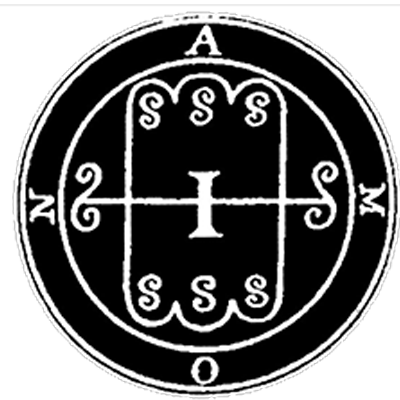
Sigil of Amon
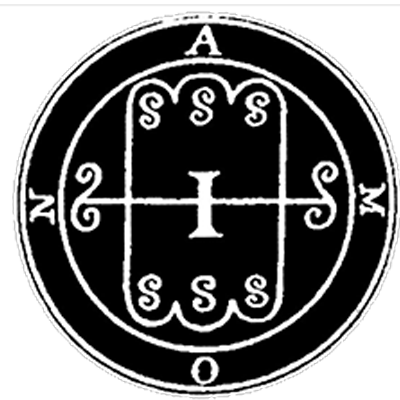
Sigil of Amon. Traditionally drawn on parchment and placed at the centre of the rite as the principal visual focus for the invocation.
The Rite: Full Ceremonial Sequence
The following section preserves the original article's ritual content without omitting its operative details.
Amon (also spelled Aamon or Amun) is a demon described in medieval grimoires, particularly the
Lesser Key of Solomon
(Lemegeton Clavicula Salomonis), compiled around the 17th century. In this text, Amon is ranked as the 7th spirit of the Goetia—a hierarchy of 72 demons supposedly summoned by King Solomon. He appears as a wolf with a serpent's tail, vomiting flames, but can take a human form with a raven's head or as a man with a wolf's teeth. Amon is said to reconcile friends and foes, reveal past and future events, and grant knowledge of sciences and secrets. He commands 40 infernal legions.
These descriptions stem from Renaissance occult traditions blending Jewish, Christian, and pagan elements. Modern interpretations vary, from literal belief in demonology to psychological or symbolic views (e.g., in chaos magic, Amon represents reconciliation and hidden knowledge).
Traditional Summoning Ritual from the Goetia
The
Lesser Key of Solomon
outlines a structured evocation process requiring preparation, tools, and protections. Below is a summarized, step-by-step adaptation based on the original text (Book 1: Ars Goetia). This is not a direct quote but a faithful reconstruction for clarity. Full texts are available in public domain editions like those edited by S.L. MacGregor Mathers (1904).
Preparation (1-7 Days Before)
Purification
Fast for 3 days (bread, water, salt only). Bathe in holy water (blessed with salt and herbs like hyssop). Confess sins and perform a Lesser Banishing Ritual of the Pentagram (LBRP) to cleanse your space:
Face east, draw a pentagram in the air with a ritual dagger or finger while vibrating "YHVH" (Yod-Heh-Vav-Heh).
Repeat for south ("Adonai"), west ("Eheieh"), north ("AGLA").
Invoke archangels: Raphael (east), Michael (south), Gabriel (west), Uriel (north).
This creates a protective circle.
Gather Tools
###
A magic circle: Draw a 9-foot diameter circle on the ground with chalk or flour, inscribed with names of power (e.g., "Tetragrammaton," "Adonai," "Elohim"). Inside, a triangle of art (equilateral, 3 feet out) for the spirit to appear.
Black-handled knife (athame) for tracing.
Incense: Frankincense and myrrh.
Virgin parchment with Amon's sigil (seal): A complex glyph resembling a crowned wolf-head with serpentine lines—search public grimoires for exact drawing.
Robes: White linen, hood optional.
Offerings: Bread, wine, or bloodless sacrifices (e.g., flowers symbolizing reconciliation).
Timing
Best during a waxing moon, Tuesday (Mars day for martial spirits), between 3-5 AM. Avoid Fridays or full moons.
The Summoning (Core Ritual)
Enter the Circle
At the appointed hour, stand in the circle facing east. Light incense in the triangle. Trace the circle with your athame, saying: "I conjure thee, O Circle of Art, to be a fortress against all spirits, powers, and imaginations."
Preliminary Invocation
Recite the Preliminary Invocation (from the Heptameron or Goetia): "O Thou, the Great and Mighty God, who art called by many names… I humbly invoke and conjure Thee to be favorable unto me… Send unto me Amon, who is under Thy power."
Call the Spirit
Hold Amon's sigil aloft. Chant the conjuration three times, increasing intensity: "I do invocate and conjure thee, O Spirit Amon; and being with power armed from the Supreme Majesty, I do strongly command thee, by Beralanensis, Baldachiensis, Paumachia, and Apologiae Sedes; by the most Powerful Princes, Genii, Liachidae, and Ministers of the Tartarean Abode; and by the Chief Prince of the Seat of Apologia in the Ninth Legion, I do invoke thee, Amon… Appear thou visibly before this Circle in a fair and comely shape, without deformity or horror… I conjure thee by the seal of thy King Solomon… Come peaceably, visibly, and affably, now and without delay."
If no appearance, use the "curse" (second conjuration): Threaten binding to a brass vessel with torment by divine names.
Appearance and Binding
Amon may manifest as smoke, sounds, visions, or (rarely) physical form in the triangle. Command him: "O thou Spirit Amon, I bind thee to appear and obey… Declare thy name, office, and the reason of thy tarrying." Do not leave the circle until licensed to depart.
Communication
Ask questions (e.g., "Reveal hidden truths" or "Reconcile [names]"). Speak clearly; use a scrying tool like a black mirror if needed.
Dismissal
When done, say: "O thou Spirit Amon, I thank thee for thy obedience. Depart in peace unto thy abodes, harming none… Go forth, I say, and be thou as thou wert before, until I call thee again." Erase the circle eastward.
Post-Ritual
Banish with LBRP again.
Journal experiences.
If disturbances occur, repeat banishings or consult a trusted occultist.
Variations and Modern Adaptations
Crowley’s Version
###: Aleister Crowley’s
The Book of the Goetia
(1904) adds Enochian calls for potency. Use the 19th Enochian Key for reconciliation themes.
Chaos Magic Approach
Treat Amon as a thoughtform. Meditate on the sigil while visualizing wolf imagery; affirm intentions without full ritual.
Safety Tips
Always prioritize mental health. If it feels overwhelming, stop and seek professional help. Historical accounts (e.g., in
Pseudomonarchia Daemonum
by Johann Weyer, 1577) warn of deception or backlash if protections fail.
Historical Image and Ritual Figure
BLACK PLACEHOLDER — replace with a verified historical image, sigil manuscript or ritual object before publication.
Ritual Architecture
Separation from Ordinary Time
Bathing, fasting, abstinence, silence, darkness or isolation prepare the body and mind to recognize the threshold. The preparation should be completed as a single coherent discipline rather than as scattered gestures.
Construction of the Chamber
Candles, incense, circle, water, salt, metal, herbs, stones and offerings organize the room around the office of Amon. Every item should have a purpose. A crowded altar weakens the central image when objects are added only for display.
Establishing Contact
The sigil, name, chant, enn or invocation becomes the fixed point of the operation. Repetition is intended to narrow awareness until the name no longer feels like ordinary language.
The Petition
One principal request should be stated. The request must include a boundary, a desired form of result and a clear completion condition. Ambiguous wishes invite expansion.
Recognition of Presence
The central phase begins when the atmosphere changes in a sustained way. Pressure, heat, cold, altered flame, internal speech, animal forms, dreams or sudden certainty may mark the transition.
Offering and Exchange
The offering expresses reciprocity. It may carry the spirit's color, office, appetite or symbolic domain. Promises should never be made casually because the rite treats them as binding.
Dismissal
The operation ends only when Amon is thanked or dismissed according to the preserved method. Candles are extinguished safely, windows opened where appropriate, offerings removed according to the rite and the chamber returned to ordinary order.
Instruments and Their Symbolism
The sigil is the visual body of the name. The candle establishes color, rank and duration. Incense gives the atmosphere density. Salt and the circle define limits. Water reflects and carries emotional force. Metal, stone, herb or coin embodies the entity's office.
The instrument is complete when it performs its function. More objects do not automatically create greater force.
Timing and Planetary Current
When several correspondences appear, one coherent system should govern the night. Combining every possible timing creates confusion rather than power.
Manifestation Signs
Signs traditionally associated with Amon include:
- a stable change in emotional pressure;
- dreams repeating the traditional form;
- candle movement without a matching draft;
- sounds, smells or bodily sensations linked to the spirit's office;
- a complete phrase arising inside thought;
- external events beginning to mirror the petition;
- fear or fascination intensifying at the exact point of contact.
One isolated sign may pass unnoticed. A pattern repeating across chamber, dream and aftermath carries greater weight.
The Frightening Edge of the Rite
Amon can intensify the conflict he is asked to resolve. Reconciliation may arrive only after concealed hostility becomes impossible to deny.
The deepest danger is transformation that feels useful. The practitioner may begin to imitate the spirit's temperament, reorganize life around the petition or interpret every event through the operation.
Failure Patterns
Failure appears when preparation is abandoned, the request changes repeatedly, symbols are mixed randomly, fear replaces attention, impossible offerings are promised or the practitioner refuses to close because no dramatic apparition appeared.
Failure may also appear as excess success: the requested force enters ordinary life faster than expected. The completion condition should therefore be written before the rite begins.
Completion and Aftermath
The operation is complete when the petition has been spoken, the exchange acknowledged, the presence dismissed and the chamber returned to ordinary order.
Record:
- date and exact timing;
- preparation completed;
- tools and offerings;
- words spoken;
- signs observed;
- dreams in the following nights;
- first external movement;
- emotional or behavioral changes;
- fulfillment of any promised offering.
The aftermath belongs to the rite. Results may arrive as opportunity, conflict, warning, sudden knowledge, disappearance of an obstacle or an intensification that reveals the true shape of the request.
Boundaries of the Petition
The petition should identify what is requested, where the result may operate, what form the result may take and what event marks completion. Wealth can arrive through loss. Truth can destroy a relationship. Protection can become isolation. Love can become possession. Invisibility can become moral evasion.
The wording is therefore part of the danger.
The Return to Ordinary Life
After closure, eat, drink, wash, change clothing, step outside or speak with another person. These actions declare that ritual time has ended.
Do not immediately repeat the operation because silence feels uncomfortable. Strong results reveal their own pattern.
Final Warning
Amon can intensify the conflict he is asked to resolve. Reconciliation may arrive only after concealed hostility becomes impossible to deny.
Do not leave the altar active indefinitely. Do not continue chanting after formal dismissal. Do not add a second petition during the closing stage.