The Arbatel does not begin with threats, blood or a catalogue of infernal monsters. It begins with aphorisms. Printed at Basel in 1575, it presents magic as disciplined wisdom under divine providence and introduces seven powers known as the Olympic Spirits: Aratron, Bethor, Phaleg, Och, Hagith, Ophiel and Phul. Its restrained voice has made the book seem luminous beside darker grimoires, but its promises remain extraordinary.
Basel, 1575
Arbatel de magia veterum first appeared in Basel in 1575. The printer is commonly associated with Peter Perna, whose press issued works of theology, Paracelsian medicine and controversial learning.
The author remains unidentified. The anonymity is significant because the book’s confident moral voice gives the impression of a teacher while withholding a biography that could be investigated or prosecuted.
Its printed origin distinguishes it from many manuscript grimoires. Arbatel entered the world as a reproducible book rather than a single secret codex.
This section matters within the history of Arbatel de Magia Veterum because it joins a textual claim to a recoverable practice of copying, ownership or institutional control. The archive cannot verify every promised supernatural effect, but it can establish who preserved the words, how the material was arranged and which later traditions inherited its structure.
The surviving evidence must be read at the level of the individual witness. Titles migrate, manuscripts combine unrelated works, and later editors normalize spellings that a copyist left unstable. Shelf mark, folio and date are therefore not decorative citations; they are the controls that keep a famous occult name attached to a real object.
Only One Part of a Larger Design
The surviving work calls itself an Isagoge, an introduction, and appears to describe only the first portion of a larger projected system. Other sections named in the plan are not known to survive.
The incompleteness creates a deliberate horizon. Readers receive a doorway into ancient magic while being reminded that the full architecture lies beyond the printed volume.
Whether the missing parts were ever written cannot be established. Their absence became part of the book’s aura.
This section matters within the history of Arbatel de Magia Veterum because it joins a textual claim to a recoverable practice of copying, ownership or institutional control. The archive cannot verify every promised supernatural effect, but it can establish who preserved the words, how the material was arranged and which later traditions inherited its structure.
Later occult publishing often produces a clean, continuous text from several damaged or divergent witnesses. That work can make a tradition readable, but it may conceal the decisions of editors. Comparing the edition with a catalogue and image restores omissions, marginalia, layout and the physical sequence in which a historical reader encountered the material.
Forty-Nine Aphorisms
The text is organized into seven groups of seven aphorisms. This numerical structure aligns the book with sacred and planetary patterns while keeping the presentation concise.
Each aphorism combines counsel, cosmology and practical implication. The form invites slow reading; a short statement can carry assumptions about providence, vocation, spirits and the proper use of gifts.
The grimoire resembles a book of wisdom literature whose sentences open onto ritual possibilities.
This section matters within the history of Arbatel de Magia Veterum because it joins a textual claim to a recoverable practice of copying, ownership or institutional control. The archive cannot verify every promised supernatural effect, but it can establish who preserved the words, how the material was arranged and which later traditions inherited its structure.
Claims of great antiquity require special care. A manuscript may preserve old material while being physically much later, and a legendary attribution may express authority rather than authorship. Separating date of object, date of textual layer and mythical origin produces a stronger history than accepting or dismissing the tradition as a whole.
Magic Under Divine Providence
Arbatel repeatedly insists that all good gifts come from God and that the practitioner must seek wisdom with humility, prayer and moral discipline. It condemns misuse and curiosity detached from vocation.
This language is not a superficial Christian disguise easily stripped away. The theology shapes the system: spirits occupy offices within creation, and legitimate knowledge depends on divine permission.
The book’s danger lies precisely in its confidence that extraordinary contact can be reconciled with piety.
This section matters within the history of Arbatel de Magia Veterum because it joins a textual claim to a recoverable practice of copying, ownership or institutional control. The archive cannot verify every promised supernatural effect, but it can establish who preserved the words, how the material was arranged and which later traditions inherited its structure.
Every act of copying is evidence of valuation. Paper, ink and time were spent because someone considered the material useful, dangerous, prestigious or worthy of preservation. Even where performance cannot be demonstrated, transmission itself is a documented historical action with social and intellectual consequences.
The Seven Olympic Spirits
Aratron, Bethor, Phaleg, Och, Hagith, Ophiel and Phul govern broad planetary domains. Later readers align them respectively with Saturn, Jupiter, Mars, the Sun, Venus, Mercury and the Moon.
The text attributes powers over longevity, wealth, warfare, healing, learning, transformation and other conditions. Their scale is “Olympic” because they govern immense regions and periods beneath the divine order.
They are not presented simply as demons. Their ambiguous status is one reason the Arbatel crossed between Christian magic, occult philosophy and later ceremonial practice.
This section matters within the history of Arbatel de Magia Veterum because it joins a textual claim to a recoverable practice of copying, ownership or institutional control. The archive cannot verify every promised supernatural effect, but it can establish who preserved the words, how the material was arranged and which later traditions inherited its structure.
Images must also be identified precisely. A related seal, later title page or parallel manuscript can illuminate the subject, but it should not be called the exact folio when it is not. This article distinguishes contextual imagery from direct facsimile so that atmosphere never replaces provenance.
Aratron, Bethor and the Weight of the Outer Planets
Aratron is associated with Saturnian power, including time, transformation and the making of things into stone or treasure in later interpretation. Bethor carries Jovian themes of dignity, wealth and favour.
These offices reflect traditional planetary qualities rather than arbitrary invention. The spirits personify the heavens as rulers who can delegate effects within creation.
The planetary framework gives the names a system. Without it, the list would be merely exotic; within it, each power occupies a celestial jurisdiction.
This section matters within the history of Arbatel de Magia Veterum because it joins a textual claim to a recoverable practice of copying, ownership or institutional control. The archive cannot verify every promised supernatural effect, but it can establish who preserved the words, how the material was arranged and which later traditions inherited its structure.
The surviving evidence must be read at the level of the individual witness. Titles migrate, manuscripts combine unrelated works, and later editors normalize spellings that a copyist left unstable. Shelf mark, folio and date are therefore not decorative citations; they are the controls that keep a famous occult name attached to a real object.
Phaleg, Och, Hagith, Ophiel and Phul
Phaleg is connected with Mars and martial affairs; Och with the Sun, health and gold; Hagith with Venus and beauty; Ophiel with Mercury and learning; Phul with the Moon and lunar influence.
Later occultists expanded these correspondences, sometimes adding seals, colours and ritual details not explicit in the 1575 text. Modern tables therefore mix original statements with subsequent tradition.
Distinguishing layers allows the Arbatel itself to remain visible beneath centuries of elaboration.
This section matters within the history of Arbatel de Magia Veterum because it joins a textual claim to a recoverable practice of copying, ownership or institutional control. The archive cannot verify every promised supernatural effect, but it can establish who preserved the words, how the material was arranged and which later traditions inherited its structure.
Later occult publishing often produces a clean, continuous text from several damaged or divergent witnesses. That work can make a tradition readable, but it may conceal the decisions of editors. Comparing the edition with a catalogue and image restores omissions, marginalia, layout and the physical sequence in which a historical reader encountered the material.
Paracelsian and Humanist Atmosphere
The work shares the intellectual air of late Renaissance natural philosophy, Reformation theology and Paracelsian reform. It treats the world as filled with gifts, signatures and intelligences available to a properly oriented seeker.
Its concern with useful knowledge, vocation and the restoration of wisdom differs from grimoires focused narrowly on coercive spirit evocation.
Arbatel belongs to a moment when magic could be imagined as a reform of learning rather than only a forbidden survival.
This section matters within the history of Arbatel de Magia Veterum because it joins a textual claim to a recoverable practice of copying, ownership or institutional control. The archive cannot verify every promised supernatural effect, but it can establish who preserved the words, how the material was arranged and which later traditions inherited its structure.
Claims of great antiquity require special care. A manuscript may preserve old material while being physically much later, and a legendary attribution may express authority rather than authorship. Separating date of object, date of textual layer and mythical origin produces a stronger history than accepting or dismissing the tradition as a whole.
From Aphorism to Later Ritual Tradition
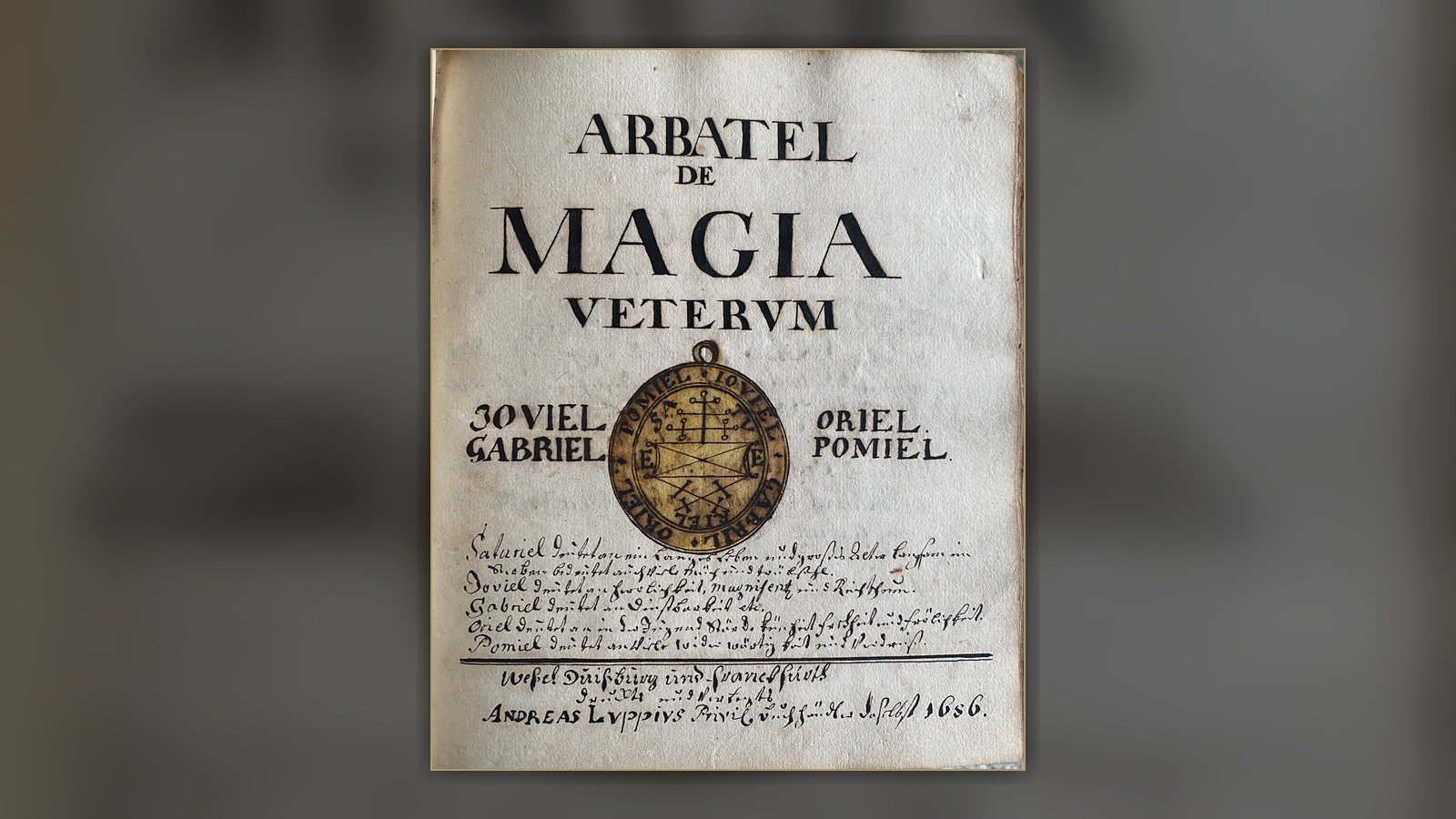
The book was reprinted and translated, including a visually influential 1686 edition associated with Andreas Luppius. Later ceremonial magicians incorporated the Olympic Spirits into broader systems.
Every new edition changed presentation through typography, diagrams, commentary or translation. The featured image comes from the later Luppius tradition and is identified as such rather than presented as the 1575 title page.
The Arbatel’s endurance rests on its openness. It gives enough structure to invite practice while leaving enough unsaid for each generation to complete the system anew.
This section matters within the history of Arbatel de Magia Veterum because it joins a textual claim to a recoverable practice of copying, ownership or institutional control. The archive cannot verify every promised supernatural effect, but it can establish who preserved the words, how the material was arranged and which later traditions inherited its structure.
Every act of copying is evidence of valuation. Paper, ink and time were spent because someone considered the material useful, dangerous, prestigious or worthy of preservation. Even where performance cannot be demonstrated, transmission itself is a documented historical action with social and intellectual consequences.
The Book as Historical Evidence
The enduring power of Arbatel de Magia Veterum comes from the meeting of claim and object. A legendary author, celestial teacher or infernal hierarchy may dominate the title, but the historical work begins with paper, parchment, handwriting, type, pigment, binding and custody. These features identify when a witness could have been made and how it passed from one set of hands to another.
Provenance also changes meaning. A ritual text in a private notebook, a confiscated bundle in a court file and the same leaves in a national library are not socially identical objects. Each setting imposes a new interpretation: tool, evidence, curiosity, pathology, heritage or research source. Forbidden history is the sequence of those transformations.
The featured image used here is an authentic historical reproduction connected directly to the subject or, where explicitly stated, to the precise manuscript tradition discussed. It has been framed for a modern 16:9 website format without replacing the central archival image. Credit and reuse status are recorded in the package ledger.
What the Archive Refused to Lose
The Arbatel and the Seven Olympic Spirits ultimately survives because prohibition never operated alone. Copyists, collectors, physicians, clergy, defendants, censors and librarians all participated in transmission, sometimes while condemning the material they preserved. Their motives were different, but the cumulative result is a record that can still be examined rather than merely repeated as legend.
The most responsible occult history does not drain mystery from the source. It replaces vague mystery with exact strangeness: a named shelf mark, an unexpected language, a corrected spirit name, an erased line, a later hand in the margin, a printed prohibition or a diagram copied by someone whose identity has disappeared. These details are darker than invention because they belong to the surviving object.
Reading the Surviving Witnesses
Researchers approaching Arbatel de Magia Veterum should separate the physical witness from the modern title used to group it. Catalogue descriptions establish dimensions, support, script, foliation and the works bound before and after the relevant text. Those details often reveal whether the item was planned as a coherent book or assembled from papers with independent histories.
Transcription creates another layer. Unfamiliar names can be altered by a single misread letter, especially when Greek, Hebrew, Latin, French, German or invented ritual syllables cross scripts. Variant spelling should therefore be recorded rather than silently corrected, because the history of error is part of the transmission of Arbatel de Magia Veterum.
Digital access has transformed this field by allowing a reader to compare image and edition across institutions. It has not abolished the need for caution. Colour balance, cropped edges, missing blanks and online metadata can affect interpretation, while some composite volumes remain only partially photographed.
The strongest account combines primary witness, institutional catalogue and specialist scholarship. Popular retellings are useful for tracing cultural memory, but they should not be allowed to replace the source that created the story. This hierarchy of evidence gives the narrative depth without turning it into a debunking exercise.
Researchers approaching Arbatel de Magia Veterum should separate the physical witness from the modern title used to group it. Catalogue descriptions establish dimensions, support, script, foliation and the works bound before and after the relevant text. Those details often reveal whether the item was planned as a coherent book or assembled from papers with independent histories.
Transcription creates another layer. Unfamiliar names can be altered by a single misread letter, especially when Greek, Hebrew, Latin, French, German or invented ritual syllables cross scripts. Variant spelling should therefore be recorded rather than silently corrected, because the history of error is part of the transmission of Arbatel de Magia Veterum.
Digital access has transformed this field by allowing a reader to compare image and edition across institutions. It has not abolished the need for caution. Colour balance, cropped edges, missing blanks and online metadata can affect interpretation, while some composite volumes remain only partially photographed.
The strongest account combines primary witness, institutional catalogue and specialist scholarship. Popular retellings are useful for tracing cultural memory, but they should not be allowed to replace the source that created the story. This hierarchy of evidence gives the narrative depth without turning it into a debunking exercise.
Researchers approaching Arbatel de Magia Veterum should separate the physical witness from the modern title used to group it. Catalogue descriptions establish dimensions, support, script, foliation and the works bound before and after the relevant text. Those details often reveal whether the item was planned as a coherent book or assembled from papers with independent histories.
Transcription creates another layer. Unfamiliar names can be altered by a single misread letter, especially when Greek, Hebrew, Latin, French, German or invented ritual syllables cross scripts. Variant spelling should therefore be recorded rather than silently corrected, because the history of error is part of the transmission of Arbatel de Magia Veterum.