In the autumn of 1632, the silence of an Ursuline convent in western France gave way to convulsions, accusations and voices that the clergy identified as devils. Within two years, Loudun had become a theatre of exorcism, and a priest named Urbain Grandier was burning in the square.
A Town Beneath the Bells
Loudun stood behind walls and towers in the province of Poitou, a town of churches, markets and old rivalries. France was moving through the unsettled reign of Louis XIII, while Cardinal Richelieu tightened royal control and Protestant strongholds watched their privileges diminish. Religious difference was not an abstract argument here. It divided families, shaped municipal power and gave every rumour of sacrilege the weight of danger.
At the centre of the town’s disputes was Urbain Grandier, priest of Saint-Pierre-du-Marché and canon of Sainte-Croix. Educated, eloquent and striking in appearance, Grandier attracted admiration and hostility in almost equal measure. He had enemies among local clergy and magistrates, and his opposition to the demolition of Loudun’s fortifications placed him against policies associated with Richelieu’s government. Long before demons were named, the town was already prepared for accusation.
Beyond the streets stood the convent of the Ursulines, a teaching order whose enclosed life was governed by prayer, obedience and discipline. Its prioress, Jeanne des Anges, would become the most famous of the women later described as possessed. Grandier had been proposed as spiritual director of the house and had refused. Another priest, Jean Mignon, eventually took the role. In the history that followed, private disappointment, clerical rivalry and spiritual terror became impossible to separate.
The Shadow of Father Moussaut
The disturbances were said to begin after the death of the convent’s former confessor, Father Moussaut. Several nuns reported seeing his figure moving through the corridors at night. A shape appeared near doors. Footsteps crossed rooms after the community had retired. What first resembled a haunting soon changed character.
Jeanne des Anges and other sisters began to experience violent bodily attacks. They fell, twisted, cried out and described obscene temptations. The women said that unseen forces entered their cells and pressed upon them. During prayer, their bodies resisted sacred gestures. The atmosphere inside the convent hardened from grief into siege.
The first exorcisms began in October 1632. Under questioning, the voices speaking through the women gave names. Among them were Asmodeus, Zabulon, Leviathan, Balaam, Isacaaron and Behemoth—names drawn from scripture and learned demonology. The possessing spirits were said to have entered through flowers or enchanted objects sent by a sorcerer. When the exorcists demanded the sorcerer’s identity, the answer was Urbain Grandier.
Exorcism Before the Crowd
The rites did not remain hidden. Loudun’s churches became stages upon which the afflicted nuns were examined and exorcised before clergy, physicians, magistrates and crowds of visitors. The Roman ritual supplied commands, prayers, holy water, relics and the repeated demand that each spirit reveal its name and submit to divine authority.
Contemporary relations describe bodies bent into unnatural postures, sudden strength, blasphemies spoken in religious spaces and answers delivered in voices that observers considered foreign to the women. Questions were asked in Latin. Sacred objects were concealed and brought close. The exorcists searched for signs that the intelligence confronting them could perceive what ordinary senses could not.
The public came in thousands. For some, the spectacles demonstrated the reality of the invisible world. For others, they revealed the danger of heresy, sorcery and corrupted priesthood. The nuns were no longer private sufferers. Their bodies had become contested ground upon which Catholic power, royal justice and demonic accusation met.
The Pact Attributed to Grandier
Grandier denied the charges. He entered the convent and challenged the proceedings, but the voices continued to accuse him. In December 1633, royal commissioner Jean Martin de Laubardemont ordered his arrest. The priest was taken away, searched and imprisoned while officials gathered testimony concerning magic, sexual misconduct and the alleged possession of the Ursulines.
Among the objects associated with the prosecution was a demonic pact said to bear Grandier’s signature and those of infernal powers. The document named Lucifer, Beelzebub, Satan, Elimi, Leviathan and Astaroth. Its theatrical form has made it one of the most reproduced relics of the affair. To those directing the case, it represented a contract between a priest and the hierarchy of Hell.
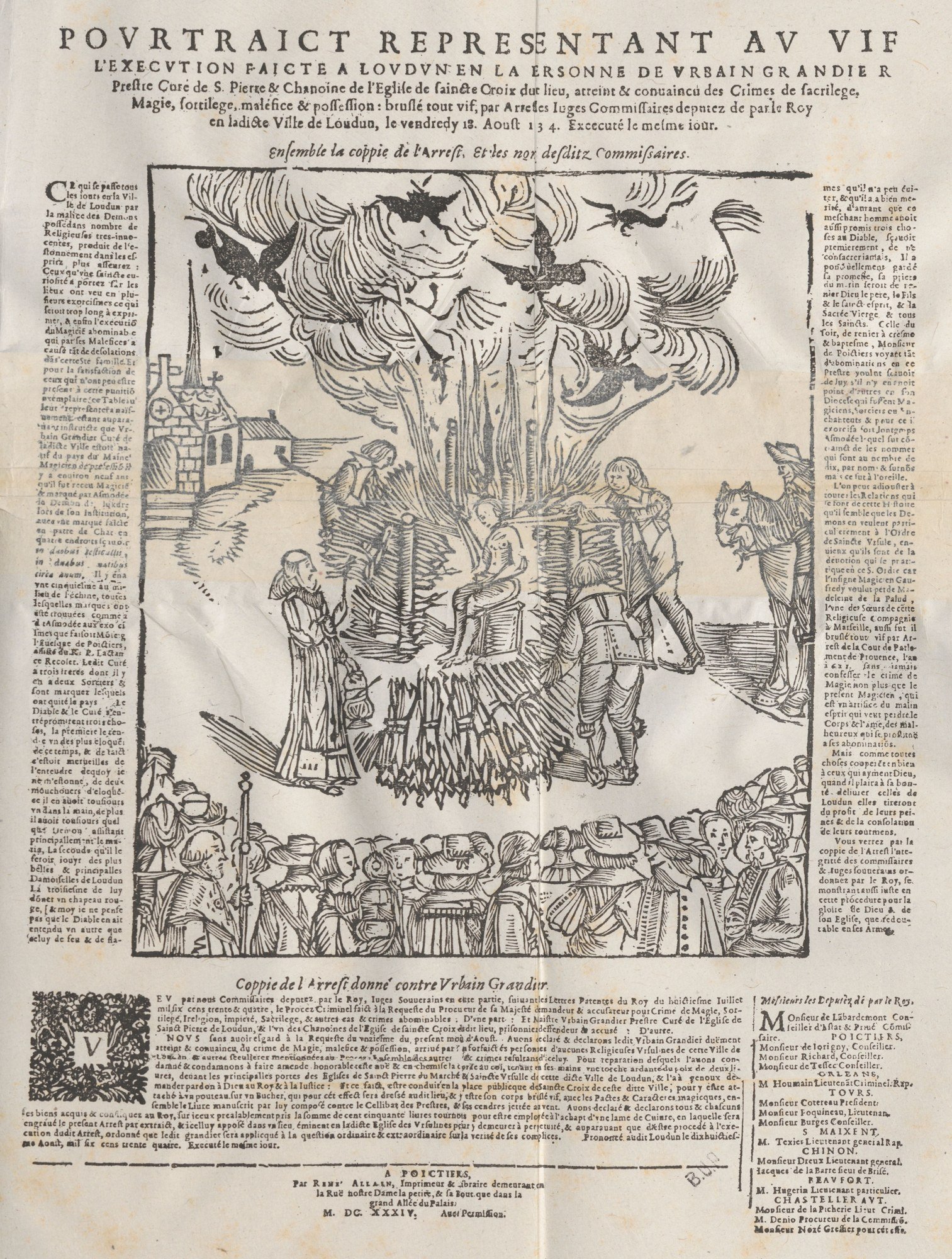
Grandier maintained his innocence under interrogation and torture. His legs were crushed in the boot, yet he refused the confession his judges sought. On 18 August 1634 he was condemned for magic, maleficence and causing possession. The sentence ordered him to perform public penance and then be burned alive with the supposed pacts and a manuscript he had written against clerical celibacy.
The Burning at Sainte-Croix
The execution drew an immense crowd to the place of Sainte-Croix. Grandier was carried through the town, bareheaded and dressed for penance. He was expected to confess before death, but witnesses recorded that he continued to deny having made any pact with demons.
At the stake, the promise that he would be strangled before the flames was not fulfilled in time. Fire rose around the priest as Capuchin friars pressed him to repent. His ashes were scattered. The man named by the devils was gone, but the possession did not end with him.
The exorcisms continued. The most celebrated sign concerned Asmodeus, who was commanded to depart from Jeanne des Anges and leave a mark upon her hand. Accounts describe sacred names appearing upon her skin, including Jesus, Mary and Joseph. She later travelled through France displaying the hand and telling the story of her deliverance.
A Convent That Would Not Fall Silent
The aftermath of Loudun spread far beyond the town. Father Jean-Joseph Surin, a Jesuit who took part in Jeanne’s exorcism, later described a terrifying reversal in which he believed the possessing spirit had turned upon him. He wrote of paralysis, interior torment and the sensation that another will moved within his body. His suffering gave the case a second haunted centre: the exorcist who entered the battle and did not leave it untouched.
Jeanne des Anges survived until 1665 and left autobiographical writings in which possession, temptation and mystical experience remained closely intertwined. The convent itself disappeared in the transformations of later centuries. The streets changed, the fortifications fell and the public square lost the scaffold that had made it infamous.
Yet Loudun left an unusually dense trail: trial papers, exorcists’ relations, medical observations, printed pamphlets, defences of Grandier and accounts written to prove that the Devil had acted openly in France. The case survived because it was never only one thing. It was a possession, a prosecution, a spectacle and a warning.
Urbain Grandier Before the Accusation
Grandier had arrived in Loudun in 1617, still a young priest but already carrying the education and confidence of a man accustomed to being heard. He became curé of Saint-Pierre-du-Marché and a canon of Sainte-Croix, offices that placed him visibly inside the religious and civic life of the town. His sermons drew listeners. His polished manners and command of language distinguished him from poorer parish clergy. They also made every scandal surrounding him more dangerous.
His reputation was never that of an austere village priest. He was accused of relationships with women, of fathering a child, and of disregarding the celibacy demanded by his office. A manuscript defending the marriage of priests was later attributed to him and would be burned with him. Some accusations came from families who believed he had dishonoured their daughters; others from clerics whom he had publicly offended. Grandier answered insult with litigation and satire, turning local quarrels into permanent enmities.
In 1630 an ecclesiastical court imposed penalties upon him after allegations of immorality, but he appealed and succeeded in having the judgment reversed. He returned to Loudun vindicated in law and more hated in practice. The acquittal did not erase the depositions gathered against him. It taught his opponents that ordinary discipline had failed.
At the same time, Loudun’s political position was changing. The town had been a Protestant stronghold, and its fortifications represented an older balance between local privilege and royal authority. Grandier opposed their demolition and had written against Cardinal Richelieu in a satire attributed to him. When Jean Martin de Laubardemont arrived with royal authority, the priest’s private enemies found themselves aligned with the machinery of the Crown.
This history matters because the demons did not name an obscure stranger. They named the most visible, disputed and vulnerable priest in Loudun. By 1632, Grandier already stood at the centre of a web of resentment dense enough to receive a supernatural accusation and carry it all the way to the stake.
Jeanne des Anges and the Enclosed World
Jeanne des Anges had been born Jeanne de Belciel in 1602 into a noble family. A childhood injury left her with a lasting physical deformity, and religious life offered both status and confinement. She entered the Ursuline order and became prioress at Loudun while still relatively young. Her later autobiography presents a woman of intense imagination, spiritual ambition and severe self-examination, capable of interpreting bodily sensation as part of an invisible struggle.
The Loudun convent was newly established and not wealthy. Many of its nuns came from respectable families unable to provide the dowries required by richer houses. The community lived under enclosure, but the walls did not isolate it from town politics. Confessors, patrons and relatives carried Loudun’s rivalries through the grille.
Jeanne had heard Grandier preach and appears to have known his reputation before the possessions. Accounts differ over whether she desired him as the convent’s director or merely considered him for the position. What is clear is that he never became confessor to the Ursulines. Jean Mignon—related to one of Grandier’s adversaries—occupied that place when the apparitions and convulsions began.
In the first phase, the nuns reported the dead Father Moussaut. The figure of a former confessor moving in the sleeping convent belonged to an old religious language of restless souls, warnings and unfinished obligations. Soon the shape was joined by touching, pressure, obscene images and compulsions that violated the women’s vows. The haunting became possession when the experiences began to speak through bodies and to identify themselves as demons.
The convent’s architecture intensified the ordeal. Cells, passages, chapel and grille created a world of thresholds. Every noise could be followed, every body watched, every episode repeated before the community. Once exorcism began, private symptoms became public signs. The women learned the names expected by demonology; the exorcists learned which gestures produced a response; and Loudun learned that something inside the convent was accusing Grandier.
The Tests of the Exorcists
Exorcists did not consider convulsion alone sufficient proof. Catholic manuals warned that illness, deception and melancholy could imitate possession. The clergy therefore sought signs that appeared to exceed natural ability: understanding unknown languages, revealing hidden objects, displaying extraordinary strength, reacting to concealed relics and speaking with knowledge unavailable to the afflicted person.
At Loudun, questions were put in Latin and sometimes in Greek. Relics were hidden beneath clothing or mixed with ordinary objects. The women were commanded to indicate where consecrated items had been placed. Witnesses recorded contortions, rigid postures and movements described as impossible without injury. Physicians signed statements concerning what they had observed, although their presence did not produce a single stable medical account of the phenomena.
The possessing spirits were arranged almost like a court. Asmodeus was repeatedly associated with Jeanne des Anges; Leviathan, Behemoth, Balaam, Zabulon and others appeared in the relations. Each was said to occupy a particular part of the body and to bear a rank, function or mark. The specificity made the invisible world seem administrative: demons confessed names, negotiated departure and were ordered to leave visible signs.
Such signs became central to the spectacle. A spirit might promise to depart on a named feast day, only to resist when the day came. It might announce that its exit would tear the skin or leave sacred words on a hand. Failure extended the rites; apparent fulfilment confirmed them. The process could therefore continue through repeated confrontations without exhausting its meaning.
The crowds did not simply watch. They prayed, shouted, pressed forward and carried reports into inns and neighbouring towns. Printed accounts transformed each ceremony into news. The convent became a destination where the invisible hierarchy of Hell was said to answer questions before magistrates and noble visitors. In an age of confessional conflict, the spectacle offered proof that Catholic rites possessed a force demons recognized and feared.
Laubardemont and the Sealed Trial
Jean Martin de Laubardemont did not arrive as a neutral magistrate. He was related to Jeanne de Barbesier, one of the nuns involved, and he served Cardinal Richelieu as an extraordinary commissioner. He had already supervised the destruction of Loudun’s fortifications. His return joined the possession case to royal justice.
Grandier was arrested in December 1633 and confined under conditions designed to prevent escape or intervention. His papers were seized. Witnesses from earlier scandals were recalled. The commission that judged him was specially constituted, and ordinary avenues of appeal were blocked. The prosecution treated the nuns’ statements, the exorcisms and allegations of sorcery as parts of one coherent crime.
Grandier demanded that the possessed women be separated and examined independently. He challenged exorcists to question the demons in languages the nuns could not know. He protested the hostility of his judges and the legal irregularity of the proceedings. His defence did not loosen the structure around him. Every denial could be interpreted as the persistence of a sorcerer protected by infernal aid.
The supposed pacts supplied the material image the trial required. One document was presented as a covenant with demons, another as an agreement written backward or signed by infernal names. Whether produced by accusers, copied from demonological models or accepted through sincere belief, the papers made an invisible conspiracy visible enough to display, archive and burn.
On 18 August 1634 the commissioners pronounced sentence. Grandier was subjected to the question extraordinaire, the crushing torture of the boots, in an attempt to obtain names of accomplices. The Loudun municipal account records that he did not confess. That refusal followed him into the square, where thousands had gathered to witness the final separation between priest and alleged masters.
The Day of Fire
The condemned man was carried on a cart through streets he had known for seventeen years. At the churches he was required to ask pardon from God, the king and justice. A rope hung around his neck. The sentence ordered the burning of his body together with magical books, the anti-celibacy manuscript attributed to him and the pacts used as evidence.
Tradition preserves scenes of struggle around his last words. Grandier attempted to address the crowd. Capuchin friars interrupted him, fearing a final speech might turn sympathy in his favour. He was promised strangulation before the fire, but the rope could not be used as intended once the flames rose. The spectacle designed to prove the defeat of a sorcerer became an extended public death.
Accounts say that pigeons circled above the pyre or descended near it, an image quickly interpreted according to the loyalties of the witness. To supporters, they suggested innocence or the departure of a soul. To enemies, any unusual movement could become one more sign of infernal attendance. Even the air above the fire was absorbed into the case.
The crowd was estimated in the thousands, with later Loudun tradition giving a figure of about six thousand. People carried away fragments and ashes. Grandier’s body disappeared, but the documents remained in official hands and the exorcisms continued under royal protection. The central paradox of Loudun began at that moment: the man identified as the author of the possession was dead, yet the forces he was accused of sending did not depart with him.
Surin, Jeanne and the Long Aftermath
Father Jean-Joseph Surin arrived in Loudun in late 1634. A Jesuit mystic of unusual intensity, he became Jeanne des Anges’s principal exorcist and spiritual director. His letters describe the work not as theatre but as direct combat. In one of the most famous passages associated with the affair, Surin wrote that the demon had passed from the possessed woman into him and that he experienced two souls struggling within one body.
Surin’s collapse lasted years. He suffered periods in which speech and movement became difficult, experienced impulses toward self-destruction and believed himself abandoned to infernal power. Those around him interpreted his condition through both spiritual and bodily language. The exorcist who had entered Loudun to command demons became, in his own testimony, another field of invasion.
Jeanne’s story moved in a different direction. She claimed deliverance through the intercession of Saint Joseph and displayed words said to have appeared on her hand. She travelled to meet Queen Anne of Austria and other powerful figures, carrying the authority of a woman who had been possessed and rescued. Her body, once used to accuse Grandier, became a relic-like witness to Catholic victory.
Possession and sanctity remained perilously close in her writings. Temptation, visions, bodily marks and divine favour occupied the same interior landscape. She was never canonized, but her autobiography allowed later generations to hear her voice outside the courtroom and the exorcists’ transcripts.
The Ursuline community survived the scandal, though its notoriety never vanished. Loudun preserved Grandier’s name in streets, local memory and archives. The alleged pact, the engravings of the execution and the printed relations gave the case an afterlife independent of the vanished convent.
What Still Lives in the Record
The documents do not preserve the sound of the voices or the exact atmosphere inside the crowded churches. They preserve something colder: names, dates, signatures, interrogations and the repeated conviction of witnesses that an intelligence hostile to the sacred had entered the convent.
Politics explains why Grandier was vulnerable. Religious conflict explains why the exorcisms became national theatre. Neither dissolves the experience recorded by the women, the priests who confronted them or the crowds who watched bodies convulse beneath relics and heard demons answer from behind human mouths.
Loudun remains frightening because the supernatural did not arrive in an abandoned ruin. It entered a disciplined religious house in daylight, before officials, physicians and thousands of spectators. By the time the fires were extinguished, one priest was dead, an exorcist believed himself invaded, and the devils of the convent had already passed into history.