On 10 March 1582, John Dee placed a question before the angel Uriel. The subject was not war, monarchy or the future of England. Dee wanted to understand a book in his library—a work he called Soyga, filled with words, magical materials and thirty-six tables whose letters seemed to resist every ordinary method of reading.
Aldaraia Sive Soyga Vocor
Dee’s catalogue records a work under the phrase Aldaraia sive Soyga vocor—Aldaraia, or I am called Soyga. The surviving manuscripts combine prayers, magical names, astrology and dense letter tables. The word Soyga has been connected through reversal to agyos, a form of the Greek word for holy. The text is mainly Latin with unusual names and constructions. The result is a body of evidence that must be read through manuscripts, catalogues and the material history of the object rather than through later legend alone.
The surviving record places this material within a precise historical world. Its exact date and authorship remain unknown.. Every copied name, altered diagram, ownership mark or change of sequence records a decision made by a reader who believed the text deserved preservation. Those decisions are often as revealing as the stated operation itself.
Even the title behaves like a cipher. It introduces a book that announces sanctity while concealing its origin. In the culture that produced it, sacred language, natural philosophy, astrology, law and ritual were not always separated by the boundaries used today. The manuscript therefore speaks from a world in which knowledge could be devotional, technical and forbidden at the same time.
Read closely, this section also explains why the subject continued to generate fear. Its authority does not depend upon a modern claim that every operation worked exactly as promised. It rests on the historical fact that scribes, collectors, judges or practitioners treated the words as consequential—important enough to copy, hide, condemn, transport or preserve across generations.
John Dee’s Library
John Dee was mathematician, astrologer, collector and adviser within Elizabethan England. His library at Mortlake became one of the largest private scholarly collections in the country. He gathered astronomy, alchemy, navigation, theology, cryptography and magic. His annotations show close reading. The result is a body of evidence that must be read through manuscripts, catalogues and the material history of the object rather than through later legend alone.
The manuscript becomes clearer when its physical details are read beside its claims. Soyga occupied him before the most famous angelic conversations with Edward Kelley.. Every copied name, altered diagram, ownership mark or change of sequence records a decision made by a reader who believed the text deserved preservation. Those decisions are often as revealing as the stated operation itself.
The manuscript did not sit in an isolated occult cabinet. It belonged to a universal library built by a man who believed all knowledge could ultimately form one sacred system. In the culture that produced it, sacred language, natural philosophy, astrology, law and ritual were not always separated by the boundaries used today. The manuscript therefore speaks from a world in which knowledge could be devotional, technical and forbidden at the same time.
Read closely, this section also explains why the subject continued to generate fear. Its authority does not depend upon a modern claim that every operation worked exactly as promised. It rests on the historical fact that scribes, collectors, judges or practitioners treated the words as consequential—important enough to copy, hide, condemn, transport or preserve across generations.
The Question to Uriel
During an angelic session in March 1582, Dee asked whether the book had belonged to Adam and whether its tables possessed meaning. The recorded answer attributed the work to revelation and warned of its difficulty. Uriel reportedly connected the book with Adam in Paradise. Dee was told that only the archangel Michael could explain parts of it. The result is a body of evidence that must be read through manuscripts, catalogues and the material history of the object rather than through later legend alone.
What appears at first to be a single mystery is actually a chain of copying, use and reinterpretation. The conversation did not yield a practical solution to the tables.. Every copied name, altered diagram, ownership mark or change of sequence records a decision made by a reader who believed the text deserved preservation. Those decisions are often as revealing as the stated operation itself.
The scene gives Soyga its unique historical force. A renowned scholar confronted a manuscript so resistant that he appealed beyond human scholarship. In the culture that produced it, sacred language, natural philosophy, astrology, law and ritual were not always separated by the boundaries used today. The manuscript therefore speaks from a world in which knowledge could be devotional, technical and forbidden at the same time.
Read closely, this section also explains why the subject continued to generate fear. Its authority does not depend upon a modern claim that every operation worked exactly as promised. It rests on the historical fact that scribes, collectors, judges or practitioners treated the words as consequential—important enough to copy, hide, condemn, transport or preserve across generations.
A Book Lost After Mortlake
After Dee’s death, his library was dispersed through theft, sale and collection. Soyga disappeared from view, surviving mainly through Dee’s catalogue and spiritual diaries. Mortlake had been damaged while Dee travelled. Manuscripts passed into later collections. The result is a body of evidence that must be read through manuscripts, catalogues and the material history of the object rather than through later legend alone.
The archive preserves both the ambition of the text and the limitations of what can now be known. Nineteenth- and twentieth-century historians knew the title but could not identify the book.. Every copied name, altered diagram, ownership mark or change of sequence records a decision made by a reader who believed the text deserved preservation. Those decisions are often as revealing as the stated operation itself.
The loss turned a difficult manuscript into a vanished object. For centuries, the tables existed only as the memory of a problem Dee had failed to solve. In the culture that produced it, sacred language, natural philosophy, astrology, law and ritual were not always separated by the boundaries used today. The manuscript therefore speaks from a world in which knowledge could be devotional, technical and forbidden at the same time.
Read closely, this section also explains why the subject continued to generate fear. Its authority does not depend upon a modern claim that every operation worked exactly as promised. It rests on the historical fact that scribes, collectors, judges or practitioners treated the words as consequential—important enough to copy, hide, condemn, transport or preserve across generations.
Rediscovered in Two Libraries
In the 1990s, scholar Deborah Harkness identified two manuscript copies: one in the Bodleian Library and another in the British Library. Neither had been catalogued under the name by which Dee knew it. Bodleian MS Bodley 908 and British Library Sloane MS 8 contain versions of the text. The tables match Dee’s descriptions. The result is a body of evidence that must be read through manuscripts, catalogues and the material history of the object rather than through later legend alone.
The surviving record places this material within a precise historical world. Differences reveal scribal transmission and errors.. Every copied name, altered diagram, ownership mark or change of sequence records a decision made by a reader who believed the text deserved preservation. Those decisions are often as revealing as the stated operation itself.
Rediscovery did not end the mystery. It restored the actual object and made the tables available for a new kind of attack. In the culture that produced it, sacred language, natural philosophy, astrology, law and ritual were not always separated by the boundaries used today. The manuscript therefore speaks from a world in which knowledge could be devotional, technical and forbidden at the same time.
Read closely, this section also explains why the subject continued to generate fear. Its authority does not depend upon a modern claim that every operation worked exactly as promised. It rests on the historical fact that scribes, collectors, judges or practitioners treated the words as consequential—important enough to copy, hide, condemn, transport or preserve across generations.
Thirty-Six Tables of Letters
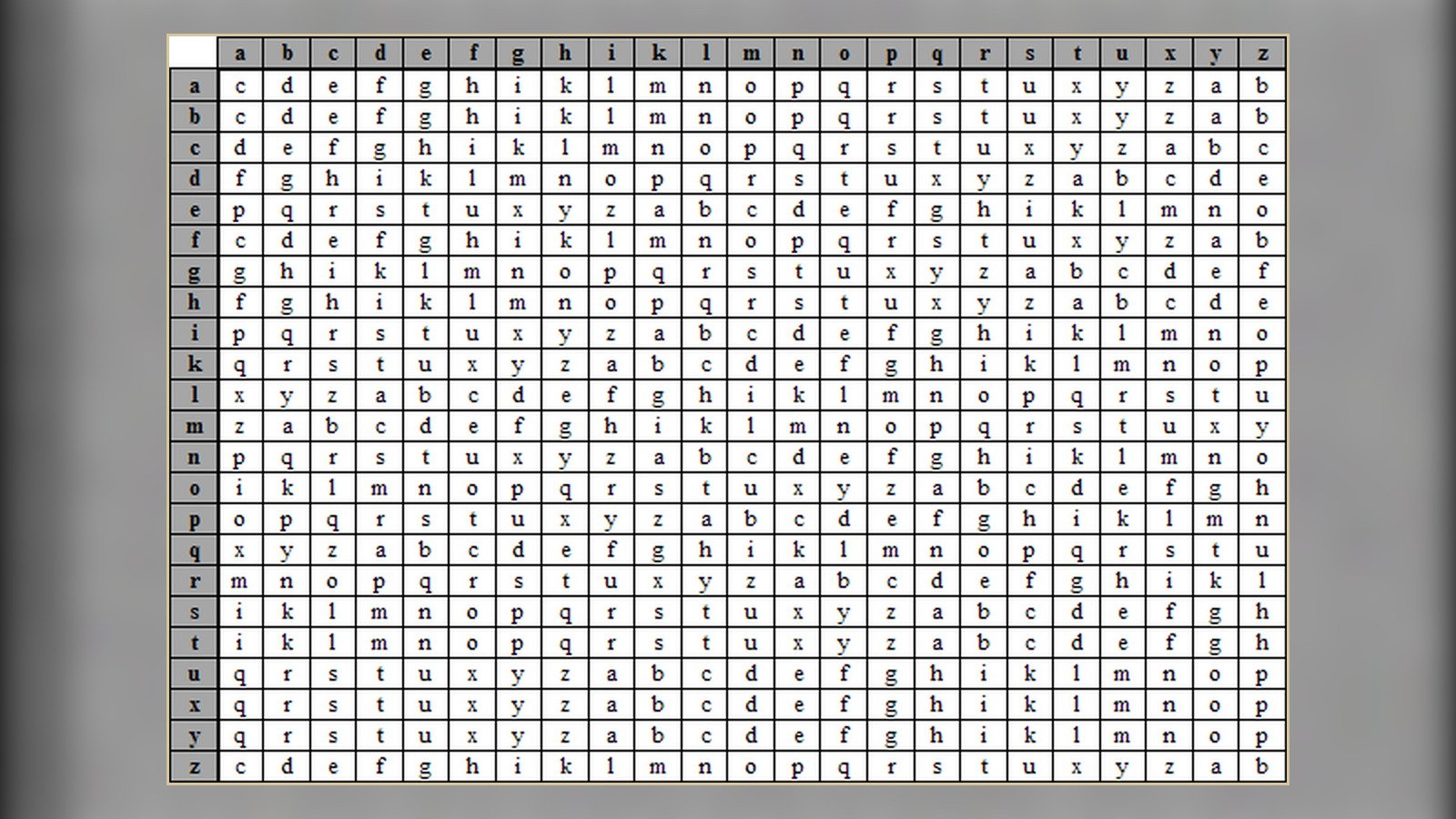
The most famous section contains thirty-six square tables, each formed as a grid of thirty-six by thirty-six letters. The result is more than forty-six thousand letters arranged with oppressive regularity. Each table is associated with a seed word. Headings connect groups with zodiacal or planetary frameworks. The result is a body of evidence that must be read through manuscripts, catalogues and the material history of the object rather than through later legend alone.
The manuscript becomes clearer when its physical details are read beside its claims. Repeated patterns appear without producing ordinary language.. Every copied name, altered diagram, ownership mark or change of sequence records a decision made by a reader who believed the text deserved preservation. Those decisions are often as revealing as the stated operation itself.
The tables are visual walls. Their meaning, if semantic meaning was intended, is buried beneath an algorithmic surface. In the culture that produced it, sacred language, natural philosophy, astrology, law and ritual were not always separated by the boundaries used today. The manuscript therefore speaks from a world in which knowledge could be devotional, technical and forbidden at the same time.
Read closely, this section also explains why the subject continued to generate fear. Its authority does not depend upon a modern claim that every operation worked exactly as promised. It rests on the historical fact that scribes, collectors, judges or practitioners treated the words as consequential—important enough to copy, hide, condemn, transport or preserve across generations.
Jim Reeds and the Construction Algorithm
Mathematician and cryptographic historian Jim Reeds discovered a procedure capable of generating the tables from their seed words. His work showed that the arrays were constructed systematically rather than at random. The algorithm uses recurring letter sequences and positional rules. Manuscript errors can be identified by comparison. The result is a body of evidence that must be read through manuscripts, catalogues and the material history of the object rather than through later legend alone.
What appears at first to be a single mystery is actually a chain of copying, use and reinterpretation. Construction does not automatically reveal a hidden message.. Every copied name, altered diagram, ownership mark or change of sequence records a decision made by a reader who believed the text deserved preservation. Those decisions are often as revealing as the stated operation itself.
The discovery solved one question and deepened another. We can know how the walls were built without knowing what chamber they were meant to enclose. In the culture that produced it, sacred language, natural philosophy, astrology, law and ritual were not always separated by the boundaries used today. The manuscript therefore speaks from a world in which knowledge could be devotional, technical and forbidden at the same time.
Read closely, this section also explains why the subject continued to generate fear. Its authority does not depend upon a modern claim that every operation worked exactly as promised. It rests on the historical fact that scribes, collectors, judges or practitioners treated the words as consequential—important enough to copy, hide, condemn, transport or preserve across generations.
The Text Beyond the Tables
Soyga also contains material on astrology, demonology, magical names and the ordering of days. Focusing only on the cipher risks losing the manuscript’s wider intellectual body. Lists and prayers connect language with celestial structure. Magical operations sit beside speculative material. The result is a body of evidence that must be read through manuscripts, catalogues and the material history of the object rather than through later legend alone.
The archive preserves both the ambition of the text and the limitations of what can now be known. The book shares interests with other late medieval and Renaissance compilations.. Every copied name, altered diagram, ownership mark or change of sequence records a decision made by a reader who believed the text deserved preservation. Those decisions are often as revealing as the stated operation itself.
The tables are the climax of a worldview in which letters, stars and sacred order can mirror one another. In the culture that produced it, sacred language, natural philosophy, astrology, law and ritual were not always separated by the boundaries used today. The manuscript therefore speaks from a world in which knowledge could be devotional, technical and forbidden at the same time.
Read closely, this section also explains why the subject continued to generate fear. Its authority does not depend upon a modern claim that every operation worked exactly as promised. It rests on the historical fact that scribes, collectors, judges or practitioners treated the words as consequential—important enough to copy, hide, condemn, transport or preserve across generations.
What the Tables Still Withhold
No consensus has established that the arrays encode a continuous hidden text. They may function as talismanic structures, demonstrations of combinatorial order or ritual objects whose power lies in construction. Dee’s question remains historically central. The algorithm explains manufacture. The result is a body of evidence that must be read through manuscripts, catalogues and the material history of the object rather than through later legend alone.
The surviving record places this material within a precise historical world. The intended use and full symbolic system remain uncertain.. Every copied name, altered diagram, ownership mark or change of sequence records a decision made by a reader who believed the text deserved preservation. Those decisions are often as revealing as the stated operation itself.
Soyga survives as a rare mystery that became more exact without becoming less mysterious. The archive returned the book, mathematics returned its method, and the tables still refuse to speak plainly. In the culture that produced it, sacred language, natural philosophy, astrology, law and ritual were not always separated by the boundaries used today. The manuscript therefore speaks from a world in which knowledge could be devotional, technical and forbidden at the same time.
Read closely, this section also explains why the subject continued to generate fear. Its authority does not depend upon a modern claim that every operation worked exactly as promised. It rests on the historical fact that scribes, collectors, judges or practitioners treated the words as consequential—important enough to copy, hide, condemn, transport or preserve across generations.
The Manuscript as Witness
The enduring importance of Book of Soyga lies in the convergence of text and object. A title alone cannot show how the work changed: one must examine handwriting, parchment or paper, pigments, bindings, ownership notes, omissions and the order in which separate texts were placed together. These details reveal whether a copy was made for use, collection, instruction, defence or concealment. They also show why modern printed editions, however valuable, can create the illusion of a stable book where the historical record preserves a family of changing witnesses.
Institutional catalogues have become essential to this reconstruction. Shelf marks that appear dry or technical are the coordinates of survival. They identify the exact volume, distinguish one recension from another and prevent famous titles from absorbing unrelated material. For SatanWorld, those catalogue identities are treated as part of the story: the route from private hand to royal cabinet, confiscated collection, antiquarian sale or national library explains how forbidden knowledge crossed the centuries.
The visual record is equally important. A circle, initial, seal, table or miniature cannot be replaced by a verbal summary without loss. Images determine the pace of reading and often carry information that the words do not explain. For that reason, this article presents historical images with their holding institution and reuse status, while original editorial diagrams are clearly identified as modern explanatory work rather than manuscript facsimiles.
What the Darkness Preserved
The Book of Soyga and John Dee’s Lost Tables belongs to forbidden history because the work survived a repeated conflict over who could possess knowledge and by what authority. The danger attributed to it changed with time: demonic assistance, unauthorised revelation, unlawful prosecution, secret communication, intellectual pride or the fear that a diagram might make inaccessible power portable. Yet each generation that feared the material also helped define and preserve it.
The final mystery is therefore not only whether a spirit appeared, a talisman received celestial force or a prayer transformed memory. It is why human beings continued to copy these instructions when copying was slow, possession could be dangerous and many of the names were barely understood. The answer lies somewhere between faith, ambition and the refusal to accept that the visible world contains all available knowledge.