On 28 July 1900, four sisters walking near the garden of Borley Rectory saw a woman dressed as a nun. They called to her. The figure did not answer, and the path before them held no living visitor.
The Rectory Opposite the Church
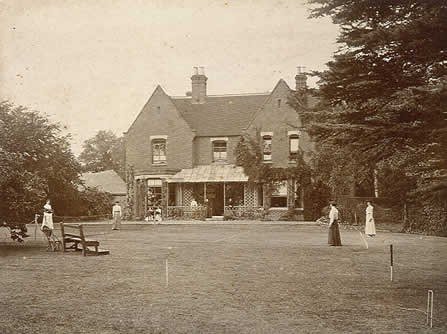
Borley Rectory was built in 1863 for Reverend Henry Dawson Ellis Bull. It stood opposite the parish church near the Essex-Suffolk border, a large red-brick house of twenty-three rooms, three staircases and almost four acres of grounds.
The building was young compared with the medieval churches and manor houses around it, yet stories attached themselves quickly. A local legend spoke of a monk and a nun punished for attempting to flee together. Another told of a phantom coach and horses passing at night. Whether older than the rectory or shaped around it, the legends gave the property a memory deeper than its walls.
Servants and visitors described footsteps where no one walked, stones appearing from nowhere and objects moving without visible hands. A schoolmaster who stayed during the 1880s later claimed he saw the nun several times and heard a coach clattering past.
The Nun in the Garden
The best-known early sighting came in 1900. Ethel, Freda, Mabel and Dodie Bull saw a dark female figure near the garden. She appeared to be wearing the habit of a nun. When challenged, she remained silent and disappeared from view.
Later witnesses included a gardener, a carpenter, a village girl and a reporter. The apparition was usually seen at a distance, moving along what became known as the Nun’s Walk. She did not rush or threaten. Her power lay in repetition: the same mournful shape returning to the same ground.
Another legend eventually gave her a name, Marie Lairre, a French nun said to have been murdered and buried near the rectory. The identity emerged most clearly during later séances, when a communicating presence claimed she had been killed at Borley.
The Smiths Hear the House
Reverend Guy Eric Smith and his wife Mabel moved into the rectory in 1928 without knowing the full extent of its reputation. They soon reported servants’ bells ringing without cause, shadowy forms and whispered words.
Local people were reluctant to enter the property. The Smiths contacted the Daily Mirror, hoping an investigator might explain or quiet the disturbances. The newspaper brought Harry Price, director of the National Laboratory for Psychical Research, to Borley on 12 June 1929.
That night a glass roof broke, a red candlestick shattered and pebbles were thrown. Raps answered from the wooden frame of a mirror during a séance in the Blue Room. Price had arrived to examine a haunted reputation; by dawn he had become part of it.
The Foyster Years
In October 1930, Reverend Lionel Foyster moved in with his wife Marianne and their young adopted daughter Adelaide. The intensity of the reports increased. Price later claimed that approximately two thousand incidents were recorded during the Foyster period.
The house produced footsteps, whispers, bells, raps, scents of perfume and incense, thrown stones, bottles and household objects, doors that locked and unlocked, broken windows, overturned furniture, small fires and writing that appeared on walls and paper.
Marianne was said to have been thrown from bed and locked inside rooms. A phantom hand was reported. Wine became ink. A bottle descended the staircase. Messages appeared to address Marianne directly, pleading for help or asking her to obtain Masses.
Lionel recorded events in a Diary of Occurrences. The phenomena seemed to cluster around Marianne, yet visitors also reported stone-throwing and bells. The rectory did not behave as a single ghost story. It behaved like a house in which every system—doors, wires, windows, fire and sound—had become capable of answering an unseen will.
Harry Price Takes the House
After the Foysters left in 1935, Borley stood empty. In 1937 Price rented it for a year and appealed through The Times for volunteers. Forty-eight official observers were selected, among them a doctor, an army colonel and engineer Sidney Glanville.
The observers stayed in the house with instructions, equipment and marked objects. Reports described footsteps, knocks, temperature changes and minor movements. Glanville’s daughter Helen used a planchette and received communications from a presence calling herself Marie Lairre.
The spirit said she had been murdered at Borley and buried on the property. Another communication predicted that the house would burn and that the bones of a murdered person would be revealed. The words seemed to place the spectral nun inside a complete history of violence and unfinished burial.
The Fire of 1939
Captain William Hart Gregson purchased the rectory in late 1938. On the night of 27 February 1939, an oil lamp overturned and fire spread through the building. Villagers gathered as flames consumed the roof and upper rooms.
Some witnesses said they saw figures at the windows while the rectory burned. The building was left a blackened shell, but the haunting reports did not end. Vigils continued in the ruins. Investigators recorded strange sounds and sudden cold.
In 1943, excavations supervised by Price uncovered a female human jawbone, medallions and other objects. Price believed the discovery supported the story of a murdered woman. The remains were later buried with ceremony, yet the identity of the person to whom the bone belonged was never securely established.
The Ruin and the Church
Borley Rectory was demolished in 1944. During the destruction, a photograph was taken that Price interpreted as a brick suspended in the air. With the house gone, reports shifted toward the churchyard, the church and the surviving grounds.
Visitors continued to describe footsteps, lights and apparitions. The phantom coach remained part of local memory. The nun outlived the building in which she had never truly been confined.
Price died in 1948, leaving books, photographs, witness statements, correspondence, plans and a vast archive. His role ensured that Borley would be examined, disputed and remembered on a scale few hauntings ever achieve.
The Bull Family and the Birth of the Haunting
Reverend Henry Dawson Ellis Bull built Borley Rectory to house a large clerical family beside the ancient church of St Mary. The residence was completed in the early 1860s, its red brick, pointed gables and irregular wings giving it the appearance of a house older than it was. With numerous children, servants, guests and parish duties, the rectory was never an empty mansion. Its first ghost stories emerged from a crowded family home.
The Bulls spoke of footsteps, servant bells and a dark figure moving beyond the lawn. Several children later remembered seeing a nun along a path near the summerhouse. The apparition’s route became so familiar that the family called it the Nun’s Walk and reportedly watched for her from a window. Their accounts established the pattern later witnesses inherited: the figure appeared outside, at a distance, and vanished when approached.
A phantom coach and horses also entered the tradition. Wheels were heard on the road or in the grounds, sometimes accompanied by the impression of a carriage arriving where no vehicle stood. Such imagery belonged naturally to rural Essex, where dark lanes and the sound of real traffic could carry far at night. At Borley, however, the coach became part of a specific invisible population that included the nun, a headless man and footsteps crossing locked rooms.
The legend of the murdered nun was elaborated over time. In its fullest form, a monk from a religious house near Borley fell in love with a nun from a nearby convent. Their attempted escape ended in capture; the monk was executed and the woman walled alive. No contemporary monastic document has been produced to secure this story, yet it supplied the haunting with a medieval crime long before the planchette named Marie Lairre.
When four Bull sisters reported seeing the nun on 28 July 1900, the apparition was already part of family expectation. Their collective sighting gave the legend a dated scene and multiple witnesses. They called to the figure from the garden. It did not answer. In later recollection, the woman moved with the silence of someone repeating a route rather than entering it for the first time.
The Smiths and the Daily Mirror
Guy and Mabel Smith arrived in 1928 to find a house that was difficult to heat, expensive to maintain and surrounded by stories the village knew better than they did. During cleaning, Mabel reportedly discovered a human skull in a cupboard, said to have been brought from elsewhere. Whether or not it belonged to the property, its presence placed a literal remnant of the dead inside the new rector’s household.
The Smiths heard bells ring after their wires had been examined, saw unexplained lights and felt the pressure of a reputation that discouraged servants. Mabel wrote to the Daily Mirror, not to advertise a haunting but to ask for help. The newspaper sent a reporter and contacted Harry Price, already known for investigating mediums and psychic claims with laboratory equipment.
Price’s first visit on 12 June 1929 became a foundational night. Stones and small objects were thrown. A mirror frame produced raps. A candlestick and other items fell or broke. The activity seemed to intensify in the presence of the investigator, an effect that would follow him throughout the controversy.
Newspaper coverage made Borley nationally visible. Visitors arrived at the gate. The Smiths, increasingly uncomfortable with both the house and its fame, left in 1929. Their short residence linked the older Bull stories to the era of mass media. From then on, every disturbance occurred beneath the shadow of England’s newspapers.
The Foyster Diary
Lionel Foyster, a cousin of the Bull family, accepted the living in 1930 and moved into the rectory with Marianne and their adopted daughter Adelaide. Lionel was older and often ill. Marianne was younger, socially restless and increasingly isolated in the large rural house. Their marriage would become inseparable from the haunting’s most violent phase.
Lionel kept a Diary of Occurrences in which he listed bells, footsteps, thrown objects and assaults. Stones appeared indoors. Keys vanished. Doors locked against occupants. Glass broke. Small fires began in different parts of the house. Writing appeared on walls in faint pencil-like lines, including appeals commonly read as “Marianne, please help get” and “Marianne light mass prayers.”
The messages gave the house a need as well as a menace. The presence seemed to ask Marianne for assistance, light and Masses, as though a trapped soul were trying to complete a sentence through damaged plaster. Other events were openly hostile. Marianne said she was struck, thrown from bed and held inside rooms. Lionel described objects arriving from directions no observer occupied.
Visitors reported incidents, but the phenomena often centred upon Marianne. Her complicated personal life later became ammunition for those who believed she engineered at least part of the activity. Yet the Foyster record cannot be reduced to one witness. Clergy, friends and investigators described sounds or movement, and Lionel’s diary preserves the bewilderment of a man attempting to catalogue a household that no longer obeyed him.
An exorcism was attempted. Lionel said the rite was interrupted by stones, noises and the striking of the officiating priest. Blessings and prayers brought no permanent release. By 1935, illness and pressure forced the Foysters to leave. The rectory stood empty, carrying wall messages that seemed to wait for another reader.
Price’s Year of Observation
Harry Price leased Borley Rectory from May 1937 to May 1938 and turned it into what he called the most haunted house in England. Through The Times, he sought responsible observers willing to spend nights in the building. Applicants were screened, given instructions and supplied with report forms, floor plans and equipment.
The “official observers” included professionals, military men, students and members of the public. They were told to note times, weather, room positions and physical sensations. Some stayed for days and encountered nothing. Others recorded footsteps, bells, shadows, drops in temperature, movement of objects and unexplained lights.
Price marked or sealed items and experimented with powders, cameras and controlled rooms. The procedures were not equivalent to a modern continuous surveillance system, but they represented an attempt to impose order on a sprawling empty house. The resulting case files became part of the Harry Price Library, preserving both dramatic claims and long stretches of uneventful watching.
Sidney Glanville, an engineer and one of Price’s trusted collaborators, became deeply involved. His daughter Helen used a planchette and produced communications attributed to Marie Lairre. The name gave the spectral nun a French identity and a story of murder on the property. Another communicator, “Sunex Amures,” predicted that the rectory would burn and that the bones of a murdered person would be discovered.
The prophecy was not fulfilled exactly as written, yet fire and bones later entered the physical history of Borley. This sequence became one of the reasons the case felt as though its legends could move forward through time, preparing later events before they occurred.
Fire in the Rectory
Captain W. H. Gregson purchased Borley Rectory in 1938. On 27 February 1939, while unpacking books in the library, he overturned an oil lamp. Flames spread rapidly through the dry interior, climbing staircases and consuming the roof. Villagers, firefighters and onlookers watched the house become a burning silhouette opposite the church.
Several witnesses later said they saw the figure of a nun or a woman at an upper window during the fire. The image repeated the earliest Borley motif at the moment of destruction: a silent female shape framed by the house, visible to those outside and unreachable within.
The fire did not end investigation. Price returned to the ruin. Vigils were held among blackened walls. Photographs showed debris and, in one famous frame taken during demolition, a brick apparently suspended in mid-air. The ruined structure became more visually Gothic than the occupied rectory had ever been, fixing Borley in the public imagination as a skeletal house open to the sky.
The Search Beneath the Ground
Price believed the planchette messages pointed toward a burial. Excavations in 1943 beneath the cellar and surrounding ground produced a female jawbone and other small bones, together with medals and objects whose relationship to the rectory was uncertain. The fragment was examined and judged human, possibly belonging to a young woman.
No complete skeleton or secure identity was established. Price nevertheless arranged for the remains to be buried in the churchyard at nearby Liston after Borley’s rector declined to receive them. A stone commemorated “the mortal remains of a young woman,” giving ceremonial rest to the person the haunting had never conclusively named.
The burial joined archaeology to legend. Marie Lairre had emerged through a planchette; the jawbone emerged from the earth. Between them lay a gap the archive could not close. For believers, the discovery suggested that the house had revealed part of its secret. For the story itself, that suggestion was enough to endure.
The Price Archive and the Battle for Borley
After Price’s death in 1948, his papers entered the University of London. The archive includes correspondence, photographs, observer reports, press cuttings, plans and material connected to the rectory. It makes Borley one of the most heavily documented hauntings in Britain, even though documentation does not mean agreement.
In 1956, the Society for Psychical Research published a critical study by Eric Dingwall, Kathleen Goldney and Trevor Hall. They challenged many claims, questioned witnesses and accused Price of shaping the legend. Defenders answered that the report treated hostile testimony more generously than favourable evidence and did not erase events predating Price.
The controversy became another haunting layer. Borley was no longer only a place where a nun walked; it was a contested archive in which investigators accused one another across decades. Every photograph, diary entry and wall message acquired two lives—one as evidence of the unknown, another as evidence in the struggle over Harry Price.
The rectory was demolished in 1944, but St Mary’s Church, the road and portions of the surrounding landscape remain. Reports migrated to the churchyard and the former grounds. Visitors came seeking a building they could no longer enter, proving that a haunted house can continue to occupy space after its last wall has fallen.
The House That Became a Legend
Borley Rectory’s reputation was created by accumulation. One sighting alone could fade. One unexplained bell might be forgotten. At Borley, generations added footsteps, figures, stones, writings, fragrances, fires and voices to the same address.
The building no longer stands, but the archive is extensive enough to reconstruct its rooms and follow the observers who waited inside them. The record contains disagreement and accusation, yet it also contains witnesses whose reports began before Harry Price arrived and continued after the rectory burned.
The spectral nun remains the perfect emblem of Borley: distant, silent and never held long enough to be understood. The house was destroyed, the bones were buried and the garden divided. Still, on the road opposite the church, England’s most haunted house occupies an empty place that has never felt entirely vacant.