On Friday, 13 June 1788, seven clergymen gathered in the vestry room of Temple Church in Bristol around a tailor from Yatton. George Lukins had spent nearly eighteen years in seizures, barking cries and voices that claimed to be infernal. When the ministers began to pray, the man answered in several tones and sang what witnesses called a Te Deum to the Devil. The rite continued for two hours.
The Yatton Demoniac
George Lukins lived in Yatton, Somerset, a village southwest of Bristol. He worked as a tailor and was known locally long before his case reached the newspapers. The printed narrative issued in 1788 stated that he had been afflicted for nearly eighteen years. That duration made his condition more than a sudden spectacle. It had become part of village memory.
Accounts placed the beginning around 1770. Lukins was said to have been involved in a Christmas entertainment or pageant when an incident left him senseless. Afterward came fits, strange sounds and violent movements. He cried like animals, sang in altered voices and declared himself tormented by evil spirits.
The manifestations were not confined to one witness. Neighbours, clergy and medical men heard of them. Some visited. The case divided Yatton between those who believed Lukins genuinely afflicted and those who considered the performances an imposture. That conflict would follow him into print, but it did not prevent ministers from preparing an exorcism.
Eighteen Years of Seizure
The published supporters of Lukins described attacks that returned in cycles. His body convulsed; his face and posture changed; sounds emerged that seemed impossible to reconcile with the quiet tailor known between episodes. He barked like a dog, made animal cries and spoke obscenities or blasphemies.
Most disturbing were the multiple voices. Observers claimed that different tones succeeded one another, as if several speakers occupied the same body. The number seven became central. Lukins reportedly declared that seven devils possessed him and that seven clergymen would be required for his deliverance.
The case thus carried its own ritual demand. It was not enough for one priest to pray privately. The possessing powers announced a number, and supporters interpreted that announcement as an instruction. The eventual gathering at Bristol was shaped around it.
Joseph Easterbrook Hears the Case
The Reverend Joseph Easterbrook, vicar of Temple Church in Bristol, became the principal clerical organizer. He listened to reports, observed Lukins and corresponded with others who knew the sufferer. Easterbrook later defended the authenticity of what occurred in the vestry.
He did not act alone. The surviving narrative was compiled from manuscripts attributed to several attendees and prefaced by a letter signed with the initials W. R. W., identified in catalogues as William Robert Wake. Multiple editions appeared rapidly in 1788, evidence of the public hunger surrounding the event.
Easterbrook faced a Church of England in which formal exorcism had an uncertain place. Protestant suspicion of superstition existed beside biblical accounts of demonic possession. To pray for Lukins was to take scripture literally in an age increasingly proud of reason.
The Journey to Bristol
Lukins was brought from Yatton to Bristol for the appointed meeting. Temple Church, with its leaning tower and old parish history, stood amid the commercial city. The rite was held not before a vast public congregation but in the vestry room, a contained space adjoining the church’s official life.
Seven ministers assembled. The exact lists vary across retellings, but the number was deliberate. Easterbrook led the confrontation. Witnesses were present to observe and later authenticate the proceedings.
The date was Friday, 13 June 1788. The association of Friday the thirteenth with misfortune had not yet taken its modern form, but the coincidence has given the case a darker resonance in later memory. What mattered to those inside was the claim that years of oppression might end before the day was over.
The Voices in the Vestry
As prayer began, Lukins entered violent convulsion. The narrative describes an extraordinary succession of sounds. The voices cursed and blasphemed. They answered the ministers and seemed to resist commands issued in the name of Christ.
At one point, witnesses said the entities sang a “Te Deum to the Devil.” The phrase inverted one of Christianity’s ancient hymns of praise. Instead of honouring God, the voices produced a demonic parody in different tones. The effect within the vestry must have been overwhelming: trained clergy listening to a single man appear to form an infernal choir.
The ministers continued. Hymns and prayer were answered by screams, howling and bodily struggle. Lukins was commanded to renounce the spirits. The possessing voices declared identities associated with the Devil and resisted departure.
The Command to Depart
The rite lasted approximately two hours according to the published account. Easterbrook and the other ministers prayed over Lukins and commanded the evil spirits to leave. The confrontation reached its height in a final series of cries.
Then the tone changed. The voices were said to depart with howling. Lukins became calm and joined the ministers in praise. Those present interpreted the transition as deliverance. The man who had been seized for almost eighteen years stood released in the vestry.
The moment was described not as a gradual medical improvement but as a spiritual break. Years of manifestations ended at the command. The number of ministers matched the number the spirits had demanded. To believers, every part of the sequence confirmed the nature of the affliction.
The Printed Narrative
News travelled quickly. Sarah Farley’s Bristol newspaper reported the event on 21 June. Pamphlets followed. A Narrative of the Extraordinary Case of Geo. Lukins appeared in several editions during 1788, its title emphasizing both the near-eighteen-year possession and the deliverance in Temple Church.
The work named witnesses, included letters and presented itself as an authenticated record. Its small physical size—roughly two dozen pages—contrasted with the scale of the claim. Readers could purchase the story of seven devils in a form designed for rapid circulation.
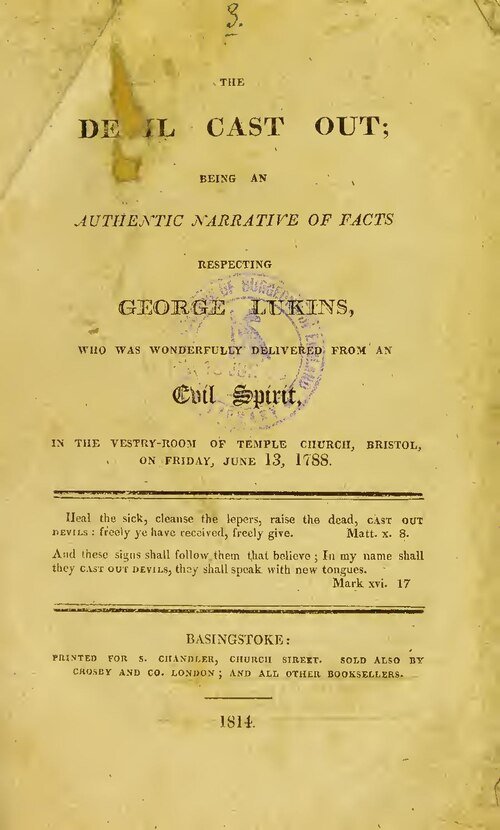
A later version, The Devil Cast Out, continued to reproduce the case. Wellcome Collection preserves an 1814 copy under a public-domain mark. The survival of these editions allows the chronology to be traced through documents produced close to the event.
The Counterattack in Print
Samuel Norman, a surgeon at Yatton, challenged the possession and accused Lukins of deception. His Authentic Anecdotes presented an opposing history, describing the tailor as a ventriloquist and connecting the fits to accusations against vulnerable neighbours. Easterbrook answered with an appeal defending Lukins from the charge of imposture.
The controversy was fierce because more than one man’s reputation was at stake. If Lukins had deceived the ministers, the exorcism exposed clergy to ridicule. If the possession was real, the critics had mocked a deliverance accomplished through prayer.
SatanWorld does not need to interrupt the story with a modern verdict. The disagreement belongs to the testimony itself. The supportive narrative and the hostile pamphlet emerged in the same year, showing how terrifying and divisive the vestry scene appeared to contemporaries.
The Bodies of the Witnesses
The strongest feature of the Lukins archive is its attention to those present. The case did not depend upon a tale remembered generations later. Ministers signed or supplied statements. Easterbrook attached his name to the account. Critics responded while witnesses could still answer.
For believers, the multiplicity of observers made the voices difficult to dismiss. They had heard tones, songs and blasphemies within a small room. They watched the transition from convulsion to calm. Their religious training made them aware of the gravity of claiming exorcism.
The vestry also limited the physical space. The sound did not echo through an unknown ruin. It came from a man surrounded by educated adults who had gathered specifically to test whether prayer would free him.
Seven as an Occult Number
The number seven carried scriptural force. The Gospels described Mary Magdalene as one from whom seven demons had gone out. Seven also marked completeness in biblical symbolism: days of creation, seals, trumpets and churches. Lukins’s claim therefore placed his affliction inside a recognizable sacred pattern.
Seven ministers confronting seven devils created an ordered opposition. The rite seemed structured before it began, as if the possessing force had disclosed the conditions of its own defeat. Later retellings naturally emphasized this symmetry.
The number also explains why the case remained memorable when many other eighteenth-century seizures faded. It supplied a title, an image and a ritual architecture: one man, seven voices, seven clergy and one afternoon of deliverance.
Temple Church After the Exorcism
Temple Church survived the eighteenth century but was later heavily damaged during the Bristol Blitz. Its leaning tower remains one of the city’s landmarks. The vestry room of 1788 belongs to a building altered by war and restoration, yet the place continues to anchor the narrative.
Yatton also preserves the local memory of Lukins. He was not an abstract “demoniac.” He was a tailor known in a specific village, carried along roads to a specific Bristol church. The geography gives the account its documentary weight.
Later histories of Bristol recorded the controversy, repeating the description of convulsions, multiple voices and the infernal hymn. The event became part of the city’s annals as well as occult history.
What Became of George Lukins
The supportive account declared Lukins delivered. Later details of his life are less richly preserved than the exorcism itself, but the central claim was that the long cycle of possession ended in the vestry. The narrative’s purpose was not simply to frighten. It was to testify that spiritual authority had prevailed.
That ending separates Lukins from cases in which the victim died or remained confined. He walked out as evidence of victory. The ministers did not present a partial improvement. They announced a casting out.
The image that remained was therefore double: the terror of the voices and the sudden silence after command. Without that silence, the pamphlet would have been only a catalogue of affliction. With it, the story became an English exorcism narrative.
The Voice That Should Not Have Fit
At the heart of the case is a problem of sound. A human throat produced animal cries, blasphemies, distinct tones and a parody of sacred music. Supporters believed the variety exceeded ordinary performance. Critics used the language of ventriloquism. The witnesses inside Temple Church believed they heard more than one presence.
The frightening quality lies in the mismatch between body and voice. Lukins remained visibly one man. The room reportedly heard a company. Every possession story turns upon this displacement, but the Yatton case made it explicit in the number seven.
Printed pages cannot reproduce what the ministers heard. They can preserve their descriptions, the date, the room and the sequence of prayer. The silence after the howling must be imagined. For the men who signed their names to the account, it was the sound of deliverance.
An English Possession at the Edge of Modernity
The year 1788 stood close to revolutions in politics, science and public thought. Bristol was a major commercial city. Surgeons argued from professional authority; newspapers converted local events into public controversy. Yet within that modernizing world, clergy gathered to cast out devils in the name of scripture.
Lukins endures because the case refuses the comfortable belief that possession belonged only to medieval monasteries. It occurred in the age of print, before critics who answered immediately and within reach of urban institutions.
Whether remembered as miracle, controversy or occult confrontation, the event remains fixed to Friday, 13 June. Seven ministers entered the vestry with a man said to contain seven spirits. Two hours later, they declared that the spirits had gone.
The Christmas Incident
The earliest narratives connected Lukins’s affliction with a village Christmas performance. He was said to have taken part in a customary entertainment when he suddenly collapsed or became violently unwell. The exact description varies among the pamphlets, but supporters treated the episode as the opening through which the later torment entered.
Seasonal drama already involved masks, noise and the temporary reversal of ordinary roles. After the incident, Lukins’s own body seemed to become a stage he could no longer close. Animal cries replaced festive performance. Fits returned beyond the holiday. What began before neighbours as public entertainment became a private affliction lasting years.
The contrast mattered to later readers. A tailor who had once imitated or performed now produced voices that supporters insisted were not imitation. Critics seized upon the theatrical beginning as evidence of skill. Believers saw a moment of vulnerability followed by genuine invasion.
Testing the Man Before the Rite
Before the Bristol gathering, Lukins had been observed in Yatton by people who approached him with different expectations. Clergymen listened for signs resembling the Gospel accounts. Medical critics watched the mechanics of the voice and body. Neighbours measured the attacks against years of ordinary acquaintance.
The supportive pamphlets stressed that Lukins did not profit comfortably from the condition. His reputation, work and social standing were damaged. His fits exposed him to ridicule and restraint. They also described periods in which prayer or sacred language brought immediate resistance, suggesting a pattern rather than random exhibition.
Those observations persuaded Easterbrook that the case justified collective prayer. The vestry meeting was therefore presented as the culmination of inquiry, not a spontaneous attempt to create spectacle. The ministers entered believing that the symptoms had already endured ordinary remedies.
The Order of the Two-Hour Confrontation
The rite proceeded through prayer, hymn and direct command. Lukins was placed among the clergy while witnesses remained near enough to see his movements. The ministers called upon divine protection and demanded that the spirits disclose themselves and leave. The responses came through convulsion and voice.
The infernal hymn formed the middle terror of the encounter. Different tones were reported, producing the impression that several intelligences answered one another from within the same chest. The ministers did not abandon the room. They intensified prayer and repeated the authority under which the command was made.
At the conclusion, the voices changed from defiance to departure. Howls were followed by quiet. Lukins then prayed with the group. The sequence—manifestation, resistance, command and calm—matched the structure expected of deliverance and allowed Easterbrook to state that the exorcism had succeeded.
The Reputation of the Seven Ministers
The presence of seven clergy placed their credibility beside Lukins’s. They were not anonymous thrill-seekers. Their offices tied them to parishes, congregations and public scrutiny. By participating, they risked becoming the subject of satire in a press increasingly hostile to claims of supernatural intervention.
The immediate controversy proved that risk real. Critics mocked the vestry and accused the ministers of credulity. Yet Easterbrook continued to defend the event and published supporting testimony. The persistence of that defence is one reason the case remains historically substantial.
Every reader must encounter the same fact the pamphlets made unavoidable: several clergymen gathered in a defined room on a known date and afterwards declared that they had witnessed a man delivered from evil spirits. The story’s authority rests upon that collective claim.
Sources and Further Reading
- A Narrative of the Extraordinary Case of Geo. Lukins, Bristol, 1788.
- Joseph Easterbrook, An Appeal to the Public Respecting George Lukins, 1788.
- Samuel Norman, Authentic Anecdotes of George Lukins, the Yatton Demoniac, 1788.
- The Devil Cast Out, 1814 edition preserved by Wellcome Collection.
- Contemporary Bristol newspaper reports and later annals of the city.