
Historical Ritual Archive
A rite of material attraction, disciplined greed and the terrible intelligence hidden inside possession.
Daemonology profile: Read the complete Daemonology profile of Mammon
This ceremonial dossier presents the rite as a single complete operation organized around the nature of Mammon, the purpose of the petition, the atmosphere of manifestation and the conditions required for a decisive closure. Its tools, timings, purifications, offerings, formulas, signs, petitions and warnings form one continuous ritual architecture.
The Power Being Addressed
Mammon is approached here as Prince of wealth, accumulation, commerce and insatiable material desire. The rite does not treat this presence as a decorative symbol or an interchangeable spirit. Every object, color, timing and spoken demand is intended to align the chamber with a distinct intelligence.
Mammon is calculating, transactional and contemptuous of vague wishes. He is drawn to measurable ambition, visible sacrifice and the willingness to reorganize life around acquisition. His favor is rarely described as generous; it is contractual, and every gain sharpens awareness of what remains unowned.
Why This Rite Exists
The operation creates a controlled passage from ordinary consciousness into the domain attributed to Mammon. Preparation separates the practitioner from distraction. The central rite gives the force a name, image and point of concentration. The petition defines the desired exchange. Closure prevents the atmosphere of the operation from spreading without limit into ordinary life.
The rite should be read as one complete structure. Removing the preparatory discipline while retaining the demand weakens the threshold. Repeating the invocation without closure prolongs pressure without giving it a boundary.
The Atmosphere of Manifestation
Gold and green flames seem heavier than ordinary light. Coins, metal and glass catch reflections that do not match the room. The presence may manifest as a richly dressed figure, a dark merchant, a pressure around the hands, or a sudden cascade of practical ideas concerning trade, leverage and advantage.
Manifestation does not need to be theatrical to be powerful. A shift in temperature, sound, dream, internal speech, posture or emotional pressure may become the first indication that the operation has crossed from preparation into contact. The traditional record expects attention rather than panic.
Sigil of Mammon
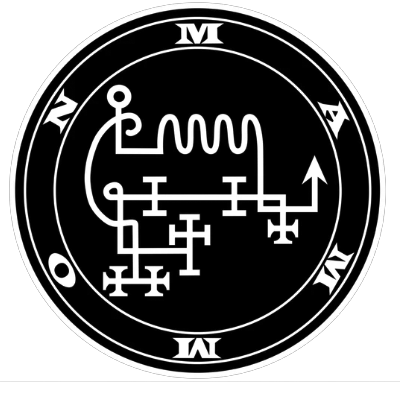
Sigil of Mammon. Traditionally drawn on parchment and placed at the centre of the rite as the principal visual focus for the invocation.
Personality and Ritual Conduct
Mammon is calculating, transactional and contemptuous of vague wishes. He is drawn to measurable ambition, visible sacrifice and the willingness to reorganize life around acquisition. His favor is rarely described as generous; it is contractual, and every gain sharpens awareness of what remains unowned.
The correct ritual posture is neither pleading nor empty aggression. The practitioner enters with a defined purpose, speaks without contradiction and does not improvise new promises under emotional pressure. The entity's personality shapes the ordeal: Mammon is not expected to respond like another king, prince or adversarial power.
The Rite: Full Ceremonial Sequence
The rite proceeds through the following sequence of preparation, construction, address, petition, recognition, exchange and dismissal.
Mammon is depicted in demonology as the chief demon of wealth, greed, and material gain, often associated with ancient Phoenician worship and later Christian texts as a fallen angel or prince of hell. He is said to rule over treasures and can grant financial prosperity, but only to those who approach with genuine intent and respect.
General Preparation
Before any ritual, practitioners emphasize mental preparation: purify your space (e.g., with incense like frankincense or myrrh), set a clear, realistic financial goal (e.g., "increase monthly income by $5,000" rather than vague riches), and cultivate confidence without fear or desperation. Mammon favors those obsessed with wealth, trade, or luxury, and responds poorly to insincerity.
Simple Summoning Ritual (Beginner-Friendly)
This method, based on sigil magic and chanting, requires minimal tools and focuses on trance induction for communication. It's designed for solo practice without elaborate setups.
Required Tools
- Paper and pen for drawing Mammon's sigil (a specific occult symbol; search "Mammon sigil Ars Goetia" to find an image).
- Candles (gold or green for wealth symbolism), crystals like pyrite or citrine to amplify energy.
Steps
Define Your Goal: Write down a specific, achievable desire related to wealth (e.g., acquiring a new asset or boosting earnings). Ensure it's something you truly want and can handle—start small to build trust.
Enter Trance and Invoke: Sit comfortably in a quiet space. Meditate for 20–30 minutes, repeating Mammon's enn (a vibrational mantra): "Tasa Mammon on ca lirach." Visualize luxury and abundance, such as a grand palace filled with gold. Feel for signs of presence, like warmth, tingling, or subtle visions.
Activate the Sigil: Draw the sigil on paper while chanting the enn. Hold it in your dominant hand, stare at it, and pour your intent into it mentally. Continue until you sense a shift (e.g., energy surges or auditory cues).
Communicate: Speak your goal confidently, as if commanding a servant: "Mammon, I call upon you to grant me [specific goal]. Aid me in this as my ally." Use a prayer like: "Great Mammon, lord of treasures, open the gates of wealth to me." Avoid begging—position yourself as superior to maintain control.
Close the Ritual: Thank him firmly: "Mammon, your work is done. Depart in peace and bring [goal] to fruition. Hail Mammon!" Burn or bury the sigil paper to release the energy. Ground yourself with food or rest.
Expect results over days or weeks, such as opportunities or synchronicities, rather than instant manifestations.
Elaborate Ritual Variation (Advanced)
For experienced practitioners, incorporate a full ceremonial setup to evoke Mammon externally
Tools: Draw a protective magic circle (with chalk or salt) and triangle of art. Use an athame (ritual knife), scrying mirror for visions, and a crystal grid (e.g., pyrite, citrine, green aventurine arranged in a wealth symbol).
Altar: Place a Mammon representation (statue or printed sigil), gold/green candles, incense (frankincense/myrrh), and offerings like coins, luxury items, or symbolically "sacrificed" valuables. Extreme traditions mention blood offerings, but this is not recommended for safety reasons.
Steps: Cast the circle for protection, chant invocations within it, offer items while visualizing Mammon's arrival, and commune via the mirror. End by banishing the circle (e.g., with a farewell incantation).
This amplifies power but increases risks like obsession with greed.
Precautions and Warnings
Always use protection (e.g., circles) to avoid unintended influences—Mammon can dominate the weak-willed.
If no results appear, don't force repeats; build gradually to avoid backlash.
Post-ritual, monitor for signs of greed or imbalance; balance with ethical practices.
Ritual Architecture
Separation
The preliminary phase cuts the practitioner away from ordinary communication, appetite, noise or emotional scattering. Fasting, bathing, isolation, abstinence, darkness or concentrated candle work function as signs that the rite has begun before the central invocation is spoken.
Construction of the Chamber
Candles, incense, sigil, water, salt, metals, stones, offerings and directional placement transform an ordinary room into a field organized around one power. The chamber should feel deliberate. Random decoration weakens the sense that every object has been placed for a reason.
Establishing the Point of Contact
The sigil, name, chant, enn, prayer or written petition supplies a fixed centre. Repetition is not mere volume. It narrows attention until the name ceases to feel like ordinary language and becomes the axis of the chamber.
The Petition
A petition should state one principal objective. It should avoid contradictory demands and avoid promises that cannot be kept. Wealth, knowledge, movement, revenge, protection, revelation or influence each create different consequences. The requested result should therefore include its boundaries.
Recognition of Presence
The rite enters its central phase when one or more of the expected signs becomes sustained: pressure, temperature change, altered candle behavior, internal speech, dreamlike imagery, animal symbolism, unusual sound or a sudden certainty that the chamber is no longer psychologically empty.
Exchange and Offering
An offering confirms that the operation is reciprocal. It may symbolize wealth, pleasure, fragrance, flame, blood-red color, water, metal, food, art, discipline or continued devotion. The meaning matters more than display. An offering should never be promised casually.
Dismissal and Return
The rite is incomplete until Mammon is formally thanked or dismissed according to the method preserved above. Candles are extinguished safely, windows opened where appropriate, remains removed, hands and face washed, and the result written before sleep or distraction changes memory.
Instruments and Their Symbolism
The sigil functions as the visual body of the named presence. The candle establishes color, rank, heat and duration. Incense gives the atmosphere a physical density and marks the transition from ordinary air into ritual air. Salt or the circle defines a limit. Water absorbs, reflects or carries emotional force. Metal, coin, stone or herb embodies the office of the entity.
The instrument is complete when it performs its role in the structure. More objects do not automatically produce greater power. A crowded altar can weaken the central image by dividing attention.
Timing and Threshold
The rite may specify midnight, planetary hours, a lunar phase, a zodiacal season or a sequence of preparatory days. Timing is not an ornament. It makes the operation feel as though the practitioner has entered an existing current rather than demanded that the current appear at convenience.
Where several timings appear in the original record, the practitioner should choose one coherent system and keep it throughout the operation rather than combining every correspondence into a single confused night.
Manifestation Signs
The signs attributed to Mammon include:
- a stable alteration of the room's emotional pressure;
- dreams or internal images repeating the entity's traditional form;
- unusual candle movement without a corresponding draft;
- sounds, animal motifs, smells or bodily sensations consistent with the entity's office;
- a response arising as a complete phrase rather than ordinary wandering thought;
- external events beginning to mirror the petition after the rite;
- resistance, fear or fascination intensifying at the exact point of contact.
One isolated sign may be meaningless. A pattern that repeats through the ritual, dream and aftermath carries greater weight inside the legend of the operation.
The Frightening Edge of the Rite
Mammon's gift can become the inability to experience enough. Wealth arrives with vigilance, comparison and fear of loss. The strongest warning is not poverty but success that converts every relationship into a transaction.
The danger is not limited to a hostile apparition. The deeper danger is transformation that feels useful while it is occurring. The practitioner may begin to imitate the spirit's temperament, reorganize life around the petition or interpret every event as part of the operation. That is why the dismissal and written closure are essential.
Failure Patterns
A rite is weakened when the practitioner changes the request repeatedly, abandons preparation, substitutes random symbols, recites without attention, continues after panic, promises impossible payment or refuses to close because no dramatic apparition appeared.
Failure can also appear as excess success: the requested current enters ordinary life faster or more strongly than expected. The record should therefore define what outcome counts as completion before the rite begins.
Completion and Aftermath
The operation is complete when the petition has been stated, the exchange acknowledged, the presence dismissed and the chamber returned to ordinary order. The practitioner should record:
- date and exact timing;
- preparatory discipline completed;
- tools and offerings used;
- words spoken;
- signs observed;
- dreams during the following nights;
- first external movement connected with the petition;
- any emotional or behavioral change;
- whether the promised offering or action was completed.
The aftermath belongs to the ritual. Results may arrive as opportunity, conflict, dream, warning, sudden knowledge, disappearance of an obstacle or an intensification that forces the seeker to confront the real shape of the request.
Final Warning
Mammon's gift can become the inability to experience enough. Wealth arrives with vigilance, comparison and fear of loss. The strongest warning is not poverty but success that converts every relationship into a transaction.
Do not leave the altar active indefinitely. Do not continue chanting after formal dismissal. Do not make a second petition simply because silence feels uncomfortable. The chamber must be returned to darkness, ordinary air and ordinary time.