
Historical Ritual Archive
An alchemical Goetic operation of altered substance, sharpened wit and the intelligence that changes value by changing form.
This rebuilt dossier preserves the entire operative substance of the earlier SatanWorld draft: the tools, sigil work, timings, purifications, chants, offerings, petitions, manifestations, dismissals and warnings remain present. The material has been reorganized so the rite unfolds as one deliberate descent rather than a loose list of instructions.
The Power Being Addressed
Zagan is approached as Sixty-first spirit of the Ars Goetia, a Great King and President commanding thirty-three legions. The operation is structured around that rank, office and manifestation.
Zagan is commanding, ironic and fascinated by reversals. He is said to transform liquids, metals, intelligence and social value. His lessons often arrive through humiliation of certainty: what seemed base becomes precious, and what seemed wise is exposed as foolish.
Daemonology profile: Read the complete Daemonology profile of Zagan
Why the Rite Exists
The rite creates a threshold between ordinary life and the domain attributed to Zagan. Preparation separates the practitioner from distraction. The sigil, name and chant establish a centre. The petition shapes the encounter. The offering acknowledges exchange. Dismissal restores the chamber to ordinary time.
A summoning without preparation is only demand. A summoning without closure is pressure without boundary.
Personality and Ritual Conduct
Zagan is commanding, ironic and fascinated by reversals. He is said to transform liquids, metals, intelligence and social value. His lessons often arrive through humiliation of certainty: what seemed base becomes precious, and what seemed wise is exposed as foolish.
The practitioner should speak with precision and avoid contradictory motives. The entity's traditional temperament determines the tone of the operation. Royal spirits are not approached like marquises, teachers are not addressed like destroyers, and powers of love, invisibility, storm, war or revelation do not answer through the same atmosphere.
The Atmosphere of Manifestation
Liquids, reflections and metallic objects draw unusual attention. The room may feel heavy, then suddenly clear. Manifestation is associated with a bull with griffin wings that later assumes human shape.
Manifestation may begin through changes in sound, heat, dream, pressure, candle behavior, animal imagery or internal speech. The legend of the rite does not require a full visible apparition before contact is recognized.
Sigil of Zagan
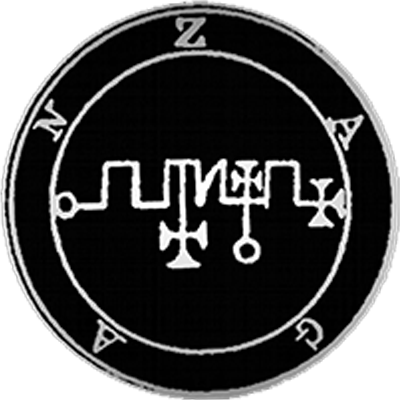
Sigil of Zagan. Traditionally drawn on parchment and placed at the centre of the rite as the principal visual focus for the invocation.
The Rite: Full Ceremonial Sequence
The following section preserves the original article's ritual content without omitting its operative details.
Zagan is the 61st spirit described in the Ars Goetia, a grimoire section of the 17th-century Lesser Key of Solomon. He's depicted as a bull with griffin wings that transforms into a human form upon summoning. Zagan is said to grant abilities like turning water into wine, blood into oil, fools into the wise, and metals into coins. He also reveals hidden truths and makes men witty. Traditionally, he's neutral but can be commanding if not approached with respect. These rituals stem from Renaissance occult traditions and are for historical or fictional interest—results are unverified and often attributed to psychology or coincidence.
Historical Context
Zagan's description originates from medieval demonology, influenced by Kabbalah and astrology. He's associated with the planet Venus and the sign Sagittarius. Summonings in grimoires like this emphasize preparation, circles of protection, and divine names to avoid backlash. Modern interpretations appear in books like The Goetia by S.L. MacGregor Mathers or Aleister Crowley's editions. Always cross-reference primary sources for accuracy.
Preparation for Summoning
Before any ritual, gather tools and set intentions. This is based on traditional Goetic methods:
Timing: Perform at dawn or dusk on a Tuesday (Mars day for power) or Wednesday (Mercury for wit). Avoid Fridays.
Location: A quiet, dark room. Cleanse with sage or salt water.
Tools
Black-handled knife or wand.
Incense: Frankincense or myrrh.
Sigil of Zagan (draw it: a central eye-like symbol with horns and wings; search "Zagan sigil" for visuals).
Virgin parchment or paper for writing commands.
Protective circle: Chalk or rope, inscribed with names like Tetragrammaton (YHWH) and planetary seals.
Mindset: Fast for 24 hours. Meditate on your desire (e.g., wisdom or transmutation). Invoke archangels Michael or Raphael for protection.
Step-by-Step Ritual
This is a simplified, traditional evocation from Goetic texts. Adapt at your own risk—it's symbolic and not guaranteed.
Cast the Circle
Draw a 9-foot circle. Inside, a triangle for the spirit. Stand facing east.
Recite: "I conjure thee, O Circle of Art, by the power of the Most High, to be a fortress against all evil."
Light Candles and Incense
Place black and white candles at cardinal points. Ignite incense.
Anoint yourself with oil (olive mixed with herbs like cinnamon for attraction).
Invocation
Hold Zagan's sigil. Chant his enn (a modern summoning phrase): "Zayin ga 'an, zayin ga 'an, lif, bar 'ma yo heh." Repeat 11 times (his number).
Full call: "Zagan, great king and president, I summon and conjure thee by the power of Adonai, Elohim, and the hosts of heaven. Appear before me in the triangle, visible and affable, without terror or deformity. Obey my commands as written on this parchment."
Appearance and Command
Expect visual/auditory hallucinations (bull form shifting to man). If he appears, state your request clearly: "Zagan, by thy office, grant me [specific desire, e.g., 'the wit to outsmart my rivals']."
Offer libation (wine or blood symbol—red ink works).
Dismissal
Thank him: "Zagan, I thank thee for thy presence. Depart in peace to thy abodes."
Erase the triangle. Extinguish candles counterclockwise.
Banish: "By the power of the pentagram, all spirits depart!"
Warnings and Variations
Risks: Grimoires warn of possession or trickery if the circle breaks. Stop if uncomfortable; ground with salt and laughter.
Modern Twists: Chaos magicians use visualization without tools. Apps or online sigils exist, but authenticity varies.
Ethics: Treat as meditation. If seeking real change, therapy or study beats demons.
Historical Image and Ritual Figure
BLACK PLACEHOLDER — replace with a verified historical image, sigil manuscript or ritual object before publication.
Ritual Architecture
Separation from Ordinary Time
Bathing, fasting, abstinence, silence, darkness or isolation prepare the body and mind to recognize the threshold. The preparation should be completed as a single coherent discipline rather than as scattered gestures.
Construction of the Chamber
Candles, incense, circle, water, salt, metal, herbs, stones and offerings organize the room around the office of Zagan. Every item should have a purpose. A crowded altar weakens the central image when objects are added only for display.
Establishing Contact
The sigil, name, chant, enn or invocation becomes the fixed point of the operation. Repetition is intended to narrow awareness until the name no longer feels like ordinary language.
The Petition
One principal request should be stated. The request must include a boundary, a desired form of result and a clear completion condition. Ambiguous wishes invite expansion.
Recognition of Presence
The central phase begins when the atmosphere changes in a sustained way. Pressure, heat, cold, altered flame, internal speech, animal forms, dreams or sudden certainty may mark the transition.
Offering and Exchange
The offering expresses reciprocity. It may carry the spirit's color, office, appetite or symbolic domain. Promises should never be made casually because the rite treats them as binding.
Dismissal
The operation ends only when Zagan is thanked or dismissed according to the preserved method. Candles are extinguished safely, windows opened where appropriate, offerings removed according to the rite and the chamber returned to ordinary order.
Instruments and Their Symbolism
The sigil is the visual body of the name. The candle establishes color, rank and duration. Incense gives the atmosphere density. Salt and the circle define limits. Water reflects and carries emotional force. Metal, stone, herb or coin embodies the entity's office.
The instrument is complete when it performs its function. More objects do not automatically create greater force.
Timing and Planetary Current
When several correspondences appear, one coherent system should govern the night. Combining every possible timing creates confusion rather than power.
Manifestation Signs
Signs traditionally associated with Zagan include:
- a stable change in emotional pressure;
- dreams repeating the traditional form;
- candle movement without a matching draft;
- sounds, smells or bodily sensations linked to the spirit's office;
- a complete phrase arising inside thought;
- external events beginning to mirror the petition;
- fear or fascination intensifying at the exact point of contact.
One isolated sign may pass unnoticed. A pattern repeating across chamber, dream and aftermath carries greater weight.
The Frightening Edge of the Rite
Transformation can become contempt for stability. The seeker may chase constant change, mistake cleverness for wisdom or manipulate value without understanding consequence.
The deepest danger is transformation that feels useful. The practitioner may begin to imitate the spirit's temperament, reorganize life around the petition or interpret every event through the operation.
Failure Patterns
Failure appears when preparation is abandoned, the request changes repeatedly, symbols are mixed randomly, fear replaces attention, impossible offerings are promised or the practitioner refuses to close because no dramatic apparition appeared.
Failure may also appear as excess success: the requested force enters ordinary life faster than expected. The completion condition should therefore be written before the rite begins.
Completion and Aftermath
The operation is complete when the petition has been spoken, the exchange acknowledged, the presence dismissed and the chamber returned to ordinary order.
Record:
- date and exact timing;
- preparation completed;
- tools and offerings;
- words spoken;
- signs observed;
- dreams in the following nights;
- first external movement;
- emotional or behavioral changes;
- fulfillment of any promised offering.
The aftermath belongs to the rite. Results may arrive as opportunity, conflict, warning, sudden knowledge, disappearance of an obstacle or an intensification that reveals the true shape of the request.
Boundaries of the Petition
The petition should identify what is requested, where the result may operate, what form the result may take and what event marks completion. Wealth can arrive through loss. Truth can destroy a relationship. Protection can become isolation. Love can become possession. Invisibility can become moral evasion.
The wording is therefore part of the danger.
The Return to Ordinary Life
After closure, eat, drink, wash, change clothing, step outside or speak with another person. These actions declare that ritual time has ended.
Do not immediately repeat the operation because silence feels uncomfortable. Strong results reveal their own pattern.
Final Warning
Transformation can become contempt for stability. The seeker may chase constant change, mistake cleverness for wisdom or manipulate value without understanding consequence.
Do not leave the altar active indefinitely. Do not continue chanting after formal dismissal. Do not add a second petition during the closing stage.
The Inner Ordeal
The rite of Zagan is also an ordeal of resemblance. The chamber is not only built to attract a power; it is built to reveal where that power already exists in the seeker's life.
The frightening moment is often not the apparition but recognition. The seeker realizes that the request has already shaped behavior, memory and desire before the first candle was lit. The entity's traditional office becomes a mirror: storm reveals instability, love reveals possession, invisibility reveals avoidance, truth reveals fear and knowledge reveals the burden of consequence.
The first impression should be written before interpretation grows around it. Record the first sound, image, sentence, physical sensation or emotional shift. Later drama may be less important than the instant the room stopped feeling ordinary.
When the Rite Is Truly Complete
A rite is not complete because the candles have burned down. It is complete when the petition has reached a defined result, the promised exchange has been honored and the seeker's ordinary life no longer remains suspended around the operation.
If the result never arrives, the record should still be closed. An unfinished petition should not become a permanent altar.