In the churches where Marthe Brossier was brought forward, the crowd did not see an abstract theological dispute. They saw a young woman contort before sacred objects, answer priests in a voice attributed to a demon and become the centre of a ritual struggle that drew spectators across France. By 1599, the case had reached Paris. Jesuit Pierre Coton questioned the presence said to inhabit her. Physicians examined her body. Royal officials feared that an exorcism spectacle could reopen the wounds of the Wars of Religion. Marthe stood at the centre of them all: afflicted woman, public sign, political weapon and living test of whether the Devil could still speak before the court of a king.
The World Around the Case
This case unfolded within France after decades of Catholic–Protestant warfare, where public exorcism could become proof of confessional power and a challenge to the fragile authority of Henri IV. Its principal foundation is a substantial manuscript dossier in the Bibliothèque nationale de France, printed pamphlets from 1599, interrogation texts and certificates produced by clergy and physicians. Those materials do not create perfect certainty, but they make possible a detailed reconstruction of when the reports began, who witnessed them and how interpretation changed as the disturbance entered public knowledge. SatanWorld follows the testimony closely, attributes extraordinary claims to the people and records that preserved them, and keeps the supernatural presence at the centre of the narrative without replacing history with invented scenes.
At the heart of the story is a body that performed recognizable signs of possession while competing experts disagreed whether those signs were supernatural, theatrical or both. The case later became one of the clearest examples of possession becoming a national argument about medicine, religious authority and political order. That legacy can obscure the people who endured the original events, so the account returns repeatedly to chronology, room, witness and consequence. The goal is not to produce a courtroom verdict on the unseen. It is to restore the full oppressive shape of an event that contemporaries believed had crossed the boundary between the ordinary world and something acting from beyond it.
From Romorantin to the Public Church
Marthe came from Romorantin and travelled under the direction of her family as reports of her affliction spread. Early narratives connected the beginning of the crisis with accusations involving Anne Chevreau, a neighbour presented in some accounts as the source of bewitchment. In church, Marthe’s reactions were interpreted through the established signs of possession: convulsion, violent resistance, altered speech and hostility toward sacred presence. Each successful exhibition increased the demand for another. The journey transformed a local disturbance into a public religious event.
The physical setting matters here. Rooms, roads, chapels, offices and courtrooms organize what witnesses can hear and whom they can observe. In this case, architecture became part of the phenomenon: it concealed sources, directed attention and gave the disturbance a route through which it could seem to approach or withdraw. The resulting atmosphere was not decorative gothic invention. It arose from the practical problem of trying to locate an event that repeatedly escaped the person searching for it.
A France Hungry for Signs
The case emerged only a few years after Henri IV’s conversion to Catholicism and the Edict of Nantes. Political peace had not erased confessional suspicion. Catholic exorcists could present a demon’s reaction to the Eucharist as proof of Catholic truth, while opponents could describe the performance as fraud designed to inflame the people. Marthe’s body became a stage upon which unresolved wars could continue without armies. A cry during ritual might be interpreted simultaneously as spiritual evidence and political provocation.
The occult interpretation gained strength because the incident appeared intentional. Random disorder becomes haunting when it answers, follows, selects or arrives at meaningful moments. Witnesses did not merely report abnormal movement; they reported behaviour. Whether that behaviour originated in an entity, a human action, unconscious process or collective expectation remains the deepest question. What the record establishes is that those present felt addressed by the disturbance rather than merely exposed to it.
The Demon Is Questioned
Interrogation records attribute questions to Pierre Coton and other clergy who addressed the demon rather than the woman. They asked identity, cause, authority and intention. The procedure followed a logic older than the case: the possessing spirit could be compelled by sacred command to expose itself, yet its answers remained suspect because demons were believed to lie. This contradiction made every response dangerous. Speech proved presence, but the presence could never be trusted. The exorcist had to display mastery over a witness whose testimony was intrinsically corrupt.
The surviving record gives this stage particular weight because it appears inside a substantial manuscript dossier in the Bibliothèque nationale de France, printed pamphlets from 1599, interrogation texts and certificates produced by clergy and physicians. Details were written by people who did not share one theory, yet they converged upon the sense that a body that performed recognizable signs of possession while competing experts disagreed whether those signs were supernatural, theatrical or both. The article preserves that convergence without pretending that a witness could see every room, motive or mechanism. The darkness comes from the limits of inspection: those present could describe what the event did, while its identity remained beyond the ordinary categories available to them.
Sacred Objects and Concealed Tests
Physicians and clerics attempted tests using blessed and unblessed objects, sometimes concealing which was which. Such experiments sought to determine whether Marthe reacted to sacred power or to expectation. Contemporary reports disagree about the results and the conditions under which they were performed. The drama lay in secrecy: a relic hidden among ordinary items, a host presented without announcement, observers watching for the instant the body changed. Every movement acquired evidential weight while the young woman’s awareness became the subject of suspicion.
Within France after decades of Catholic–Protestant warfare, where public exorcism could become proof of confessional power and a challenge to the fragile authority of Henri IV, the events described under “Sacred Objects and Concealed Tests” carried meanings larger than a private disturbance. A noise, voice or bodily reaction could indicate sin, intrusion, restless death, public danger or a failure of institutional protection. That cultural field did not make the witnesses foolish; it supplied the language through which an otherwise shapeless terror became narratable. The same language could also place immense pressure upon the afflicted person, whose every movement was watched for confirmation.
The Royal Physicians
Henri IV’s government appointed medical observers because the case threatened more than one patient. Physicians examined Marthe’s sensitivity, breathing, pulse and response to procedures. Some concluded that artifice or illness could account for what they saw; others defended supernatural interpretation. The famous language attached to the affair—that there was much illness, some fraud and little of the Devil—condensed a political need for containment. A medical verdict could silence a spectacle that direct religious prohibition might only make more powerful.
This phase also explains why the case endured as one of the clearest examples of possession becoming a national argument about medicine, religious authority and political order. Later summaries often isolate the most spectacular incident, but the original force lay in accumulation: repeated nights, changing witnesses, failed searches and the intrusion of the phenomenon into worship, work or family routine. No single detail must carry the entire story. The authority of the narrative rests upon a sequence in which ordinary explanations were tried, doubted and tried again.
Pamphlets for and Against the Possession
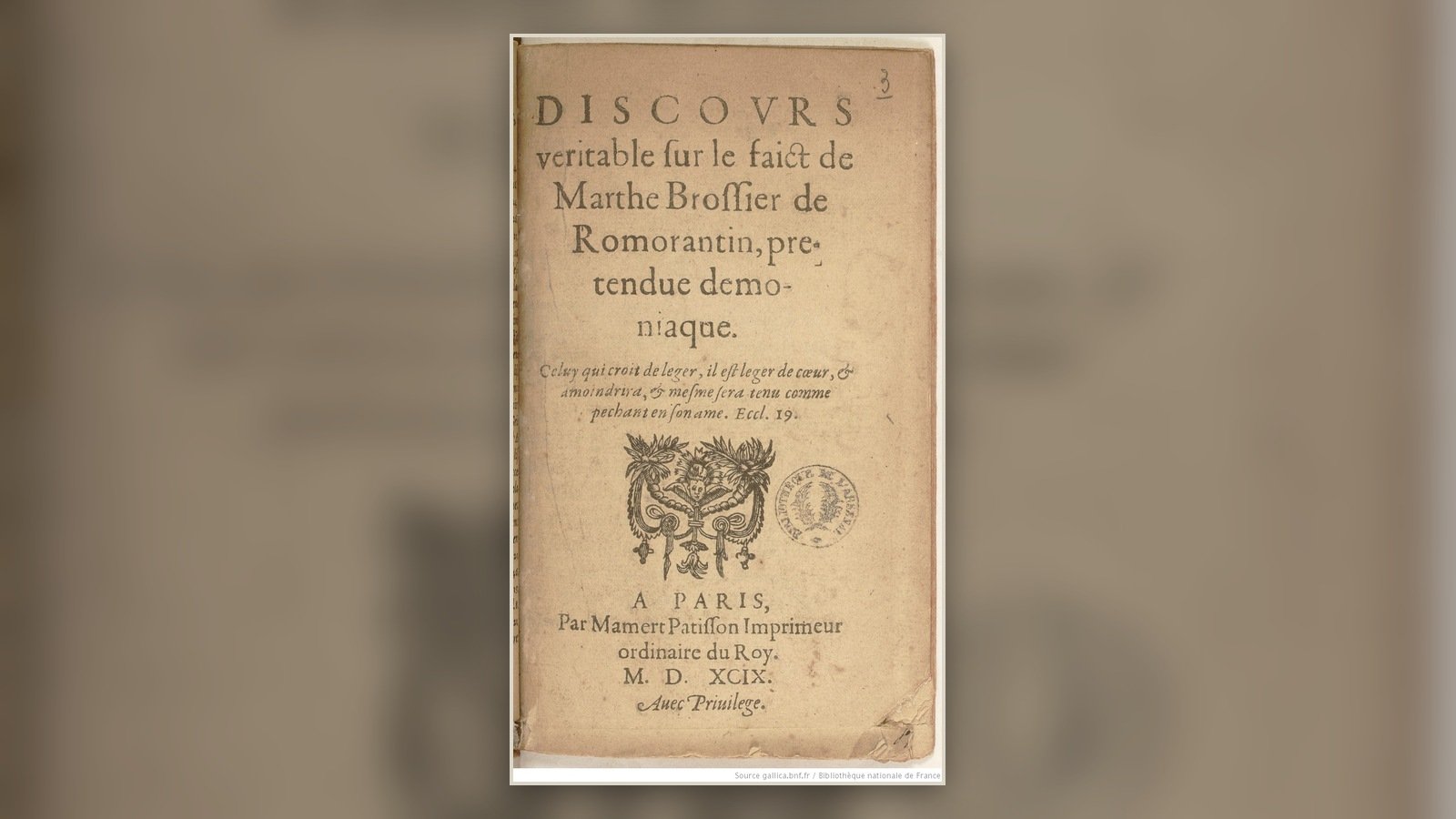
The printing press multiplied Marthe. Titles promised true discourse, authentic relation and exposure of imposture. Readers who never entered the church could encounter the demon through pages shaped by partisan selection. Supporters preserved ritual victories and terrifying manifestations; opponents described coaching, concealment and theatrical skill. The pamphlet war did not merely report the case. It created rival Marthe Brossiers, each serving a different account of France: a kingdom defended by Catholic sacrament, or a kingdom endangered by clerical manipulation.
Testimony must be read as human evidence rather than as a transparent window. Fear sharpens some perceptions and distorts others; memory selects; institutions preserve the statements that fit their procedures. Yet these limits do not reduce the event to nothing. They reveal how a body that performed recognizable signs of possession while competing experts disagreed whether those signs were supernatural, theatrical or both was experienced by people whose decisions had real consequences. The case remains frightening because uncertainty did not suspend action. Families, clergy, doctors, technicians or courts still had to decide what to do next.
Custody and the End of the Spectacle
Authorities restricted Marthe’s movement and attempted to remove her from the crowds that sustained the case. Control of her body became control of the narrative. Without churches filled with spectators, the possession lost its national force. The state’s intervention reveals the fear surrounding public exorcism: even if the phenomena were accepted as real, their political use could be judged intolerable. Marthe’s fate after the height of the affair is less visible than the officials and authors who spoke over her.
The physical setting matters here. Rooms, roads, chapels, offices and courtrooms organize what witnesses can hear and whom they can observe. In this case, architecture became part of the phenomenon: it concealed sources, directed attention and gave the disturbance a route through which it could seem to approach or withdraw. The resulting atmosphere was not decorative gothic invention. It arose from the practical problem of trying to locate an event that repeatedly escaped the person searching for it.
The Archive of a Contested Body
The BnF dossier preserves letters, certificates, anti-imposture writings and descriptions by witnesses. Its abundance does not produce a simple verdict. Instead it shows institutions constructing evidence according to different rules. The priest seeks obedience to ritual command; the physician seeks repeatable bodily response; the magistrate seeks public stability; the pamphleteer seeks persuasion. Marthe is present in all these records and yet remains difficult to recover as a private person.
The occult interpretation gained strength because the incident appeared intentional. Random disorder becomes haunting when it answers, follows, selects or arrives at meaningful moments. Witnesses did not merely report abnormal movement; they reported behaviour. Whether that behaviour originated in an entity, a human action, unconscious process or collective expectation remains the deepest question. What the record establishes is that those present felt addressed by the disturbance rather than merely exposed to it.
What the Demon Left Behind
The case survived because no authority could fully monopolize its meaning. Skeptical examination did not erase the reports of those who believed they had witnessed possession, and clerical testimony did not overcome every controlled test. The darkness of the affair lies in its collision of certainty: crowds convinced by ritual, physicians convinced by bodily observation, officials convinced that the spectacle itself was dangerous. Marthe’s demon became the name for a conflict France could not permit to continue in public.
The surviving record gives this stage particular weight because it appears inside a substantial manuscript dossier in the Bibliothèque nationale de France, printed pamphlets from 1599, interrogation texts and certificates produced by clergy and physicians. Details were written by people who did not share one theory, yet they converged upon the sense that a body that performed recognizable signs of possession while competing experts disagreed whether those signs were supernatural, theatrical or both. The article preserves that convergence without pretending that a witness could see every room, motive or mechanism. The darkness comes from the limits of inspection: those present could describe what the event did, while its identity remained beyond the ordinary categories available to them.
A further layer concerns the passage from private ordeal to public case. Once strangers arrived, the people involved were no longer only witnesses; they became objects of examination. Their words could be repeated without their control, and every inconsistency acquired importance. Publicity enlarged the archive while changing the conditions under which new events occurred.
The event also carried an ethical burden. Belief in an invading presence could produce vigilance, solidarity and sustained care, but it could also expose vulnerable people to restraint, interrogation and spectacle. A serious occult history must preserve both realities. The witnesses’ supernatural interpretation belongs to the case, and so do the consequences of acting upon it.
Later culture often compresses the subject into a single image or phrase. Returning to the longer record restores duration: waiting, interrupted sleep, repeated consultation and the slow erosion of confidence in familiar surroundings. The most frightening cases are rarely one impossible moment. They are the days during which no one knows whether the moment will return.
A further layer concerns the passage from private ordeal to public case. Once strangers arrived, the people involved were no longer only witnesses; they became objects of examination. Their words could be repeated without their control, and every inconsistency acquired importance. Publicity enlarged the archive while changing the conditions under which new events occurred.
The event also carried an ethical burden. Belief in an invading presence could produce vigilance, solidarity and sustained care, but it could also expose vulnerable people to restraint, interrogation and spectacle. A serious occult history must preserve both realities. The witnesses’ supernatural interpretation belongs to the case, and so do the consequences of acting upon it.
Later culture often compresses the subject into a single image or phrase. Returning to the longer record restores duration: waiting, interrupted sleep, repeated consultation and the slow erosion of confidence in familiar surroundings. The most frightening cases are rarely one impossible moment. They are the days during which no one knows whether the moment will return.
What Remains
The case demonstrates that exorcism was also media. Architecture, audience, timing and publication determined how the event was understood. The ritual was performed before bodies and before institutions.
Marthe’s own motives cannot be reduced safely to either holiness or fraud. Family pressure, illness, belief and public attention may have operated together without being separable in the surviving record.
The title pages and manuscript interrogations are not secondary decoration. They are the physical remains of a moment when the alleged voice of a demon became a problem for the French state.
What remains is one of the clearest examples of possession becoming a national argument about medicine, religious authority and political order. The names and places survive because the event entered documents before it became entertainment. Those documents preserve voices that are sincere, frightened, partisan, careful and sometimes contradictory. They do not eliminate the darkness. They give it historical weight. The case continues to disturb because a body that performed recognizable signs of possession while competing experts disagreed whether those signs were supernatural, theatrical or both, and because the actions taken in response changed lives long after the last reported manifestation.
The final boundary must therefore remain open. A historical archive can show what witnesses heard, what bodies endured, what instruments registered and what courts or churches decided. It cannot command the unseen to identify itself for a later reader. These stories persist in the interval between record and presence—the place where testimony becomes memory, memory becomes legend, and the legend still carries the pressure of something that once entered an ordinary room and refused to behave like anything known.