
Historical Ritual Archive
This rite is treated as a serious occult operation preserved within historical, religious and living ceremonial traditions. Traditional accounts warn that careless work may produce obsession, deceptive signs, nightmares, spiritual attachment, conflict or the sense of being watched by the power addressed. Ordinary hazards involving flame, smoke, exhaustion and emotional distress remain real. Enter with one purpose, keep the chamber orderly and close the operation completely. Nothing in this archive replaces ordinary judgment, consent, evidence or lawful conduct. No blood, self-injury, animal harm, grave disturbance, coercion or dangerous substance is required or permitted in this form of the rite.
The Power Being Addressed
Guison, also written Gusion or Gusoin in later catalogues and translations, is approached as the eleventh spirit of the Ars Goetia. He bears the rank of Duke and is said to command forty legions. The early modern catalogue gives him an unusual manifestation described in some editions through the obscure word xenopilus, a term whose exact visual meaning remains uncertain. Later occult art and practitioner traditions often render him with a noble, animal-headed or dog-like form, emphasizing watchfulness, intelligence and grave composure rather than bestial violence.
His offices form one of the clearest intellectual and social patterns in the Goetic hierarchy. Guison is said to disclose the past, present and future; answer questions truthfully; reconcile estranged friends; restore dignity; and bestow honor or favorable standing. These powers converge around the recovery of a broken order. He reveals what has happened, clarifies what is happening, shows what may follow, and then repairs the human relationship or reputation damaged by confusion.
The historical catalogue is concise. Later ceremonial traditions developed correspondences, offerings, planetary associations and richer descriptions of his presence. This article keeps those layers distinct while presenting a complete ritual workflow consistent with the SatanWorld archive.
Daemonology profile: Read the complete Daemonology profile of Guison
Purpose of the Rite
This rite is used for one of four closely related purposes: obtaining truthful perspective on a difficult sequence of events, reconciling a damaged friendship, recovering dignity after misunderstanding or disgrace, or clarifying the most honorable course through a dispute. It is not designed to force affection, erase another person's will or manufacture false prestige. Guison's current is strongest where truth and restored order are allowed to work together.
The petition should name the precise relationship, decision or unanswered event at the center of the operation. A vague request for “all hidden knowledge” creates noise. A defined question such as “show me the cause of this rupture and the honorable action now available” gives the rite a stable shape.
Before the chamber is prepared, write three boundaries beneath the petition: no deception, no coercion and no injury. Then write one ordinary action you are willing to take if the answer requires humility, apology, documentation, patience or withdrawal. Guison's office concerns truth and dignity together; a practitioner who asks for reconciliation while refusing responsibility contradicts the intelligence being invoked.
Personality and Ritual Conduct
Guison is traditionally approached as grave, exact and unexpectedly courteous. He does not reward theatrical emotion. The presence is often described as that of a judge who has already read the record and now waits to hear whether the petitioner will speak honestly. He is less interested in flattery than in sequence: what happened first, what followed, what was concealed and what consequence now remains.
His personality combines patience with intolerance for self-deception. A request framed to prove the practitioner innocent at any cost is likely to produce confused or uncomfortable material. A request framed to reveal the complete pattern, including the petitioner's own failures, is more coherent with his office.
Speak in a measured voice. Do not improvise threats, promises of extravagant offerings or claims of spiritual rank. Guison's dignity is answered by dignity. The correct ritual attitude is calm authority joined to a willingness to hear an unwelcome truth.
The Atmosphere of Manifestation
The chamber may become unusually still, as though conversation in an adjoining room has suddenly stopped. Sounds can seem separated from one another: the flame, the movement of cloth, the settling of wood. A pressure may gather around the temples or behind the eyes, followed by a sudden ordering of memories into a clear sequence.
Practitioners often associate Guison's approach with the return of forgotten details, names, dates, phrases or gestures. A conflict previously remembered as one emotional block may divide into distinct moments. This is one of the most characteristic signs of the Duke's office: confusion becomes chronology.
The manifestation may also carry a formal, watchful quality. The sigil can appear visually sharper, and the letters around its outer ring may seem to stand forward from the black field. A sensation of being evaluated is common in later practitioner testimony. It should not be confused with condemnation. The rite is testing whether the petition remains truthful under pressure.
Sigil of Guison
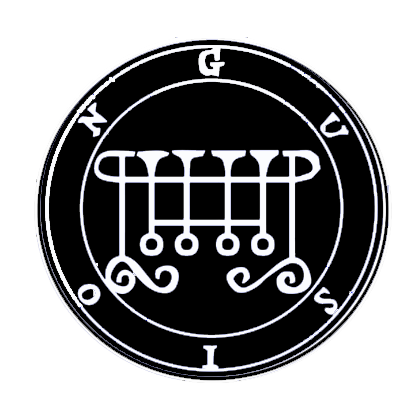
Sigil of Guison. Traditionally drawn on parchment and placed at the centre of the rite as the principal visual focus for the invocation.
Timing and Correspondences
- Rank: Duke
- Traditional office: truth concerning past, present and future; reconciliation; dignity and honor
- Timing: Friday for reconciliation, Thursday for honor and counsel, or the planetary hour chosen consistently with the petition
- Direction: west or northwest
- Colors: deep blue, black, silver and muted gold
- Incense: frankincense, sandalwood or benzoin used lightly
- Offering: clean water, bread, a written apology, a charitable act performed without publicity, or the keeping of a promise after the rite
These correspondences organize attention; they do not compel manifestation. Use one coherent arrangement. Excessive candles, smoke and symbols produce distraction rather than authority.
Location and Environmental Preparation
Choose a quiet room in which the operation can end without interruption. Clean the floor and working surface. Remove unrelated devotional objects, open screens and devices that might produce sounds or notifications. The chamber should feel deliberate rather than theatrical.
Place the working table toward the west or northwest. The sigil rests upright or flat at the center of the table. A single candle stands behind it so the seal is illuminated without being obscured by glare. The written petition remains beneath the sigil until Step 8. A bowl of clean water is placed to the left, and the record book to the right.
The practitioner should have an ordinary chair available. Prolonged standing is not a test of sincerity. The body must remain stable enough to distinguish ritual signs from fatigue.
Tools, Materials and Offerings
- The supplied sigil of Guison, printed clearly
- One blue, white or black candle in a stable holder
- A small bowl of clean water
- Light incense with adequate ventilation, or no incense if breathing conditions make smoke unsuitable
- The written petition and three stated prohibitions
- A notebook and pen
- A modest offering connected to reconciliation, truth or fulfilled responsibility
- A timer kept outside direct sight for a maximum working period
No weapon, blood, intoxicant or hazardous material belongs in this rite. The authority of the operation rests in order, clarity and closure.
The Rite: Full Ceremonial Sequence
Step 1: Define the Petition
Write one question or request in a single paragraph. Name the people or situation involved without insulting them. State what you seek from Guison: truthful understanding, reconciliation, restored dignity or honorable counsel. Beneath it write: “Let no answer be accepted that requires deception, coercion or harm.”
Read the petition once in an ordinary voice. If it contains several separate desires, rewrite it before continuing. The rite begins when the request can be stated without explanation.
Step 2: Prepare the Body and Mind
Wash your hands and face. Eat normally earlier in the day and avoid deliberate sleep deprivation. Sit in silence for several minutes and count the breath without forcing it. Allow anger, hope and fear to be acknowledged, then place them outside the petition.
Say: I enter this chamber to know what is true, to repair what may be repaired, and to accept the honorable limit of what cannot be restored.
Step 3: Construct the Chamber
Set the sigil at the center. Place the candle behind it, water to the left and notebook to the right. Lay the petition beneath the seal. Walk once around the working area and remove anything that feels accidental or unstable.
Light the candle. If incense is used, burn only a small amount. The room should remain breathable and visually clear.
Step 4: Establish the Boundary
Stand before the table and mark the four directions with an open hand. At each direction say: Let truth enter. Let deception remain outside. Let dignity govern what is spoken here.
Return to the west. Visualize a quiet boundary surrounding the working area. It is not a wall of fear but a limit of purpose. Nothing unrelated to the petition is invited to remain.
Step 5: Place and Awaken the Sigil
Look at the center of the seal without straining the eyes. Trace its principal lines in the air with the index finger, beginning at the upper edge and moving slowly through the central figure. Do not copy every mark mechanically; recognize the sigil as the identifying focus of the Duke's office.
Say three times: Guison, Gusion, Duke who knows the sequence of things, attend this seal and hear the petition prepared beneath it.
Pause after each repetition. The name should be spoken clearly, not shouted or stretched into physical discomfort.
Step 6: Speak the Conjuration
Face the sigil and speak:
Guison, noble Duke of the hidden record, who reveals what has passed, what now stands and what consequence approaches, I call you by the office preserved beneath your name. Enter this chamber in a form that brings no terror, deception or injury. Let the confused become ordered. Let estrangement be judged truthfully. Let dignity be restored only where truth permits it. Attend this seal, receive this voice and answer within the limits declared.
Repeat the conjuration a second time more slowly. On the third speaking, replace the final sentence with the exact purpose of the rite.
Step 7: Recognize the Presence
Remain silent for several minutes. Observe several signs rather than seizing upon one. A coherent presence may be marked by converging changes: sudden stillness, sharpened memory, pressure around the eyes, a formal emotional atmosphere, repeated words or an unexpected chronological understanding.
Do not accept random intrusive thoughts as commands. Record impressions in short phrases. A valid response should remain relevant to the petition and should not demand secrecy, escalating devotion or harmful action.
Step 8: Deliver the Petition
Lift the written petition from beneath the sigil and read it once. Then ask three questions at most:
- What truth about the past has been misunderstood or concealed?
- What condition governs the present situation?
- What honorable action now leads toward reconciliation, dignity or closure?
Allow silence after each question. Do not ask the same question repeatedly in different words. Repetition can turn uncertainty into imagined certainty.
Step 9: Test the Response
Read back the impressions already recorded. Ask: Does this answer preserve truth, consent and lawful conduct? If the response requires coercion, false accusation, obsession or humiliation, reject it aloud: This does not belong to the office named. It has no authority here.
A coherent answer can be translated into ordinary action: verify a fact, request a conversation, offer an apology, preserve evidence, wait, withdraw or accept that reconciliation is not available.
Step 10: Present the Offering
Raise the bowl of water and say: Guison, receive this sign of clarity and peace. The greater offering will be the truthful action completed after this chamber is closed.
Name the practical offering you have chosen. Do not promise anything impossible or financially reckless. A small promise kept is more consistent with the Duke's office than a dramatic promise abandoned.
Step 11: Give the License to Depart
Say:
Guison, Duke of hidden knowledge and restored dignity, the petition has been spoken and the record has been made. Depart now in peace and return to your proper place. Let no presence, shadow or attachment remain in this chamber. What is true may endure; what is deceptive is dismissed. Go without injury, disturbance or claim upon any person here.
Wait for the atmosphere to lessen. Extinguish the candle safely. Empty the water outside or into clean earth later, without ceremony that prolongs the contact.
Step 12: Close and Record
Open a door or window briefly if practical. Wash your hands. Eat or drink something ordinary. Write the ending time and summarize the rite in factual language. Separate what was observed during the operation from later interpretation.
Do not contact the estranged person immediately while emotionally charged. Allow at least one sleep cycle before acting unless an ordinary urgent matter already requires attention.
Signs of Manifestation and Response
The strongest signs are not dramatic apparitions but ordered knowledge. Events may arrange themselves into an intelligible chain. A missing document, remembered sentence or overlooked motive may become obvious. Dreams can present meetings, courts, corridors, dogs, sealed letters or old rooms in which a conversation is repeated with one altered detail.
In reconciliation work, the response may appear through a softened opportunity rather than a supernatural declaration: a message arrives, a neutral intermediary speaks, or the practitioner finally understands what apology is required. In dignity work, the answer may be restraint. Guison can restore honor by revealing that a public struggle should end.
Dangers, Distortions and Failed Closure
The principal distortion is self-justification disguised as revelation. The practitioner may hear only what confirms innocence and blame. Another danger is compulsive chronology: repeatedly reviewing messages, dates and memories until ordinary uncertainty becomes unbearable.
Failed closure is indicated by persistent ritual speech outside the chamber, repeated checking of the sigil, inability to sleep or the belief that every coincidence concerns the petition. Remove the sigil from sight, stop further work, restore routine and seek ordinary support if distress persists.
Completion and Aftermath
Within three days, review the notes once. Mark each statement as observation, interpretation or later confirmation. Take one grounded action consistent with the petition. Then complete the promised offering.
The rite is finished when truth has been translated into proportionate conduct. Reconciliation may mean restored friendship, a respectful final exchange or acceptance that separation must remain. Honor is not the domination of another person's view. It is the recovery of coherent action under the light of what has been revealed.