The book is so large that two people are often needed to move it. Its leaves were made from the skins of animals; its script remains unnervingly consistent across hundreds of pages; and near the end of the volume, a full-page Devil crouches alone inside a pale frame. For centuries, the Codex Gigas has been called the Devil’s Bible. The name is modern, but the unease surrounding the manuscript is much older.
A Monument Made from Parchment
The Codex Gigas is the largest surviving medieval manuscript commonly described as a single-volume book. It weighs about seventy-five kilograms and preserves 310 parchment leaves of extraordinary dimensions. The physical object overwhelms ordinary ideas of reading: its page is closer to a small tabletop than to a devotional book. The preparation of its parchment required a large number of animal skins. The result is a body of evidence that must be read through manuscripts, catalogues and the material history of the object rather than through later legend alone.
The surviving record places this material within a precise historical world. The scale would have demanded costly materials, planning and sustained labour.. Every copied name, altered diagram, ownership mark or change of sequence records a decision made by a reader who believed the text deserved preservation. Those decisions are often as revealing as the stated operation itself.
Its size was not ornamental excess alone. The volume was conceived as a library compressed between boards, a single material world in which Scripture, history, medicine, confession, calendars and protective texts could coexist. In the culture that produced it, sacred language, natural philosophy, astrology, law and ritual were not always separated by the boundaries used today. The manuscript therefore speaks from a world in which knowledge could be devotional, technical and forbidden at the same time.
Read closely, this section also explains why the subject continued to generate fear. Its authority does not depend upon a modern claim that every operation worked exactly as promised. It rests on the historical fact that scribes, collectors, judges or practitioners treated the words as consequential—important enough to copy, hide, condemn, transport or preserve across generations.
Podlažice and the Vanished Monastery
The manuscript was produced in Bohemia in the early thirteenth century, probably between 1204 and 1230. The first known connection is with the small Benedictine monastery of Podlažice, a house later destroyed and never rebuilt. A note links the book to Podlažice. In 1295 the manuscript was pawned and then associated with the larger Benedictine monastery at Břevnov. The result is a body of evidence that must be read through manuscripts, catalogues and the material history of the object rather than through later legend alone.
The manuscript becomes clearer when its physical details are read beside its claims. The modest resources of Podlažice have long raised questions about where the work was physically completed.. Every copied name, altered diagram, ownership mark or change of sequence records a decision made by a reader who believed the text deserved preservation. Those decisions are often as revealing as the stated operation itself.
The lost monastery gives the codex one of its deepest shadows. The place identified with its birth disappeared, leaving the manuscript as a surviving body from an institution erased by war and time. In the culture that produced it, sacred language, natural philosophy, astrology, law and ritual were not always separated by the boundaries used today. The manuscript therefore speaks from a world in which knowledge could be devotional, technical and forbidden at the same time.
Read closely, this section also explains why the subject continued to generate fear. Its authority does not depend upon a modern claim that every operation worked exactly as promised. It rests on the historical fact that scribes, collectors, judges or practitioners treated the words as consequential—important enough to copy, hide, condemn, transport or preserve across generations.
The Hand That Did Not Change
Palaeographic study has found remarkable unity in the writing. The same style, proportions and habits appear across an immense stretch of text, supporting the conclusion that one principal scribe carried out the work. The writing is a carefully controlled late Romanesque minuscule. The colours of initials and decoration vary according to section. The result is a body of evidence that must be read through manuscripts, catalogues and the material history of the object rather than through later legend alone.
What appears at first to be a single mystery is actually a chain of copying, use and reinterpretation. Estimates of the labour range across many years rather than a single night.. Every copied name, altered diagram, ownership mark or change of sequence records a decision made by a reader who believed the text deserved preservation. Those decisions are often as revealing as the stated operation itself.
The one-scribe conclusion does not make the achievement ordinary. It intensifies it: the codex becomes the life-work of an unknown monk whose body, eyesight and daily discipline were consumed by a page sequence that seems almost inhuman in scale. In the culture that produced it, sacred language, natural philosophy, astrology, law and ritual were not always separated by the boundaries used today. The manuscript therefore speaks from a world in which knowledge could be devotional, technical and forbidden at the same time.
Read closely, this section also explains why the subject continued to generate fear. Its authority does not depend upon a modern claim that every operation worked exactly as promised. It rests on the historical fact that scribes, collectors, judges or practitioners treated the words as consequential—important enough to copy, hide, condemn, transport or preserve across generations.
A Library Bound as One Book
The Codex Gigas contains most of the Latin Vulgate Bible, but the biblical text is only the centre of a much wider collection. Its other works create a map of what a monastery considered necessary for the ordering of knowledge and life. The manuscript includes works by Josephus and Isidore of Seville. Medical writings attributed to Constantine the African. The result is a body of evidence that must be read through manuscripts, catalogues and the material history of the object rather than through later legend alone.
The archive preserves both the ambition of the text and the limitations of what can now be known. A Bohemian chronicle by Cosmas of Prague. Every copied name, altered diagram, ownership mark or change of sequence records a decision made by a reader who believed the text deserved preservation. Those decisions are often as revealing as the stated operation itself.
Placed together, these works make the codex less a mysterious Bible with additions than an encyclopaedic instrument. It joins salvation history to the management of sickness, sin, memory and the local dead. In the culture that produced it, sacred language, natural philosophy, astrology, law and ritual were not always separated by the boundaries used today. The manuscript therefore speaks from a world in which knowledge could be devotional, technical and forbidden at the same time.
Read closely, this section also explains why the subject continued to generate fear. Its authority does not depend upon a modern claim that every operation worked exactly as promised. It rests on the historical fact that scribes, collectors, judges or practitioners treated the words as consequential—important enough to copy, hide, condemn, transport or preserve across generations.
The Heavenly City and the Devil
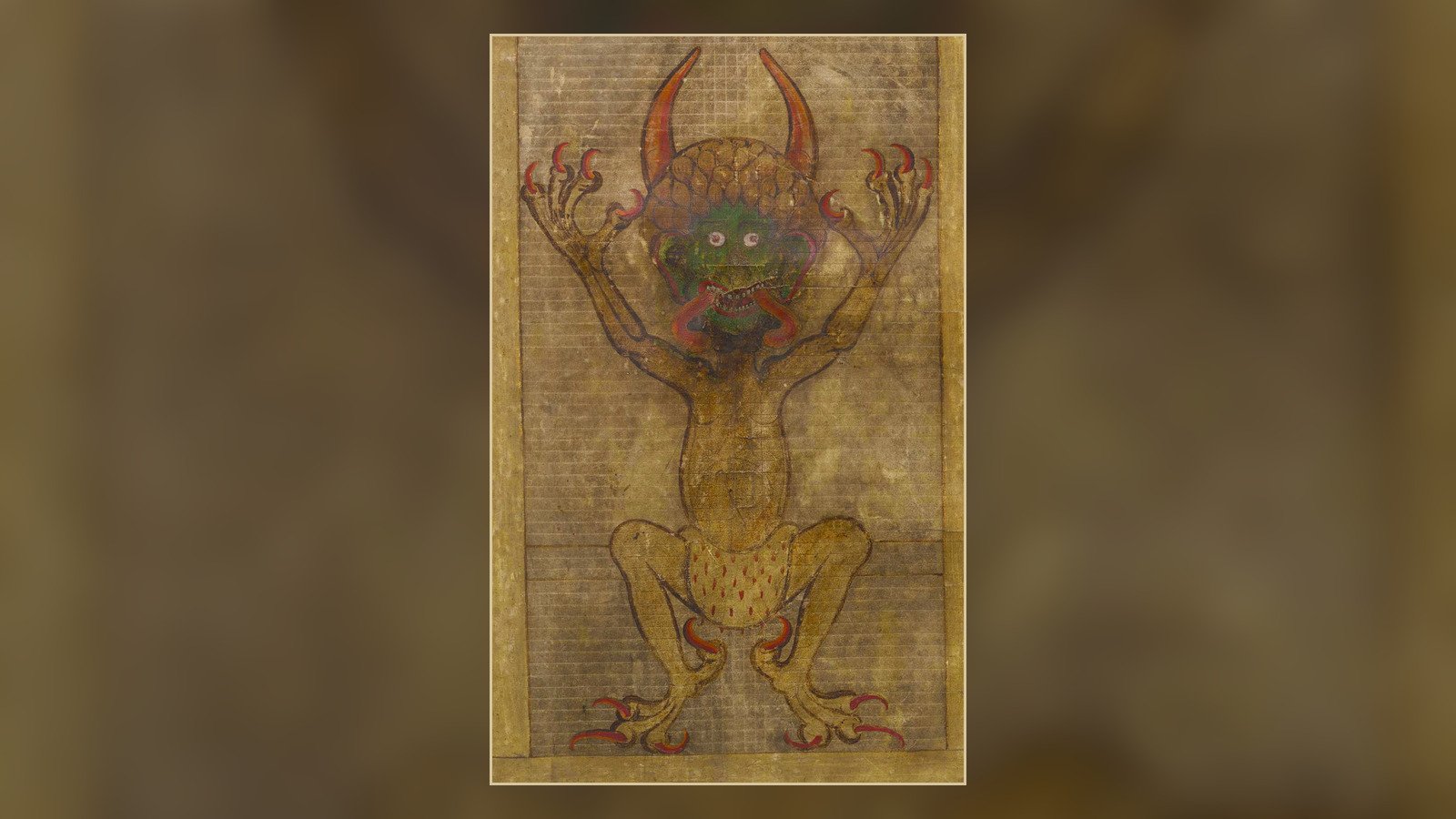
Two of the manuscript’s most famous pages face one another. One presents the Heavenly City in ordered towers and walls. The other gives almost the entire page to a solitary Devil, frontal, clawed and staring. The Devil is painted with horns, green face, red tongues and an ermine-like loin covering. The figure is isolated rather than embedded in a narrative scene. The result is a body of evidence that must be read through manuscripts, catalogues and the material history of the object rather than through later legend alone.
The surviving record places this material within a precise historical world. Full-page standalone demonic portraits are highly unusual in surviving medieval books.. Every copied name, altered diagram, ownership mark or change of sequence records a decision made by a reader who believed the text deserved preservation. Those decisions are often as revealing as the stated operation itself.
The facing images create an architecture of opposition. The reader encounters not a battle but two realms: the ordered city of salvation and the creature who inhabits the opposite page as if confined within the manuscript itself. In the culture that produced it, sacred language, natural philosophy, astrology, law and ritual were not always separated by the boundaries used today. The manuscript therefore speaks from a world in which knowledge could be devotional, technical and forbidden at the same time.
Read closely, this section also explains why the subject continued to generate fear. Its authority does not depend upon a modern claim that every operation worked exactly as promised. It rests on the historical fact that scribes, collectors, judges or practitioners treated the words as consequential—important enough to copy, hide, condemn, transport or preserve across generations.
Conjurations, Healing and the Dangerous Margin
Immediately after the famous images come texts of conjuration and protection. These are not an independent demon-summoning grimoire, yet their presence helped later readers imagine the codex as a forbidden book. The formulas include adjurations against illnesses and sudden afflictions. Sacred names and commanded powers appear in language shared with medieval healing and exorcistic traditions. The result is a body of evidence that must be read through manuscripts, catalogues and the material history of the object rather than through later legend alone.
The manuscript becomes clearer when its physical details are read beside its claims. Medical recipes and penitential material surround the supernatural texts.. Every copied name, altered diagram, ownership mark or change of sequence records a decision made by a reader who believed the text deserved preservation. Those decisions are often as revealing as the stated operation itself.
The codex therefore preserves a medieval boundary that modern categories often erase. Prayer, medicine, exorcism and learned compilation could meet on the same parchment without appearing contradictory to the person who copied them. In the culture that produced it, sacred language, natural philosophy, astrology, law and ritual were not always separated by the boundaries used today. The manuscript therefore speaks from a world in which knowledge could be devotional, technical and forbidden at the same time.
Read closely, this section also explains why the subject continued to generate fear. Its authority does not depend upon a modern claim that every operation worked exactly as promised. It rests on the historical fact that scribes, collectors, judges or practitioners treated the words as consequential—important enough to copy, hide, condemn, transport or preserve across generations.
Rudolf II, Prague and the Swedish Army
By the late sixteenth century the manuscript had entered the orbit of Emperor Rudolf II, whose Prague court became famous for astronomy, alchemy, collecting and the search for hidden knowledge. The codex was moved to Prague in 1594. When Swedish forces took the city in 1648, it was carried away as war booty with other imperial treasures. The result is a body of evidence that must be read through manuscripts, catalogues and the material history of the object rather than through later legend alone.
What appears at first to be a single mystery is actually a chain of copying, use and reinterpretation. It has remained in Sweden ever since.. Every copied name, altered diagram, ownership mark or change of sequence records a decision made by a reader who believed the text deserved preservation. Those decisions are often as revealing as the stated operation itself.
The manuscript’s journey transformed it from monastic compendium into royal trophy. Each transfer added another layer to its legend: monastery, imperial cabinet, military seizure and national treasure. In the culture that produced it, sacred language, natural philosophy, astrology, law and ritual were not always separated by the boundaries used today. The manuscript therefore speaks from a world in which knowledge could be devotional, technical and forbidden at the same time.
Read closely, this section also explains why the subject continued to generate fear. Its authority does not depend upon a modern claim that every operation worked exactly as promised. It rests on the historical fact that scribes, collectors, judges or practitioners treated the words as consequential—important enough to copy, hide, condemn, transport or preserve across generations.
The Monk Who Bargained with the Devil
The best-known legend claims that a monk, condemned to be immured alive, promised to create the greatest book in a single night. When the task proved impossible, he summoned the Devil and offered his soul in exchange for completion. The tale is not supported by the manuscript’s production evidence. Its earliest precise form is later than the codex itself. The result is a body of evidence that must be read through manuscripts, catalogues and the material history of the object rather than through later legend alone.
The archive preserves both the ambition of the text and the limitations of what can now be known. The Devil portrait became the visual proof around which the story crystallized.. Every copied name, altered diagram, ownership mark or change of sequence records a decision made by a reader who believed the text deserved preservation. Those decisions are often as revealing as the stated operation itself.
Historical accuracy does not diminish the legend’s power. The narrative translates the real impossibility of the manuscript into supernatural terms: a lifetime of disciplined labour is compressed into one forbidden night. In the culture that produced it, sacred language, natural philosophy, astrology, law and ritual were not always separated by the boundaries used today. The manuscript therefore speaks from a world in which knowledge could be devotional, technical and forbidden at the same time.
Read closely, this section also explains why the subject continued to generate fear. Its authority does not depend upon a modern claim that every operation worked exactly as promised. It rests on the historical fact that scribes, collectors, judges or practitioners treated the words as consequential—important enough to copy, hide, condemn, transport or preserve across generations.
The Book in the Modern Archive
The Codex Gigas is now held by the National Library of Sweden, where conservation and digitisation have made its pages accessible without subjecting the original to constant handling. The manuscript returned temporarily to Prague for exhibition in 2007–2008. High-resolution digital access permits comparison of script, decoration and contents. The result is a body of evidence that must be read through manuscripts, catalogues and the material history of the object rather than through later legend alone.
The surviving record places this material within a precise historical world. Its scale remains difficult to grasp on a screen.. Every copied name, altered diagram, ownership mark or change of sequence records a decision made by a reader who believed the text deserved preservation. Those decisions are often as revealing as the stated operation itself.
The digital codex reveals everything and conceals the most important fact: the pressure of the object itself. Its pages can be enlarged, but the bodily encounter with a book weighing as much as a person cannot be reproduced. In the culture that produced it, sacred language, natural philosophy, astrology, law and ritual were not always separated by the boundaries used today. The manuscript therefore speaks from a world in which knowledge could be devotional, technical and forbidden at the same time.
Read closely, this section also explains why the subject continued to generate fear. Its authority does not depend upon a modern claim that every operation worked exactly as promised. It rests on the historical fact that scribes, collectors, judges or practitioners treated the words as consequential—important enough to copy, hide, condemn, transport or preserve across generations.
The Manuscript as Witness
The enduring importance of Codex Gigas lies in the convergence of text and object. A title alone cannot show how the work changed: one must examine handwriting, parchment or paper, pigments, bindings, ownership notes, omissions and the order in which separate texts were placed together. These details reveal whether a copy was made for use, collection, instruction, defence or concealment. They also show why modern printed editions, however valuable, can create the illusion of a stable book where the historical record preserves a family of changing witnesses.
Institutional catalogues have become essential to this reconstruction. Shelf marks that appear dry or technical are the coordinates of survival. They identify the exact volume, distinguish one recension from another and prevent famous titles from absorbing unrelated material. For SatanWorld, those catalogue identities are treated as part of the story: the route from private hand to royal cabinet, confiscated collection, antiquarian sale or national library explains how forbidden knowledge crossed the centuries.
The visual record is equally important. A circle, initial, seal, table or miniature cannot be replaced by a verbal summary without loss. Images determine the pace of reading and often carry information that the words do not explain. For that reason, this article presents historical images with their holding institution and reuse status, while original editorial diagrams are clearly identified as modern explanatory work rather than manuscript facsimiles.
What the Darkness Preserved
Codex Gigas and the Legend of the Devil’s Bible belongs to forbidden history because the work survived a repeated conflict over who could possess knowledge and by what authority. The danger attributed to it changed with time: demonic assistance, unauthorised revelation, unlawful prosecution, secret communication, intellectual pride or the fear that a diagram might make inaccessible power portable. Yet each generation that feared the material also helped define and preserve it.
The final mystery is therefore not only whether a spirit appeared, a talisman received celestial force or a prayer transformed memory. It is why human beings continued to copy these instructions when copying was slow, possession could be dangerous and many of the names were barely understood. The answer lies somewhere between faith, ambition and the refusal to accept that the visible world contains all available knowledge.