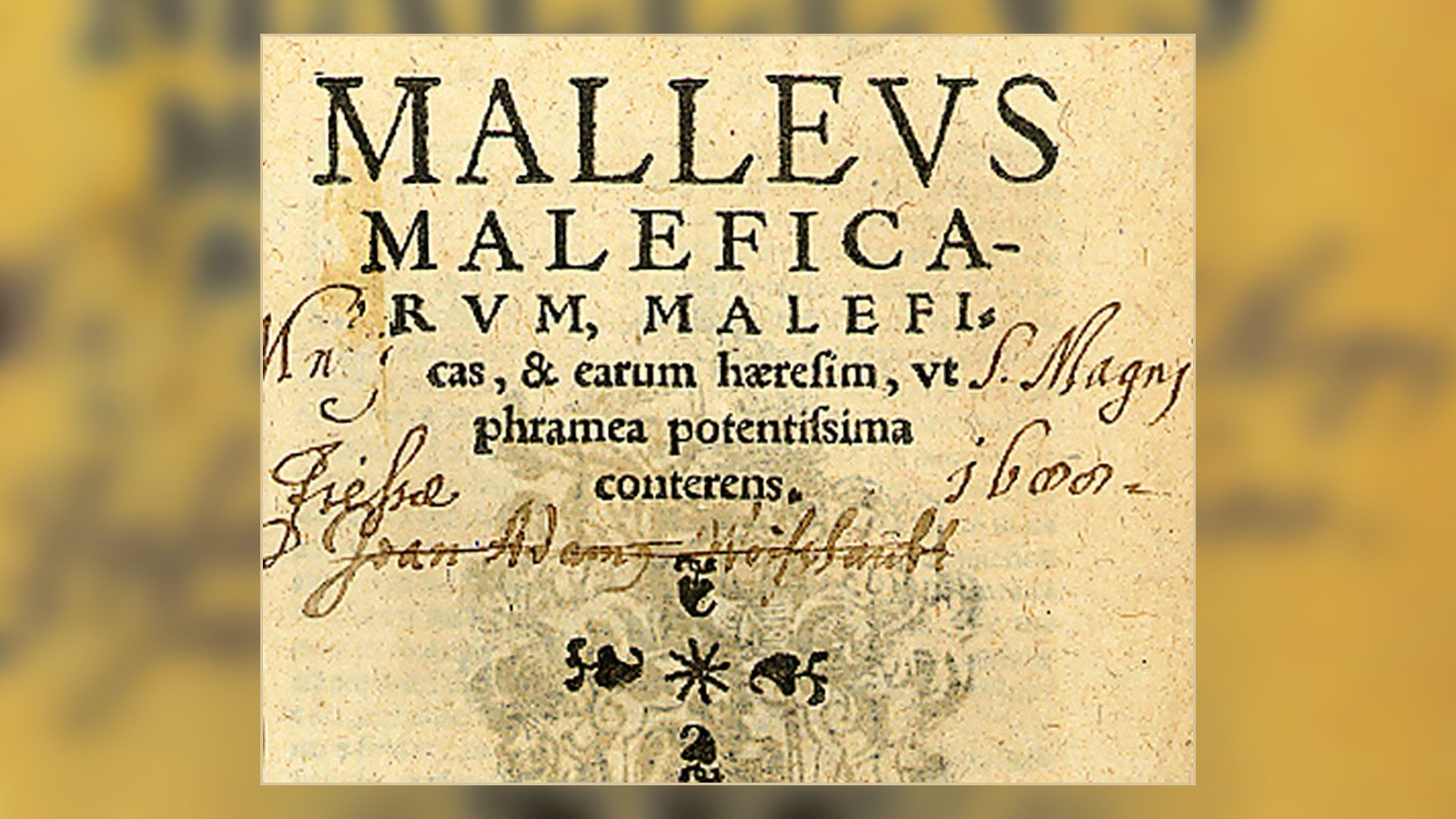
The most frightening pages of the Malleus Maleficarum contain few monsters. Its darkness lies in procedure. Questions are arranged, suspicions become categories, and the body of an accused person is converted into evidence. Printed at the end of the fifteenth century, the Hammer of Witches offered readers not merely a theory of witchcraft but a method for pursuing it.
Heinrich Kramer Before the Hammer
Heinrich Kramer, known in Latin as Henricus Institoris, was a Dominican inquisitor whose campaigns against alleged witchcraft met resistance as well as support. His failure at Innsbruck in 1485 formed an immediate background to the book. Local authorities and Bishop Georg Golser challenged Kramer’s conduct. The prosecution of Helena Scheuberin collapsed. The result is a body of evidence that must be read through manuscripts, catalogues and the material history of the object rather than through later legend alone.
The surviving record places this material within a precise historical world. Kramer left the region carrying anger at judges and clerics who rejected his methods.. Every copied name, altered diagram, ownership mark or change of sequence records a decision made by a reader who believed the text deserved preservation. Those decisions are often as revealing as the stated operation itself.
The Malleus can be read as an attempt to defeat that resistance in print. It constructs a world in which doubt about witchcraft becomes dangerous negligence and procedural restraint can appear as complicity. In the culture that produced it, sacred language, natural philosophy, astrology, law and ritual were not always separated by the boundaries used today. The manuscript therefore speaks from a world in which knowledge could be devotional, technical and forbidden at the same time.
Read closely, this section also explains why the subject continued to generate fear. Its authority does not depend upon a modern claim that every operation worked exactly as promised. It rests on the historical fact that scribes, collectors, judges or practitioners treated the words as consequential—important enough to copy, hide, condemn, transport or preserve across generations.
Publication and the Authority of Print
The work appeared in 1486 or 1487, during the first generations of European print. Repeated editions gave a controversial inquisitor’s arguments a reach impossible for a manuscript circulating in one region. Early editions were produced in German printing centres. The text was frequently bound with Pope Innocent VIII’s bull Summis desiderantes affectibus. The result is a body of evidence that must be read through manuscripts, catalogues and the material history of the object rather than through later legend alone.
The manuscript becomes clearer when its physical details are read beside its claims. A supposed approval by the University of Cologne has long been disputed.. Every copied name, altered diagram, ownership mark or change of sequence records a decision made by a reader who believed the text deserved preservation. Those decisions are often as revealing as the stated operation itself.
The physical arrangement mattered. By placing papal and academic-looking authority around the treatise, printers helped create the impression that the book represented a settled institutional position even when its status was more complicated. In the culture that produced it, sacred language, natural philosophy, astrology, law and ritual were not always separated by the boundaries used today. The manuscript therefore speaks from a world in which knowledge could be devotional, technical and forbidden at the same time.
Read closely, this section also explains why the subject continued to generate fear. Its authority does not depend upon a modern claim that every operation worked exactly as promised. It rests on the historical fact that scribes, collectors, judges or practitioners treated the words as consequential—important enough to copy, hide, condemn, transport or preserve across generations.
The Three-Part Machine
The Malleus is organised into three broad parts: the reality and theology of witchcraft, the forms of alleged harm and resistance, and the procedures by which cases should be investigated and judged. Questions and answers give the work scholastic rhythm. Biblical and patristic authorities are marshalled beside legal claims. The result is a body of evidence that must be read through manuscripts, catalogues and the material history of the object rather than through later legend alone.
What appears at first to be a single mystery is actually a chain of copying, use and reinterpretation. Examples of maleficium turn abstract demonology into concrete accusation.. Every copied name, altered diagram, ownership mark or change of sequence records a decision made by a reader who believed the text deserved preservation. Those decisions are often as revealing as the stated operation itself.
This architecture converts fear into workflow. The reader moves from belief, to recognition, to prosecution—the exact sequence by which an invisible crime can become a sentence. In the culture that produced it, sacred language, natural philosophy, astrology, law and ritual were not always separated by the boundaries used today. The manuscript therefore speaks from a world in which knowledge could be devotional, technical and forbidden at the same time.
Read closely, this section also explains why the subject continued to generate fear. Its authority does not depend upon a modern claim that every operation worked exactly as promised. It rests on the historical fact that scribes, collectors, judges or practitioners treated the words as consequential—important enough to copy, hide, condemn, transport or preserve across generations.
The Pact, the Demon and the Body
For Kramer, witchcraft depended upon a pact with demons. The alleged witch did not possess autonomous supernatural power; she entered a relationship in which the Devil enabled harmful acts while claiming spiritual allegiance. The book discusses storms, illness, impotence, reproductive harm and attacks on livestock. Demons are said to manipulate perception and matter within limits permitted by God. The result is a body of evidence that must be read through manuscripts, catalogues and the material history of the object rather than through later legend alone.
The archive preserves both the ambition of the text and the limitations of what can now be known. Sacrilege and apostasy sit beneath the physical accusations.. Every copied name, altered diagram, ownership mark or change of sequence records a decision made by a reader who believed the text deserved preservation. Those decisions are often as revealing as the stated operation itself.
The result is a total explanatory system. Misfortune can be traced to malice, malice to a witch, and the witch to an infernal pact invisible to ordinary witnesses. In the culture that produced it, sacred language, natural philosophy, astrology, law and ritual were not always separated by the boundaries used today. The manuscript therefore speaks from a world in which knowledge could be devotional, technical and forbidden at the same time.
Read closely, this section also explains why the subject continued to generate fear. Its authority does not depend upon a modern claim that every operation worked exactly as promised. It rests on the historical fact that scribes, collectors, judges or practitioners treated the words as consequential—important enough to copy, hide, condemn, transport or preserve across generations.
Women Under the Hammer
The Malleus is notorious for its gendered hostility. It repeatedly presents women as more susceptible to deception, appetite, revenge and demonic influence, even though witchcraft prosecutions varied greatly by region and sex. Kramer used etymology, Scripture, classical authorities and misogynistic commonplaces. Sexual and reproductive themes recur throughout the text. The result is a body of evidence that must be read through manuscripts, catalogues and the material history of the object rather than through later legend alone.
The surviving record places this material within a precise historical world. Female speech and conflict could be read as signs of spiritual danger.. Every copied name, altered diagram, ownership mark or change of sequence records a decision made by a reader who believed the text deserved preservation. Those decisions are often as revealing as the stated operation itself.
The book did not invent European misogyny, but it concentrated old prejudices into a prosecutorial language. A woman’s vulnerability within household and community could be transformed into evidence against her. In the culture that produced it, sacred language, natural philosophy, astrology, law and ritual were not always separated by the boundaries used today. The manuscript therefore speaks from a world in which knowledge could be devotional, technical and forbidden at the same time.
Read closely, this section also explains why the subject continued to generate fear. Its authority does not depend upon a modern claim that every operation worked exactly as promised. It rests on the historical fact that scribes, collectors, judges or practitioners treated the words as consequential—important enough to copy, hide, condemn, transport or preserve across generations.
How Suspicion Became Evidence
The third part discusses denunciation, witness testimony, arrest, questioning, imprisonment and the use of torture under legal conditions. It also addresses the difficulties created by an alleged crime that was secret by definition. Anonymous or hostile testimony could enter proceedings. Reputation and prior suspicion mattered. The result is a body of evidence that must be read through manuscripts, catalogues and the material history of the object rather than through later legend alone.
The manuscript becomes clearer when its physical details are read beside its claims. Judges were instructed in strategies for eliciting confession and managing recantation.. Every copied name, altered diagram, ownership mark or change of sequence records a decision made by a reader who believed the text deserved preservation. Those decisions are often as revealing as the stated operation itself.
The machinery is most disturbing when it appears reasonable within its own assumptions. Once witchcraft is accepted as hidden conspiracy, ordinary protections can be redefined as obstacles placed by the Devil. In the culture that produced it, sacred language, natural philosophy, astrology, law and ritual were not always separated by the boundaries used today. The manuscript therefore speaks from a world in which knowledge could be devotional, technical and forbidden at the same time.
Read closely, this section also explains why the subject continued to generate fear. Its authority does not depend upon a modern claim that every operation worked exactly as promised. It rests on the historical fact that scribes, collectors, judges or practitioners treated the words as consequential—important enough to copy, hide, condemn, transport or preserve across generations.
The Devil’s Mark of Procedure
The Malleus belongs to learned demonology, but its influence depended on local law, political authority and judicial practice. It was never a universal code imposed identically across Europe. Some courts ignored it. Other demonologists disagreed with Kramer. The result is a body of evidence that must be read through manuscripts, catalogues and the material history of the object rather than through later legend alone.
What appears at first to be a single mystery is actually a chain of copying, use and reinterpretation. Major witch-hunt regions developed their own statutes, handbooks and evidentiary customs.. Every copied name, altered diagram, ownership mark or change of sequence records a decision made by a reader who believed the text deserved preservation. Those decisions are often as revealing as the stated operation itself.
Accuracy requires resisting two myths at once: that the book single-handedly caused every witch hunt, and that it was merely an obscure curiosity. Its real power lay in giving educated readers a portable, printed model of persecution. In the culture that produced it, sacred language, natural philosophy, astrology, law and ritual were not always separated by the boundaries used today. The manuscript therefore speaks from a world in which knowledge could be devotional, technical and forbidden at the same time.
Read closely, this section also explains why the subject continued to generate fear. Its authority does not depend upon a modern claim that every operation worked exactly as promised. It rests on the historical fact that scribes, collectors, judges or practitioners treated the words as consequential—important enough to copy, hide, condemn, transport or preserve across generations.
Editions, Readers and the Long Afterlife
The text passed through numerous editions into the seventeenth century. Its continued printing kept late-medieval arguments available during the period when large witch prosecutions intensified in parts of Europe. Collectors annotated copies. Later translations made the work accessible to modern audiences. The result is a body of evidence that must be read through manuscripts, catalogues and the material history of the object rather than through later legend alone.
The archive preserves both the ambition of the text and the limitations of what can now be known. The 1928 English translation by Montague Summers shaped popular understanding while newer scholarship corrected many of its choices.. Every copied name, altered diagram, ownership mark or change of sequence records a decision made by a reader who believed the text deserved preservation. Those decisions are often as revealing as the stated operation itself.
Every new edition changes the book’s audience. A manual once used within demonological argument became evidence in the history of law, gender, violence and institutional fear. In the culture that produced it, sacred language, natural philosophy, astrology, law and ritual were not always separated by the boundaries used today. The manuscript therefore speaks from a world in which knowledge could be devotional, technical and forbidden at the same time.
Read closely, this section also explains why the subject continued to generate fear. Its authority does not depend upon a modern claim that every operation worked exactly as promised. It rests on the historical fact that scribes, collectors, judges or practitioners treated the words as consequential—important enough to copy, hide, condemn, transport or preserve across generations.
The Archive of a Persecuting Imagination
Surviving copies now sit in libraries as material witnesses. Marginal notes, bindings, ownership marks and edition differences reveal how the work moved through clerical, legal and private collections. The Library of Congress holds early illustrated editions. Bibliographical research tracks printers and variants. The result is a body of evidence that must be read through manuscripts, catalogues and the material history of the object rather than through later legend alone.
The surviving record places this material within a precise historical world. Digital facsimiles allow comparison without flattening the text into a single modern translation.. Every copied name, altered diagram, ownership mark or change of sequence records a decision made by a reader who believed the text deserved preservation. Those decisions are often as revealing as the stated operation itself.
The Malleus remains forbidden history not because it contains a secret spell, but because it shows how intellectual authority can be organised around an accusation until cruelty acquires the appearance of method. In the culture that produced it, sacred language, natural philosophy, astrology, law and ritual were not always separated by the boundaries used today. The manuscript therefore speaks from a world in which knowledge could be devotional, technical and forbidden at the same time.
Read closely, this section also explains why the subject continued to generate fear. Its authority does not depend upon a modern claim that every operation worked exactly as promised. It rests on the historical fact that scribes, collectors, judges or practitioners treated the words as consequential—important enough to copy, hide, condemn, transport or preserve across generations.
The Manuscript as Witness
The enduring importance of Malleus Maleficarum lies in the convergence of text and object. A title alone cannot show how the work changed: one must examine handwriting, parchment or paper, pigments, bindings, ownership notes, omissions and the order in which separate texts were placed together. These details reveal whether a copy was made for use, collection, instruction, defence or concealment. They also show why modern printed editions, however valuable, can create the illusion of a stable book where the historical record preserves a family of changing witnesses.
Institutional catalogues have become essential to this reconstruction. Shelf marks that appear dry or technical are the coordinates of survival. They identify the exact volume, distinguish one recension from another and prevent famous titles from absorbing unrelated material. For SatanWorld, those catalogue identities are treated as part of the story: the route from private hand to royal cabinet, confiscated collection, antiquarian sale or national library explains how forbidden knowledge crossed the centuries.
The visual record is equally important. A circle, initial, seal, table or miniature cannot be replaced by a verbal summary without loss. Images determine the pace of reading and often carry information that the words do not explain. For that reason, this article presents historical images with their holding institution and reuse status, while original editorial diagrams are clearly identified as modern explanatory work rather than manuscript facsimiles.
What the Darkness Preserved
Malleus Maleficarum and the Machinery of the Witch Hunts belongs to forbidden history because the work survived a repeated conflict over who could possess knowledge and by what authority. The danger attributed to it changed with time: demonic assistance, unauthorised revelation, unlawful prosecution, secret communication, intellectual pride or the fear that a diagram might make inaccessible power portable. Yet each generation that feared the material also helped define and preserve it.
The final mystery is therefore not only whether a spirit appeared, a talisman received celestial force or a prayer transformed memory. It is why human beings continued to copy these instructions when copying was slow, possession could be dangerous and many of the names were barely understood. The answer lies somewhere between faith, ambition and the refusal to accept that the visible world contains all available knowledge.