A reader opening Steganographia encounters angels, planetary rulers, mysterious names and long conjurations. The text appears to teach communication through spirits who carry words across impossible distances. Yet beneath the invocations lies another system: messages hidden in plain sight, protected by the expectation that only an occult book would look so strange.
Johannes Trithemius
Johannes Trithemius was a Benedictine abbot, historian, bibliographer and scholar whose reputation moved uneasily between learned piety and accusations of magic. Born in 1462, he became abbot of Sponheim. He built a remarkable library. The result is a body of evidence that must be read through manuscripts, catalogues and the material history of the object rather than through later legend alone.
The surviving record places this material within a precise historical world. His works addressed monastic reform, history, ciphers and occult philosophy.. Every copied name, altered diagram, ownership mark or change of sequence records a decision made by a reader who believed the text deserved preservation. Those decisions are often as revealing as the stated operation itself.
Trithemius inhabited the exact threshold on which Steganographia depends: a churchman whose command of hidden writing could be read as evidence of forbidden art. In the culture that produced it, sacred language, natural philosophy, astrology, law and ritual were not always separated by the boundaries used today. The manuscript therefore speaks from a world in which knowledge could be devotional, technical and forbidden at the same time.
Read closely, this section also explains why the subject continued to generate fear. Its authority does not depend upon a modern claim that every operation worked exactly as promised. It rests on the historical fact that scribes, collectors, judges or practitioners treated the words as consequential—important enough to copy, hide, condemn, transport or preserve across generations.
A Work Circulating Before Print
Steganographia was composed around the turn of the sixteenth century and circulated in manuscript long before its first printed edition. Its secrecy was intensified by restricted copying and rumour. Trithemius discussed the work in correspondence. Manuscripts passed among learned readers. The result is a body of evidence that must be read through manuscripts, catalogues and the material history of the object rather than through later legend alone.
The manuscript becomes clearer when its physical details are read beside its claims. Incomplete understanding encouraged charges of necromancy.. Every copied name, altered diagram, ownership mark or change of sequence records a decision made by a reader who believed the text deserved preservation. Those decisions are often as revealing as the stated operation itself.
A hidden book about hidden writing became self-protecting. Every delay in publication made its angelic language appear more dangerous. In the culture that produced it, sacred language, natural philosophy, astrology, law and ritual were not always separated by the boundaries used today. The manuscript therefore speaks from a world in which knowledge could be devotional, technical and forbidden at the same time.
Read closely, this section also explains why the subject continued to generate fear. Its authority does not depend upon a modern claim that every operation worked exactly as promised. It rests on the historical fact that scribes, collectors, judges or practitioners treated the words as consequential—important enough to copy, hide, condemn, transport or preserve across generations.
The First Two Books
Books I and II describe systems for transmitting secret messages through apparent invocations to named spirits. The surface text can be read as ritual, while procedural rules reveal concealed information. Messages may be embedded through letter patterns and acrostic mechanisms. Spirit names organise chapters. The result is a body of evidence that must be read through manuscripts, catalogues and the material history of the object rather than through later legend alone.
What appears at first to be a single mystery is actually a chain of copying, use and reinterpretation. The apparent conjuration distracts the uninitiated reader.. Every copied name, altered diagram, ownership mark or change of sequence records a decision made by a reader who believed the text deserved preservation. Those decisions are often as revealing as the stated operation itself.
The method exploits expectation. A censor who sees nonsense or magic may fail to notice a disciplined system of communication. In the culture that produced it, sacred language, natural philosophy, astrology, law and ritual were not always separated by the boundaries used today. The manuscript therefore speaks from a world in which knowledge could be devotional, technical and forbidden at the same time.
Read closely, this section also explains why the subject continued to generate fear. Its authority does not depend upon a modern claim that every operation worked exactly as promised. It rests on the historical fact that scribes, collectors, judges or practitioners treated the words as consequential—important enough to copy, hide, condemn, transport or preserve across generations.
The Third Book
Book III is denser and long resisted explanation. It associates intelligence with planetary spirits and elaborate tables, preserving a stronger appearance of occult operation. The text names celestial rulers. Numerical and alphabetic structures govern transformation. The result is a body of evidence that must be read through manuscripts, catalogues and the material history of the object rather than through later legend alone.
The archive preserves both the ambition of the text and the limitations of what can now be known. Later researchers demonstrated cryptographic organisation where earlier readers saw only magic.. Every copied name, altered diagram, ownership mark or change of sequence records a decision made by a reader who believed the text deserved preservation. Those decisions are often as revealing as the stated operation itself.
The third book became the manuscript’s deepest chamber. Its resistance kept the supernatural interpretation alive even after simpler ciphers were recognised. In the culture that produced it, sacred language, natural philosophy, astrology, law and ritual were not always separated by the boundaries used today. The manuscript therefore speaks from a world in which knowledge could be devotional, technical and forbidden at the same time.
Read closely, this section also explains why the subject continued to generate fear. Its authority does not depend upon a modern claim that every operation worked exactly as promised. It rests on the historical fact that scribes, collectors, judges or practitioners treated the words as consequential—important enough to copy, hide, condemn, transport or preserve across generations.
Angels as Cryptographic Architecture
The spirit hierarchies are not accidental decoration. They provide memorable labels, ordering systems and cover language for techniques of concealment. Names divide methods. Invocations create plausible occult prose. The result is a body of evidence that must be read through manuscripts, catalogues and the material history of the object rather than through later legend alone.
The surviving record places this material within a precise historical world. Planetary structures supply sequence and hierarchy.. Every copied name, altered diagram, ownership mark or change of sequence records a decision made by a reader who believed the text deserved preservation. Those decisions are often as revealing as the stated operation itself.
Steganographia shows that cryptography can hide not only a message but the fact that a message exists. The angel is both mask and mechanism. In the culture that produced it, sacred language, natural philosophy, astrology, law and ritual were not always separated by the boundaries used today. The manuscript therefore speaks from a world in which knowledge could be devotional, technical and forbidden at the same time.
Read closely, this section also explains why the subject continued to generate fear. Its authority does not depend upon a modern claim that every operation worked exactly as promised. It rests on the historical fact that scribes, collectors, judges or practitioners treated the words as consequential—important enough to copy, hide, condemn, transport or preserve across generations.
The 1606 Printed Edition
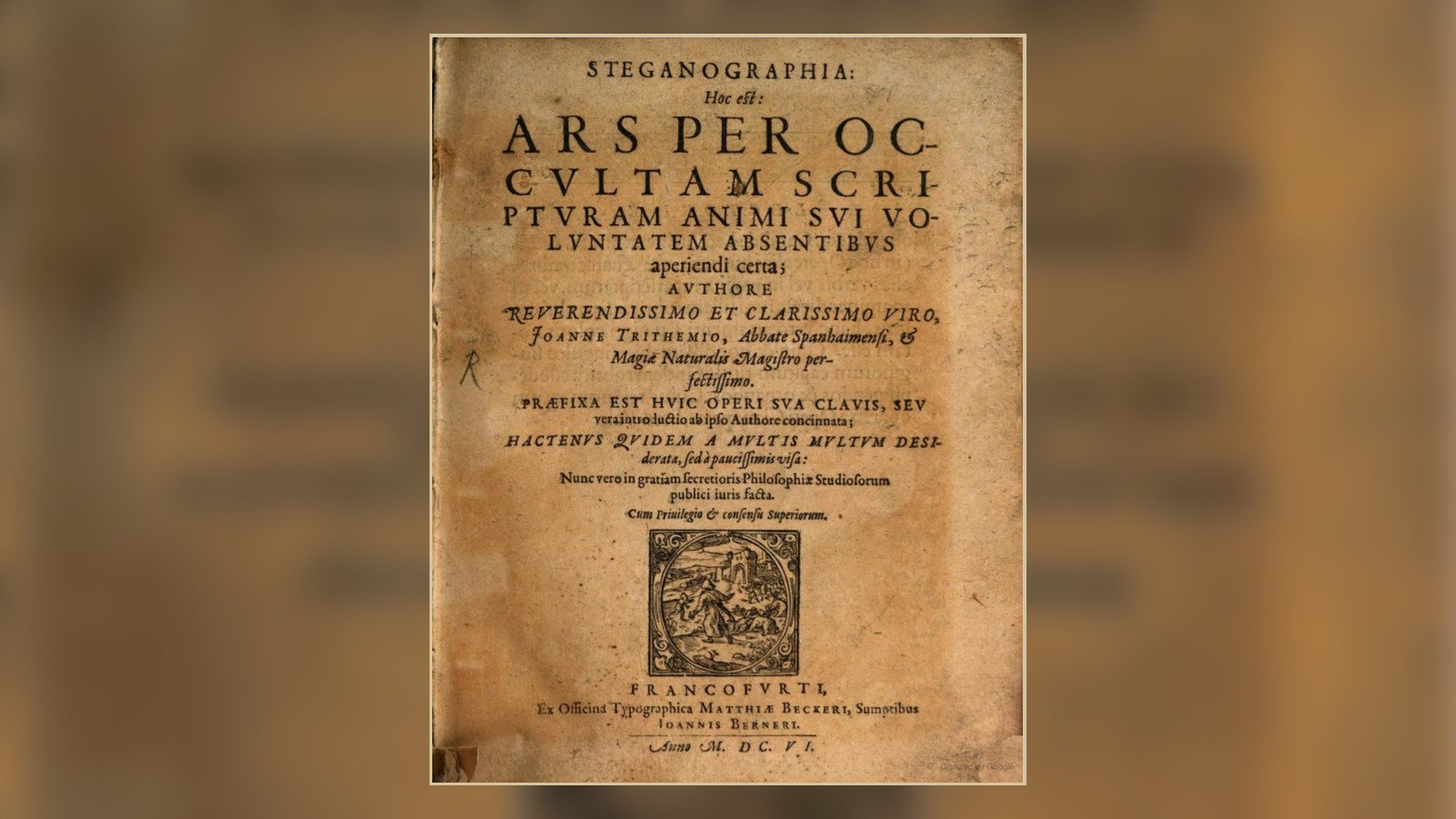
The first printed edition appeared in Frankfurt in 1606, decades after Trithemius’s death. Print exposed the work to a wider audience and to institutional judgement. The edition contains three books, a general key and a steganographic key. Printers fixed a text previously circulating in variants. The result is a body of evidence that must be read through manuscripts, catalogues and the material history of the object rather than through later legend alone.
The manuscript becomes clearer when its physical details are read beside its claims. Readers could now compare methods more systematically.. Every copied name, altered diagram, ownership mark or change of sequence records a decision made by a reader who believed the text deserved preservation. Those decisions are often as revealing as the stated operation itself.
Publication ended one secrecy and began another. The physical book was available, but its meaning remained divided between magical and cryptographic readers. In the culture that produced it, sacred language, natural philosophy, astrology, law and ritual were not always separated by the boundaries used today. The manuscript therefore speaks from a world in which knowledge could be devotional, technical and forbidden at the same time.
Read closely, this section also explains why the subject continued to generate fear. Its authority does not depend upon a modern claim that every operation worked exactly as promised. It rests on the historical fact that scribes, collectors, judges or practitioners treated the words as consequential—important enough to copy, hide, condemn, transport or preserve across generations.
Placed on the Index
Steganographia was placed on the Index of Forbidden Books in 1609. Its apparent spirit magic and uncertain purpose made it unacceptable within Catholic censorship. The ban followed the printed edition. Later Index treatment sometimes distinguished corrected or interpreted forms. The result is a body of evidence that must be read through manuscripts, catalogues and the material history of the object rather than through later legend alone.
What appears at first to be a single mystery is actually a chain of copying, use and reinterpretation. The work’s reputation as demonic magic persisted.. Every copied name, altered diagram, ownership mark or change of sequence records a decision made by a reader who believed the text deserved preservation. Those decisions are often as revealing as the stated operation itself.
Censorship confirmed the aura the cipher required. A prohibited book of hidden communication became more powerful as an object of forbidden knowledge. In the culture that produced it, sacred language, natural philosophy, astrology, law and ritual were not always separated by the boundaries used today. The manuscript therefore speaks from a world in which knowledge could be devotional, technical and forbidden at the same time.
Read closely, this section also explains why the subject continued to generate fear. Its authority does not depend upon a modern claim that every operation worked exactly as promised. It rests on the historical fact that scribes, collectors, judges or practitioners treated the words as consequential—important enough to copy, hide, condemn, transport or preserve across generations.
Keys, Decipherments and Debate
Scholars gradually demonstrated the cryptographic nature of major portions of the work. In the twentieth and late twentieth centuries, further solutions clarified Book III. Early readers identified acrostic and substitution methods. Modern cryptanalysts reconstructed numerical procedures. The result is a body of evidence that must be read through manuscripts, catalogues and the material history of the object rather than through later legend alone.
The archive preserves both the ambition of the text and the limitations of what can now be known. Not every spiritual or theoretical passage is reducible to a simple cipher.. Every copied name, altered diagram, ownership mark or change of sequence records a decision made by a reader who believed the text deserved preservation. Those decisions are often as revealing as the stated operation itself.
The false choice between magic and cryptography obscures Trithemius’s world. Hidden writing, spiritual hierarchy and universal knowledge could belong to one intellectual project. In the culture that produced it, sacred language, natural philosophy, astrology, law and ritual were not always separated by the boundaries used today. The manuscript therefore speaks from a world in which knowledge could be devotional, technical and forbidden at the same time.
Read closely, this section also explains why the subject continued to generate fear. Its authority does not depend upon a modern claim that every operation worked exactly as promised. It rests on the historical fact that scribes, collectors, judges or practitioners treated the words as consequential—important enough to copy, hide, condemn, transport or preserve across generations.
The Long Shadow of Concealed Communication
Steganographia influenced later cryptography and occult philosophy. Its title gave the modern field of steganography a name for hiding information within other media. John Dee and other Renaissance readers knew Trithemius’s reputation. Later cryptographic writers cited him. The result is a body of evidence that must be read through manuscripts, catalogues and the material history of the object rather than through later legend alone.
The surviving record places this material within a precise historical world. Digital security uses the term without the angels.. Every copied name, altered diagram, ownership mark or change of sequence records a decision made by a reader who believed the text deserved preservation. Those decisions are often as revealing as the stated operation itself.
The spirits have left the machine, but their architecture remains. Every concealed message inside an innocent image repeats the principle that made Trithemius’s book feared. In the culture that produced it, sacred language, natural philosophy, astrology, law and ritual were not always separated by the boundaries used today. The manuscript therefore speaks from a world in which knowledge could be devotional, technical and forbidden at the same time.
Read closely, this section also explains why the subject continued to generate fear. Its authority does not depend upon a modern claim that every operation worked exactly as promised. It rests on the historical fact that scribes, collectors, judges or practitioners treated the words as consequential—important enough to copy, hide, condemn, transport or preserve across generations.
The Manuscript as Witness
The enduring importance of Steganographia lies in the convergence of text and object. A title alone cannot show how the work changed: one must examine handwriting, parchment or paper, pigments, bindings, ownership notes, omissions and the order in which separate texts were placed together. These details reveal whether a copy was made for use, collection, instruction, defence or concealment. They also show why modern printed editions, however valuable, can create the illusion of a stable book where the historical record preserves a family of changing witnesses.
Institutional catalogues have become essential to this reconstruction. Shelf marks that appear dry or technical are the coordinates of survival. They identify the exact volume, distinguish one recension from another and prevent famous titles from absorbing unrelated material. For SatanWorld, those catalogue identities are treated as part of the story: the route from private hand to royal cabinet, confiscated collection, antiquarian sale or national library explains how forbidden knowledge crossed the centuries.
The visual record is equally important. A circle, initial, seal, table or miniature cannot be replaced by a verbal summary without loss. Images determine the pace of reading and often carry information that the words do not explain. For that reason, this article presents historical images with their holding institution and reuse status, while original editorial diagrams are clearly identified as modern explanatory work rather than manuscript facsimiles.
What the Darkness Preserved
Steganographia and the Censorship of Hidden Knowledge belongs to forbidden history because the work survived a repeated conflict over who could possess knowledge and by what authority. The danger attributed to it changed with time: demonic assistance, unauthorised revelation, unlawful prosecution, secret communication, intellectual pride or the fear that a diagram might make inaccessible power portable. Yet each generation that feared the material also helped define and preserve it.
The final mystery is therefore not only whether a spirit appeared, a talisman received celestial force or a prayer transformed memory. It is why human beings continued to copy these instructions when copying was slow, possession could be dangerous and many of the names were barely understood. The answer lies somewhere between faith, ambition and the refusal to accept that the visible world contains all available knowledge.