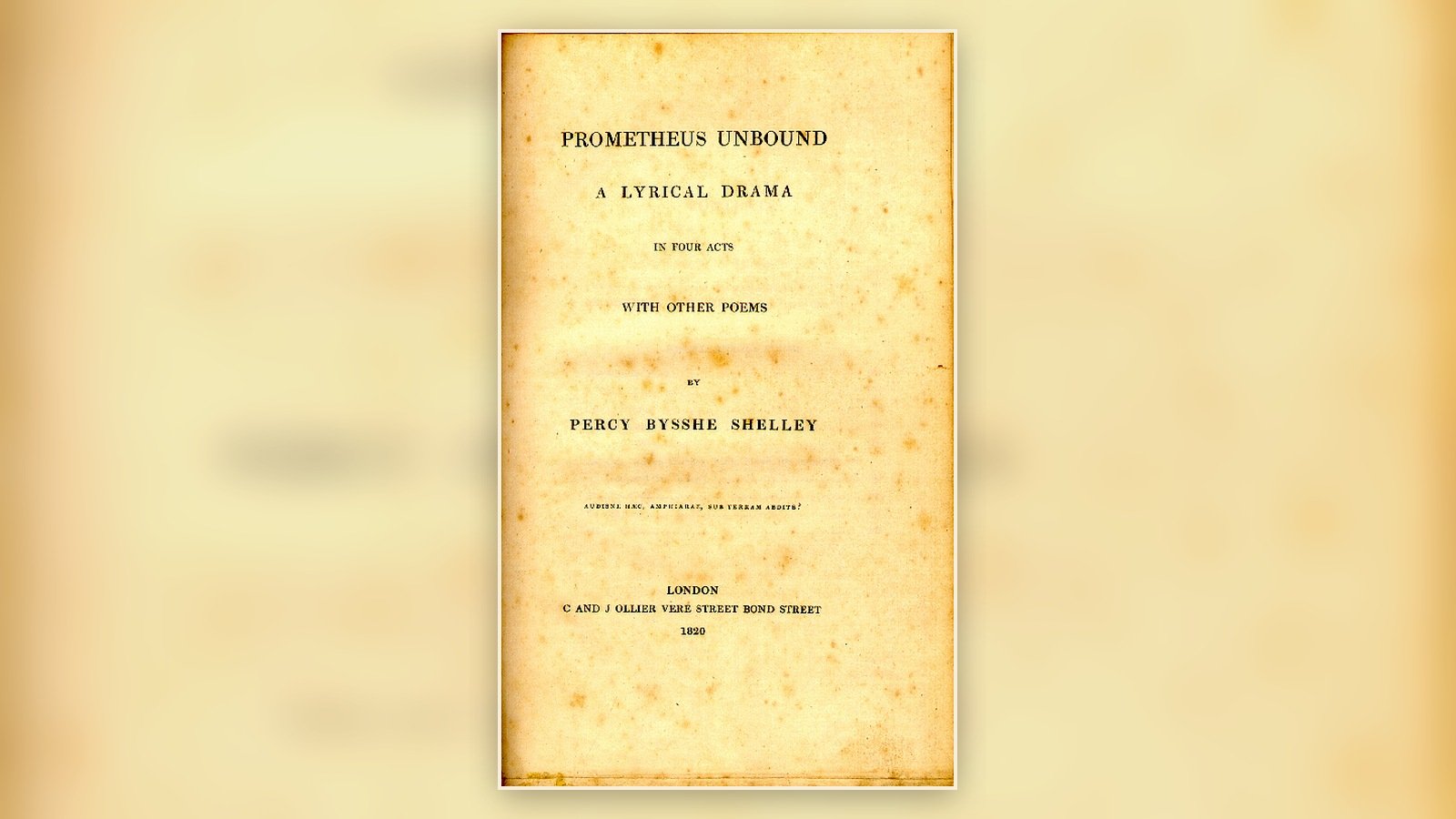
Prometheus hangs above a ravine in the Indian Caucasus, tortured by a ruler who demands submission and by a curse the prisoner himself once spoke. Shelley begins not at the moment of rebellion but after centuries of punishment. The Titan has every reason to hate Jupiter. Yet his first decisive act is to recall the curse so that he may hear it and then withdraw it. Prometheus will resist, but he will not remain inwardly governed by the tyrant. In that movement Shelley builds one of Romanticism’s most demanding philosophies of revolt: defiance without reconciliation, victory without revenge, and liberation that does not become a new throne.
The Historical and Philosophical Problem
Shelley’s Prometheus and the Ethics of Defiance belongs to Greek myth, post-revolutionary Europe, Shelley’s radical politics and Romantic theories of imagination. Its central problem is a reworking of Prometheus in which the champion of humanity refuses both submission and the emotional reproduction of tyranny. The article follows close reading of the 1820 lyrical drama, its preface, Aeschylean background and Shelley’s political context and keeps one contradiction in view: the poem celebrates uncompromising resistance while insisting that hatred can bind the rebel to the oppressor. The purpose is not to turn a literary or philosophical figure into an object of compulsory belief. It is to show how rebellion, knowledge and authority were argued through real texts and institutions.
The stakes concern whether a revolution can destroy domination without rebuilding it in another name. That question is larger than the original author or event because later readers inherited the symbol under different conditions. The history must therefore distinguish initial meaning, hostile accusation, sympathetic reception and modern appropriation while allowing them to illuminate one another.
From Aeschylus to Shelley
Shelley knew Aeschylus’s Prometheus Bound and rejected the traditional assumption that the surviving tragedy would have been completed by reconciliation between Prometheus and Zeus. In the preface to Prometheus Unbound he declared himself averse to a conclusion that reconciled the champion with the oppressor of humanity. His sequel therefore changes the myth’s moral architecture. The Titan does not bargain for release, and Jupiter does not become just. The tyrant falls because the conditions sustaining tyranny are transformed, not because victim and ruler discover a comfortable compromise.
The most common distortion is reducing the poem either to abstract optimism or to a simple prophecy of political revolution. That simplification removes the ethical pressure from the subject by making judgment automatic. The original work is stronger because it allows attraction and danger to occupy the same scene, forcing the reader to decide without the protection of a slogan.
Composition in Italy
Shelley wrote the first act at Este in 1818 and completed the later acts in Rome and Florence during 1819. The poem appeared in 1820 with major lyrics including Ode to the West Wind and To a Skylark. Italy supplied ruins, landscapes and political distance from Britain, but the drama remained connected to the repression of radical hopes after the French Revolution and the Napoleonic wars. Shelley wrote amid censorship, surveillance and the violent treatment of reform movements, including the shock of Peterloo in 1819.
At the philosophical centre lies the possibility that noble defiance becomes another appetite for mastery when it abandons compassion and measure. Rebellion is not purified merely because its opponent is oppressive. Every adversarial tradition must ask what forms of conduct it authorizes once the old command has been rejected and whether another person remains more than material for the rebel’s freedom.
The Curse Recalled and Renounced
Prometheus asks the powers around him to repeat the curse he once pronounced against Jupiter. When he hears its hatred, he withdraws it. This is not forgiveness in the sense of accepting oppression, nor is it reconciliation. The act breaks an interior chain. If Prometheus continues to desire only the tyrant’s suffering, Jupiter still determines his emotional world. Shelley makes self-mastery the first condition of political liberation: the rebel must refuse the oppressor’s cruelty without incorporating cruelty as the substance of resistance.
The section contributes to the vision of Prometheus as an ethical rebel whose strength lies in endurance, imagination and refusal of revenge. Cultural legacy is not evidence that later users recovered an unchanged secret tradition. It is evidence that an image or argument remained capable of organizing new conflicts. Transmission transforms, and the transformations themselves belong to history.
Jupiter and the Logic of Power
Jupiter rules through fear, worship and the claim that domination is permanent. His speeches expose the insecurity beneath absolute authority: power must repeatedly demand recognition because it cannot create genuine consent. The god’s violence reaches beyond the Titan to humanity, whose capacities are diminished by superstition and submission. Shelley’s Jupiter is theological and political at once. He represents any order that converts dependence into virtue and names obedience as the natural condition of the governed.
The conflict over whether a revolution can destroy domination without rebuilding it in another name also explains why the subject repeatedly crosses the boundary between literature and religion. A literary figure can become a spiritual emblem; a theological accusation can become a political identity. Accuracy requires following the passage rather than deciding in advance where the “real” meaning must reside.
Asia, Love and Imagination
Asia is not a decorative reward waiting for the hero. Her journey gives the poem a second mode of knowledge. Where Prometheus represents endurance and intellectual resistance, Asia embodies desire, sympathy and imaginative perception. Their reunion suggests that liberation cannot be achieved by negation alone. A world released from tyranny requires positive powers capable of creating relationships, language and beauty. Shelley’s radicalism therefore refuses the idea that destruction by itself produces freedom.
A darker implication is that authority often creates the adversary it fears. By forbidding a question, persecuting a book or demanding ritual assent, an institution gives dissent a shared symbol. Yet prohibition alone does not prove the dissenter correct. It proves only that power has entered the argument.
Demogorgon and the Fall of Jupiter
The mysterious Demogorgon emerges as a power that cannot be reduced to a familiar god. When Jupiter demands recognition of his permanence, Demogorgon answers with an authority deeper than the tyrant’s claim and carries him into the abyss. The scene is deliberately obscure. Shelley avoids replacing one named sovereign with another. Demogorgon can be read as necessity, historical change, unconscious power or the impersonal consequence of a system that has exhausted its legitimacy. The fall occurs without Prometheus becoming executioner.
The individual reader is implicated as well. It is easy to admire defiance at a historical distance while avoiding the discipline of self-critique. The adversarial method becomes serious only when it tests cherished rebellion with the same severity used against inherited authority.
A Revolution Without a New Throne
After Jupiter’s defeat, Prometheus does not ascend to govern the liberated world. This absence is the poem’s crucial political gesture. The hero’s moral stature depends upon refusing the office of ruler. Shelley imagines freedom as a transformation of relations rather than a transfer of command. The vision is utopian and vulnerable to criticism, but it directly addresses the recurring tragedy of revolution: the rebel who defeats a tyrant and inherits the tyrant’s chair.
This is why the subject belongs to dark philosophy rather than inspirational mythology. It asks what freedom costs, what knowledge fails to repair, and how a person acts after certainty has been broken. The darkness is not decoration; it is the absence of an innocent position.
The Fourth Act and Cosmic Renewal
The final act moves beyond dramatic conflict into a choral vision of renewed earth, mind and language. Its abundance can seem remote from political reality, yet the form enacts Shelley’s claim that liberation changes perception as well as institutions. The world is not merely administered differently; it becomes newly audible and imaginable. This is why poetry matters within the drama. Imagination is not escape from history but the faculty through which alternatives to domination become conceivable.
The historical value of the fourth act and cosmic renewal is that it exposes a reworking of Prometheus in which the champion of humanity refuses both submission and the emotional reproduction of tyranny. Later summaries often preserve the dramatic conclusion and lose the route by which it was reached. Restoring publication, audience and argument makes the subject more disturbing rather than less: the symbol was produced through real conflicts over whether a revolution can destroy domination without rebuilding it in another name.
The Limits of Shelleyan Hope
Prometheus Unbound does not provide a programme for government, economics or institutional transition. Its strength is ethical and symbolic, and that strength can become a limitation if its transformation is treated as a practical blueprint. Shelley’s faith in love and imagination may underestimate the durability of organized power. Yet the poem asks a question that technical politics often evades: what inner habits must change if liberated people are not to reproduce the forms they overthrow?
This stage also sharpens the central tension: the poem celebrates uncompromising resistance while insisting that hatred can bind the rebel to the oppressor. The opposition cannot be resolved by declaring one side enlightened and the other benighted. The archive shows intelligence, fear, self-interest and sincere conviction operating across the conflict. A serious adversarial reading keeps those mixed motives visible.
Deeper Questions
Shelley’s Prometheus differs from the isolated egoist. He resists because humanity suffers, not only because his own dignity is offended. His endurance is relational, and his release becomes meaningful through the liberation of others. This gives the poem an ethical structure beyond personal self-assertion.
The refusal to curse is sometimes mistaken for passivity. In fact, Prometheus never accepts Jupiter’s right to rule. Shelley separates hatred from resistance so that refusal can remain absolute without becoming sadistic. The distinction is difficult precisely because anger often supplies oppressed people with the energy to act.
The poem’s Luciferian relevance lies in its treatment of forbidden power and knowledge, but Shelley’s figure is Promethean rather than a Christian Devil. The comparison should illuminate shared structures—rebellion, punishment, illumination—without erasing their different mythologies.
Shelley’s political imagination was shaped by the failure of revolutions as well as by hope. The poem’s insistence that the liberated hero must not rule answers the historical experience of emancipation turning into empire. It is less naïve about power than its radiant ending first appears.
The ethical demand remains severe: oppose domination, refuse reconciliation with injustice, surrender the pleasure of revenge, and create forms of life not organized by the enemy. Few political traditions satisfy all four. That difficulty is the source of the poem’s continuing force.
A further question concerns the material form of the archive. Books, paintings, trials and institutional procedures do not merely carry ideas; they decide who may encounter them and under what conditions. The survival of Prometheus Unbound as a searchable subject depends upon acts of preservation that earlier authorities may have intended as refutation or control.
The language of illumination should not be confused with the possession of final truth. Every figure in this history sees something the official order excludes, but partial sight can still become arrogance. The ethical measure is whether new knowledge enlarges responsibility or merely enlarges the self’s claim to rule.
Reception also changes when a work moves from scandal to canon. Once taught, collected and digitized, a forbidden text can lose the danger of its first appearance. Recovering the original conflict restores the cost paid by writers, publishers and readers without requiring modern audiences to imitate their conclusions.
The political lesson is equally unstable. Institutions need continuity, but continuity can protect error; rebels need disruption, but disruption can destroy the conditions of freedom. The archive offers no formula that removes this tension. It offers cases through which judgment can be trained.
A further question concerns the material form of the archive. Books, paintings, trials and institutional procedures do not merely carry ideas; they decide who may encounter them and under what conditions. The survival of Prometheus Unbound as a searchable subject depends upon acts of preservation that earlier authorities may have intended as refutation or control.
The language of illumination should not be confused with the possession of final truth. Every figure in this history sees something the official order excludes, but partial sight can still become arrogance. The ethical measure is whether new knowledge enlarges responsibility or merely enlarges the self’s claim to rule.
Reception also changes when a work moves from scandal to canon. Once taught, collected and digitized, a forbidden text can lose the danger of its first appearance. Recovering the original conflict restores the cost paid by writers, publishers and readers without requiring modern audiences to imitate their conclusions.
The political lesson is equally unstable. Institutions need continuity, but continuity can protect error; rebels need disruption, but disruption can destroy the conditions of freedom. The archive offers no formula that removes this tension. It offers cases through which judgment can be trained.
A further question concerns the material form of the archive. Books, paintings, trials and institutional procedures do not merely carry ideas; they decide who may encounter them and under what conditions. The survival of Prometheus Unbound as a searchable subject depends upon acts of preservation that earlier authorities may have intended as refutation or control.
The language of illumination should not be confused with the possession of final truth. Every figure in this history sees something the official order excludes, but partial sight can still become arrogance. The ethical measure is whether new knowledge enlarges responsibility or merely enlarges the self’s claim to rule.
Reception also changes when a work moves from scandal to canon. Once taught, collected and digitized, a forbidden text can lose the danger of its first appearance. Recovering the original conflict restores the cost paid by writers, publishers and readers without requiring modern audiences to imitate their conclusions.
The political lesson is equally unstable. Institutions need continuity, but continuity can protect error; rebels need disruption, but disruption can destroy the conditions of freedom. The archive offers no formula that removes this tension. It offers cases through which judgment can be trained.
A further question concerns the material form of the archive. Books, paintings, trials and institutional procedures do not merely carry ideas; they decide who may encounter them and under what conditions. The survival of Prometheus Unbound as a searchable subject depends upon acts of preservation that earlier authorities may have intended as refutation or control.
What Remains
The subject leaves no painless conclusion. It preserves the vision of Prometheus as an ethical rebel whose strength lies in endurance, imagination and refusal of revenge while exposing the possibility that noble defiance becomes another appetite for mastery when it abandons compassion and measure. The inherited authority may be unjust, the rebel’s question may be necessary, and the rebel may still fail. Dark philosophy begins where those statements are allowed to remain true together.
SatanWorld approaches this history as an archive of contested knowledge. The task is to hear the forbidden voice without granting it automatic innocence, and to examine authority without treating opposition as a substitute for evidence. What remains is the responsibility of judgment: freedom after command, knowledge after prohibition, and the difficult refusal to become the power one resisted.