The fluorescent tubes did not merely flicker. Witnesses said they rotated in their sockets until they stood at right angles, then shattered. Fuses blew without a pattern the electricians could stabilize. Telephone calls registered in impossible numbers, often to the speaking clock, while no one admitted placing them. In late 1967, the Rosenheim law office of Sigmund Adam began to behave as if its wiring, furniture and machines had acquired a hostile intention. Utility technicians came first. Then physicists installed recording instruments. Finally, parapsychologist Hans Bender arrived and found the case already surrounded by journalists, diagrams and the young employee whose presence seemed to mark the border between an ordinary office and a poltergeist laboratory.
The World Around the Case
This case unfolded within a modern Bavarian professional office dependent upon electric light, telephone exchange and technical expertise—the very environment in which unexplained physical effects were expected to become measurable. Its principal foundation is the 1968 report associated with Hans Bender, contemporary technical measurements, photographs, press coverage and later discussion by the Institut für Grenzgebiete der Psychologie. Those materials do not create perfect certainty, but they make possible a detailed reconstruction of when the reports began, who witnessed them and how interpretation changed as the disturbance entered public knowledge. SatanWorld follows the testimony closely, attributes extraordinary claims to the people and records that preserved them, and keeps the supernatural presence at the centre of the narrative without replacing history with invented scenes.
At the heart of the story is disturbances apparently registered by instruments and repeatedly associated with the presence of a young clerk without reducing to a single electrical fault. The case later became one of the twentieth century’s most famous “instrumented” poltergeist cases, where the supernatural entered through office technology rather than an old house. That legacy can obscure the people who endured the original events, so the account returns repeatedly to chronology, room, witness and consequence. The goal is not to produce a courtroom verdict on the unseen. It is to restore the full oppressive shape of an event that contemporaries believed had crossed the boundary between the ordinary world and something acting from beyond it.
Sigmund Adam’s Law Office
The disturbances occurred in the office of attorney Sigmund Adam in Rosenheim, a prosperous Bavarian town. The setting contained fluorescent lighting, telephones, filing systems, a photocopier and the normal machinery of legal work. Employees initially faced the problem as an operational failure. Lights failed, equipment malfunctioned and the telephone account became inexplicable. Because the office’s business depended on reliable systems, Adam called technicians rather than ghost hunters. The paranormal interpretation developed only after repeated interventions failed to restore ordinary order.
The physical setting matters here. Rooms, roads, chapels, offices and courtrooms organize what witnesses can hear and whom they can observe. In this case, architecture became part of the phenomenon: it concealed sources, directed attention and gave the disturbance a route through which it could seem to approach or withdraw. The resulting atmosphere was not decorative gothic invention. It arose from the practical problem of trying to locate an event that repeatedly escaped the person searching for it.
Light Fixtures in Motion
Reports described fluorescent tubes swinging or rotating in their mountings, bulbs exploding and light fittings behaving as if struck by sudden force. Some incidents occurred in view of several employees. The spectacle was unnerving because the apparatus remained connected to a technical system already examined for faults. A lamp moving by itself in an old corridor belongs easily to folklore; a fluorescent tube twisting above a lawyer’s desk in 1967 seemed to challenge the confidence that modern buildings make causes visible.
The occult interpretation gained strength because the incident appeared intentional. Random disorder becomes haunting when it answers, follows, selects or arrives at meaningful moments. Witnesses did not merely report abnormal movement; they reported behaviour. Whether that behaviour originated in an entity, a human action, unconscious process or collective expectation remains the deepest question. What the record establishes is that those present felt addressed by the disturbance rather than merely exposed to it.
The Telephone Account
The telephone system generated repeated calls and charges that staff denied making. Numbers associated with the speaking clock appeared with extraordinary frequency. The telephone company inspected the equipment and placed monitoring devices on the line. The anomalies became part of the case because they seemed recorded independently of witness memory. Yet the very complexity of a switching network made interpretation difficult. An error could hide inside the system, while intentional manipulation would require access and opportunity.
The surviving record gives this stage particular weight because it appears inside the 1968 report associated with Hans Bender, contemporary technical measurements, photographs, press coverage and later discussion by the Institut für Grenzgebiete der Psychologie. Details were written by people who did not share one theory, yet they converged upon the sense that disturbances apparently registered by instruments and repeatedly associated with the presence of a young clerk without reducing to a single electrical fault. The article preserves that convergence without pretending that a witness could see every room, motive or mechanism. The darkness comes from the limits of inspection: those present could describe what the event did, while its identity remained beyond the ordinary categories available to them.
Siemens and the Utility Investigations
Electrical companies and technicians replaced components, checked grounding, monitored voltage and examined possible external causes. The office was temporarily supplied through altered connections in an effort to isolate the disturbance. Sudden deviations continued to appear on recording instruments. Technical attention increased rather than diminished the atmosphere. Each new cable and meter promised that the next event would finally reveal its mechanism; instead the case accumulated charts that seemed to prove only that something irregular was happening.
Within a modern Bavarian professional office dependent upon electric light, telephone exchange and technical expertise—the very environment in which unexplained physical effects were expected to become measurable, the events described under “Siemens and the Utility Investigations” carried meanings larger than a private disturbance. A noise, voice or bodily reaction could indicate sin, intrusion, restless death, public danger or a failure of institutional protection. That cultural field did not make the witnesses foolish; it supplied the language through which an otherwise shapeless terror became narratable. The same language could also place immense pressure upon the afflicted person, whose every movement was watched for confirmation.
Karger and Zicha Install Their Instruments
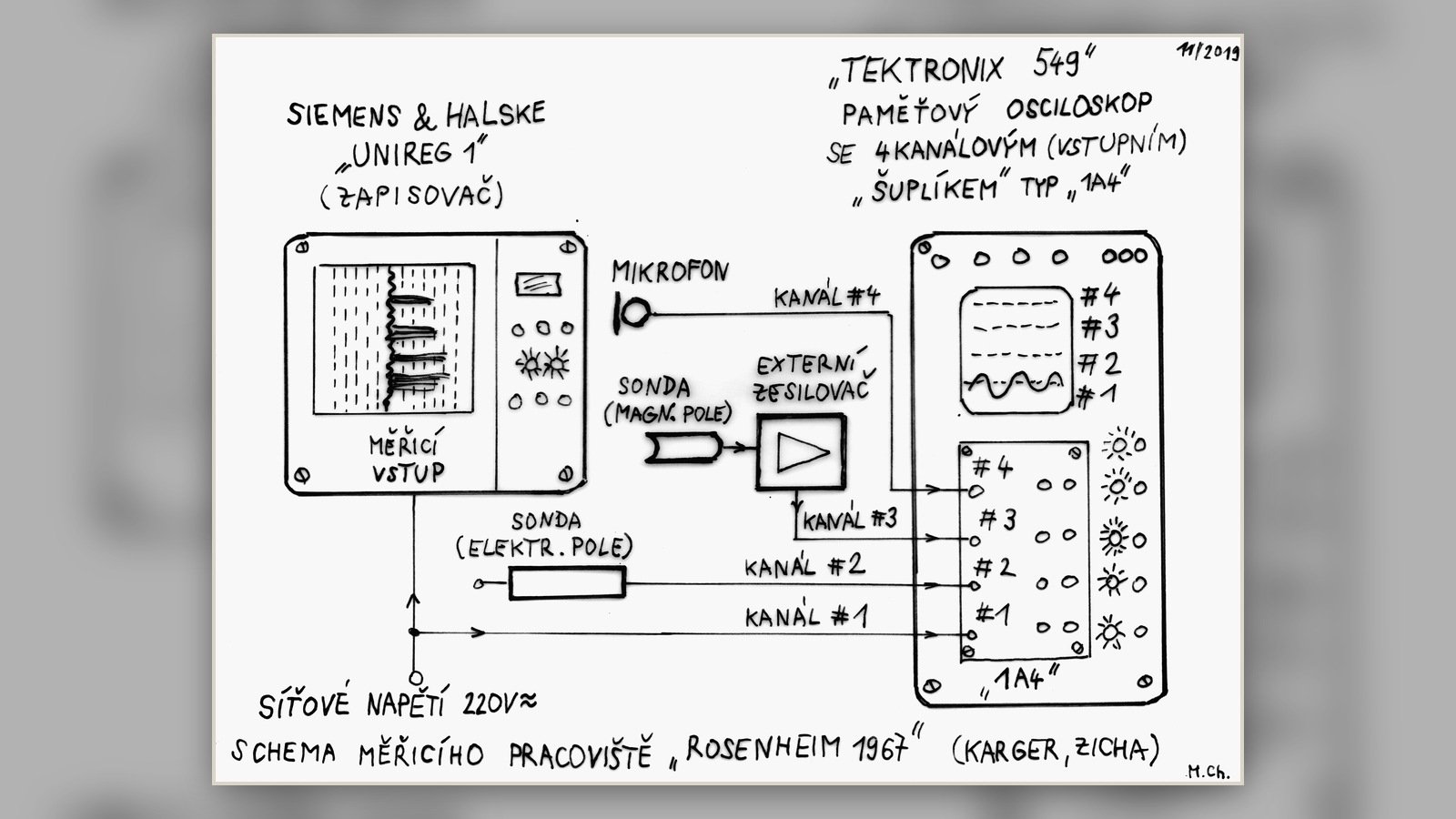
Physicists Friedbert Karger and Gerhard Zicha established a measurement station using recording and oscilloscope equipment. Their schematic survives as an emblem of the case: wires, meters and channels surrounding a phenomenon that refused to announce itself on command. Sharp impulses were reportedly captured during disturbances. The investigators rejected several simple electrical explanations, though the measurements did not identify a supernatural force. What they created was a disciplined record of anomaly at the exact point where cause remained absent.
This phase also explains why the case endured as one of the twentieth century’s most famous “instrumented” poltergeist cases, where the supernatural entered through office technology rather than an old house. Later summaries often isolate the most spectacular incident, but the original force lay in accumulation: repeated nights, changing witnesses, failed searches and the intrusion of the phenomenon into worship, work or family routine. No single detail must carry the entire story. The authority of the narrative rests upon a sequence in which ordinary explanations were tried, doubted and tried again.
Pictures, Drawers and Office Objects
As the case developed, reports extended beyond electricity. Pictures were said to rotate on walls, drawers moved and objects shifted. These incidents brought the pattern closer to traditional poltergeist activity, where mechanical disorder gathers around a human centre. Photographs of displaced fixtures circulated widely. The office became a place in which every object could be watched, yet observation itself altered behaviour: employees, investigators and reporters crowded rooms built for quiet legal work.
Testimony must be read as human evidence rather than as a transparent window. Fear sharpens some perceptions and distorts others; memory selects; institutions preserve the statements that fit their procedures. Yet these limits do not reduce the event to nothing. They reveal how disturbances apparently registered by instruments and repeatedly associated with the presence of a young clerk without reducing to a single electrical fault was experienced by people whose decisions had real consequences. The case remains frightening because uncertainty did not suspend action. Families, clergy, doctors, technicians or courts still had to decide what to do next.
Annemarie Schneider
Attention focused on a young employee, usually identified as Annemarie Schneider or Schaberl in different retellings. Disturbances appeared to coincide with her presence and reportedly ceased or changed when she left. Bender’s interpretation followed the recurrent spontaneous psychokinesis model, in which unconscious tension in an “agent” produces physical effects without deliberate intention. This did not make the young woman a magician or fraud in his account. It made her the human point through which the office’s disorder was expressed.
The physical setting matters here. Rooms, roads, chapels, offices and courtrooms organize what witnesses can hear and whom they can observe. In this case, architecture became part of the phenomenon: it concealed sources, directed attention and gave the disturbance a route through which it could seem to approach or withdraw. The resulting atmosphere was not decorative gothic invention. It arose from the practical problem of trying to locate an event that repeatedly escaped the person searching for it.
Press, Spectacle and Strain
Once journalists arrived, the law office could no longer function normally. Witnesses knew that every event might appear in print, skeptics searched for trickery and believers waited for confirmation. Employees lived inside a public experiment they had not chosen. The pressure surrounding Annemarie intensified. Poltergeist cases often burn out when the social arrangement changes, and Rosenheim’s activity declined after her employment ended. The departure offered correlation, not a complete explanation.
The occult interpretation gained strength because the incident appeared intentional. Random disorder becomes haunting when it answers, follows, selects or arrives at meaningful moments. Witnesses did not merely report abnormal movement; they reported behaviour. Whether that behaviour originated in an entity, a human action, unconscious process or collective expectation remains the deepest question. What the record establishes is that those present felt addressed by the disturbance rather than merely exposed to it.
The Unresolved Instrumented Case
Rosenheim remains disputed because its strongest claim is also its limitation. Instruments registered electrical irregularities, but instruments do not interpret motives. Witnesses saw physical movement, but crowded conditions complicate observation. The association with Annemarie is striking, but association does not reveal a mechanism. The case survives at the boundary between technical record and supernatural narrative: a modern office turned into an environment where machines testified that the normal system had been disturbed without naming what disturbed it.
The surviving record gives this stage particular weight because it appears inside the 1968 report associated with Hans Bender, contemporary technical measurements, photographs, press coverage and later discussion by the Institut für Grenzgebiete der Psychologie. Details were written by people who did not share one theory, yet they converged upon the sense that disturbances apparently registered by instruments and repeatedly associated with the presence of a young clerk without reducing to a single electrical fault. The article preserves that convergence without pretending that a witness could see every room, motive or mechanism. The darkness comes from the limits of inspection: those present could describe what the event did, while its identity remained beyond the ordinary categories available to them.
A further layer concerns the passage from private ordeal to public case. Once strangers arrived, the people involved were no longer only witnesses; they became objects of examination. Their words could be repeated without their control, and every inconsistency acquired importance. Publicity enlarged the archive while changing the conditions under which new events occurred.
The event also carried an ethical burden. Belief in an invading presence could produce vigilance, solidarity and sustained care, but it could also expose vulnerable people to restraint, interrogation and spectacle. A serious occult history must preserve both realities. The witnesses’ supernatural interpretation belongs to the case, and so do the consequences of acting upon it.
Later culture often compresses the subject into a single image or phrase. Returning to the longer record restores duration: waiting, interrupted sleep, repeated consultation and the slow erosion of confidence in familiar surroundings. The most frightening cases are rarely one impossible moment. They are the days during which no one knows whether the moment will return.
A further layer concerns the passage from private ordeal to public case. Once strangers arrived, the people involved were no longer only witnesses; they became objects of examination. Their words could be repeated without their control, and every inconsistency acquired importance. Publicity enlarged the archive while changing the conditions under which new events occurred.
The event also carried an ethical burden. Belief in an invading presence could produce vigilance, solidarity and sustained care, but it could also expose vulnerable people to restraint, interrogation and spectacle. A serious occult history must preserve both realities. The witnesses’ supernatural interpretation belongs to the case, and so do the consequences of acting upon it.
Later culture often compresses the subject into a single image or phrase. Returning to the longer record restores duration: waiting, interrupted sleep, repeated consultation and the slow erosion of confidence in familiar surroundings. The most frightening cases are rarely one impossible moment. They are the days during which no one knows whether the moment will return.
What Remains
Rosenheim’s atmosphere is technological rather than gothic. The terror comes from systems designed to make invisible forces predictable—electricity and telephony—suddenly behaving as though prediction no longer applies.
The young employee at the centre deserves restraint. Later retellings often turn her into either a fraud or an unconscious psychic engine, both identities larger than the evidence allows.
The surviving diagrams are compelling because they show serious effort to capture the anomaly. They are not proof of a spirit; they are proof that the witnesses tried to force the disturbance into a measurable form.
What remains is one of the twentieth century’s most famous “instrumented” poltergeist cases, where the supernatural entered through office technology rather than an old house. The names and places survive because the event entered documents before it became entertainment. Those documents preserve voices that are sincere, frightened, partisan, careful and sometimes contradictory. They do not eliminate the darkness. They give it historical weight. The case continues to disturb because disturbances apparently registered by instruments and repeatedly associated with the presence of a young clerk without reducing to a single electrical fault, and because the actions taken in response changed lives long after the last reported manifestation.
The final boundary must therefore remain open. A historical archive can show what witnesses heard, what bodies endured, what instruments registered and what courts or churches decided. It cannot command the unseen to identify itself for a later reader. These stories persist in the interval between record and presence—the place where testimony becomes memory, memory becomes legend, and the legend still carries the pressure of something that once entered an ordinary room and refused to behave like anything known.