The figure was white in a lane already emptied by fear. For weeks, people near St Paul’s churchyard in Hammersmith had spoken of a ghost rising from the burial ground—tall, pale and capable of seizing those who crossed its path. Armed men began to patrol. On the night of 3 January 1804, excise officer Francis Smith saw a person dressed in white near Black Lion Lane and demanded an answer. The figure was Thomas Millwood, a bricklayer and plasterer returning through the winter darkness in the white clothes of his trade. Smith fired. Millwood died where the supernatural rumour met a loaded gun. The ghost vanished into the legal history of a killing committed by a man who said he believed he was defending the living from the dead.
The World Around the Case
This case unfolded within Hammersmith at the western edge of early nineteenth-century London, where churchyard fears, winter darkness and rapidly spreading reports produced armed civilian patrols. Its principal foundation is Old Bailey-era newspaper reports, trial accounts, legal commentary and later analysis preserved by the Library of Congress and British legal historians. Those materials do not create perfect certainty, but they make possible a detailed reconstruction of when the reports began, who witnessed them and how interpretation changed as the disturbance entered public knowledge. SatanWorld follows the testimony closely, attributes extraordinary claims to the people and records that preserved them, and keeps the supernatural presence at the centre of the narrative without replacing history with invented scenes.
At the heart of the story is an alleged apparition that may have begun as prank, misidentification or genuine belief but acquired lethal reality through collective fear. The case later became a haunting remembered not for proving a ghost but for exposing how supernatural error, vigilantism and criminal responsibility collide. That legacy can obscure the people who endured the original events, so the account returns repeatedly to chronology, room, witness and consequence. The goal is not to produce a courtroom verdict on the unseen. It is to restore the full oppressive shape of an event that contemporaries believed had crossed the boundary between the ordinary world and something acting from beyond it.
Rumours Around St Paul’s
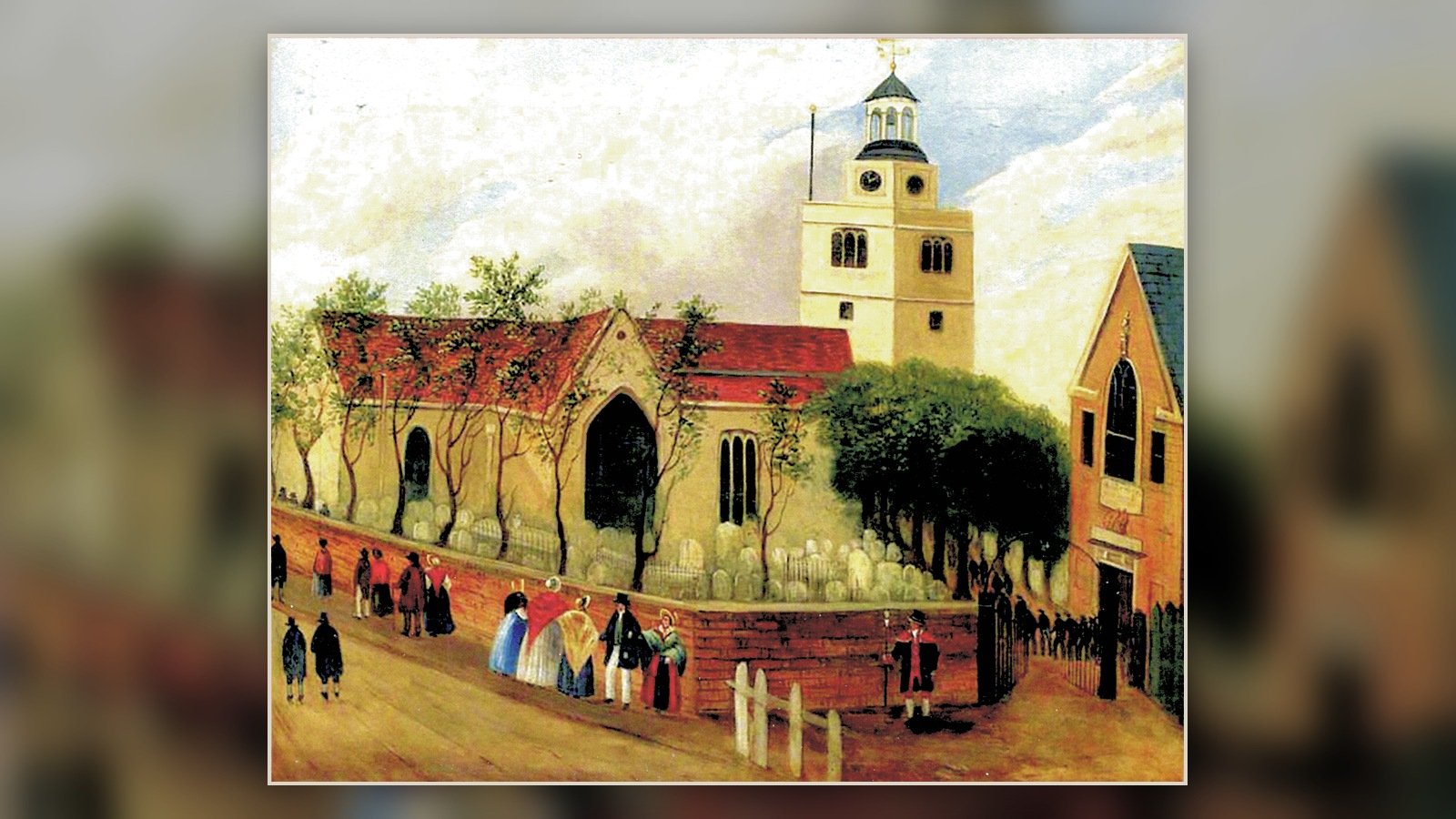
In December 1803, reports circulated that a white apparition haunted the roads and fields near St Paul’s churchyard. Some stories linked it to a person buried after suicide, whose spirit was believed unable to rest in consecrated ground. Witnesses described encounters, pursuit and physical attack. The details changed as they travelled: horns, glassy eyes, a shroud, an immense white form. Repetition gave the rumour geography. Certain lanes became places to avoid after dark even for people who had never seen anything themselves.
The physical setting matters here. Rooms, roads, chapels, offices and courtrooms organize what witnesses can hear and whom they can observe. In this case, architecture became part of the phenomenon: it concealed sources, directed attention and gave the disturbance a route through which it could seem to approach or withdraw. The resulting atmosphere was not decorative gothic invention. It arose from the practical problem of trying to locate an event that repeatedly escaped the person searching for it.
Fear Becomes a Patrol
Residents formed watches and armed themselves. The transition from story to vigil altered the danger. A ghost cannot be arrested, so watchers entered the night prepared to confront whatever appeared. Every pale garment, sudden movement or frightened cry could complete the image already held in the mind. Authorities offered rewards or sought information, but informal patrols moved faster than official certainty. Francis Smith joined this environment carrying a firearm.
The occult interpretation gained strength because the incident appeared intentional. Random disorder becomes haunting when it answers, follows, selects or arrives at meaningful moments. Witnesses did not merely report abnormal movement; they reported behaviour. Whether that behaviour originated in an entity, a human action, unconscious process or collective expectation remains the deepest question. What the record establishes is that those present felt addressed by the disturbance rather than merely exposed to it.
Thomas Millwood’s White Clothes
Millwood worked as a plasterer and bricklayer. His trade clothing was naturally white, making him conspicuous in darkness. Evidence at the later trial indicated that he had previously been mistaken for the ghost and warned about the risk of walking in such dress. That warning reveals how thoroughly the apparition had occupied local perception. Millwood did not disguise himself as a spectre; he moved through a district in which ordinary work clothes had been transformed into supernatural evidence.
The surviving record gives this stage particular weight because it appears inside Old Bailey-era newspaper reports, trial accounts, legal commentary and later analysis preserved by the Library of Congress and British legal historians. Details were written by people who did not share one theory, yet they converged upon the sense that an alleged apparition that may have begun as prank, misidentification or genuine belief but acquired lethal reality through collective fear. The article preserves that convergence without pretending that a witness could see every room, motive or mechanism. The darkness comes from the limits of inspection: those present could describe what the event did, while its identity remained beyond the ordinary categories available to them.
The Shot in Black Lion Lane
On the evening of 3 January, Smith encountered Millwood near Black Lion Lane. He called out and, receiving no answer that dispelled his fear, fired at close range. Millwood was killed. The event stripped the ghost story of distance. A rumour that had produced excitement and dread now produced a corpse, witnesses and a weapon. Smith did not flee into anonymity. He was arrested and brought to trial, where belief itself became part of the defence.
Within Hammersmith at the western edge of early nineteenth-century London, where churchyard fears, winter darkness and rapidly spreading reports produced armed civilian patrols, the events described under “The Shot in Black Lion Lane” carried meanings larger than a private disturbance. A noise, voice or bodily reaction could indicate sin, intrusion, restless death, public danger or a failure of institutional protection. That cultural field did not make the witnesses foolish; it supplied the language through which an otherwise shapeless terror became narratable. The same language could also place immense pressure upon the afflicted person, whose every movement was watched for confirmation.
Can a Ghost Be Killed?
Smith maintained that he believed the figure was the threatening apparition. The legal problem was severe. If his belief was genuine, did mistake excuse the intentional firing of a gun? The court distinguished error from lawful justification. Even if Smith thought he confronted a ghost, he had chosen lethal force without legal necessity. The imagined supernatural character of the target did not make the act less dangerous to human beings who might be mistaken for it.
This phase also explains why the case endured as a haunting remembered not for proving a ghost but for exposing how supernatural error, vigilantism and criminal responsibility collide. Later summaries often isolate the most spectacular incident, but the original force lay in accumulation: repeated nights, changing witnesses, failed searches and the intrusion of the phenomenon into worship, work or family routine. No single detail must carry the entire story. The authority of the narrative rests upon a sequence in which ordinary explanations were tried, doubted and tried again.
The Murder Trial
The case came before the Old Bailey in January 1804. The jury attempted to return a lesser verdict, but the judge directed that the facts amounted to murder under the law as it then stood. Smith was convicted and sentenced to death. The harshness of the result reflected the doctrine that a mistaken belief did not automatically reduce an intentional killing. The Crown later commuted or pardoned the sentence, but the conviction entered legal memory.
Testimony must be read as human evidence rather than as a transparent window. Fear sharpens some perceptions and distorts others; memory selects; institutions preserve the statements that fit their procedures. Yet these limits do not reduce the event to nothing. They reveal how an alleged apparition that may have begun as prank, misidentification or genuine belief but acquired lethal reality through collective fear was experienced by people whose decisions had real consequences. The case remains frightening because uncertainty did not suspend action. Families, clergy, doctors, technicians or courts still had to decide what to do next.
The Alleged Prankster
Later accounts claimed that a local shoemaker or other resident admitted dressing in white to frighten an apprentice who had terrified his children with ghost stories. The confession is difficult to align perfectly with every reported sighting, and it came too late to save Millwood. If a prank began the panic, the prankster did not control what the story became. Once the apparition entered public circulation, strangers supplied new descriptions and vigilantes supplied weapons.
The physical setting matters here. Rooms, roads, chapels, offices and courtrooms organize what witnesses can hear and whom they can observe. In this case, architecture became part of the phenomenon: it concealed sources, directed attention and gave the disturbance a route through which it could seem to approach or withdraw. The resulting atmosphere was not decorative gothic invention. It arose from the practical problem of trying to locate an event that repeatedly escaped the person searching for it.
A Ghost in the Law Books
The Hammersmith case remained important in discussions of mistake of fact and criminal liability. For generations, legal writers cited Smith’s conviction when considering whether an honest but unreasonable belief could justify violence. The doctrine evolved, but the ghost stayed in the argument as an unforgettable example. A supernatural belief became legally real not because the court affirmed a haunting, but because the consequences of that belief had to be judged.
The occult interpretation gained strength because the incident appeared intentional. Random disorder becomes haunting when it answers, follows, selects or arrives at meaningful moments. Witnesses did not merely report abnormal movement; they reported behaviour. Whether that behaviour originated in an entity, a human action, unconscious process or collective expectation remains the deepest question. What the record establishes is that those present felt addressed by the disturbance rather than merely exposed to it.
The Haunting That Killed a Man
No final account proves what the first Hammersmith witnesses saw. They may have encountered a prankster, a person in work clothes, suggestion in darkness or events later exaggerated. The uncertainty no longer protects the story from history. Thomas Millwood’s death is fixed. The most frightening presence in Black Lion Lane was not necessarily the white figure people feared. It was the certainty that fear had created before Smith raised his gun.
The surviving record gives this stage particular weight because it appears inside Old Bailey-era newspaper reports, trial accounts, legal commentary and later analysis preserved by the Library of Congress and British legal historians. Details were written by people who did not share one theory, yet they converged upon the sense that an alleged apparition that may have begun as prank, misidentification or genuine belief but acquired lethal reality through collective fear. The article preserves that convergence without pretending that a witness could see every room, motive or mechanism. The darkness comes from the limits of inspection: those present could describe what the event did, while its identity remained beyond the ordinary categories available to them.
A further layer concerns the passage from private ordeal to public case. Once strangers arrived, the people involved were no longer only witnesses; they became objects of examination. Their words could be repeated without their control, and every inconsistency acquired importance. Publicity enlarged the archive while changing the conditions under which new events occurred.
The event also carried an ethical burden. Belief in an invading presence could produce vigilance, solidarity and sustained care, but it could also expose vulnerable people to restraint, interrogation and spectacle. A serious occult history must preserve both realities. The witnesses’ supernatural interpretation belongs to the case, and so do the consequences of acting upon it.
Later culture often compresses the subject into a single image or phrase. Returning to the longer record restores duration: waiting, interrupted sleep, repeated consultation and the slow erosion of confidence in familiar surroundings. The most frightening cases are rarely one impossible moment. They are the days during which no one knows whether the moment will return.
A further layer concerns the passage from private ordeal to public case. Once strangers arrived, the people involved were no longer only witnesses; they became objects of examination. Their words could be repeated without their control, and every inconsistency acquired importance. Publicity enlarged the archive while changing the conditions under which new events occurred.
The event also carried an ethical burden. Belief in an invading presence could produce vigilance, solidarity and sustained care, but it could also expose vulnerable people to restraint, interrogation and spectacle. A serious occult history must preserve both realities. The witnesses’ supernatural interpretation belongs to the case, and so do the consequences of acting upon it.
Later culture often compresses the subject into a single image or phrase. Returning to the longer record restores duration: waiting, interrupted sleep, repeated consultation and the slow erosion of confidence in familiar surroundings. The most frightening cases are rarely one impossible moment. They are the days during which no one knows whether the moment will return.
A further layer concerns the passage from private ordeal to public case. Once strangers arrived, the people involved were no longer only witnesses; they became objects of examination. Their words could be repeated without their control, and every inconsistency acquired importance. Publicity enlarged the archive while changing the conditions under which new events occurred.
What Remains
The case demonstrates how folklore can become infrastructure. It reorganized routes, clothing, patrols and expectations until the district behaved as though the ghost were an established danger.
Smith’s belief may have been sincere, but sincerity does not erase responsibility. This is the dark philosophical core of the case: an imagined threat can produce a fully real victim.
The Hammersmith Ghost survives because the supernatural and legal narratives cannot be separated. The haunting’s most certain manifestation was the law it forced to speak.
What remains is a haunting remembered not for proving a ghost but for exposing how supernatural error, vigilantism and criminal responsibility collide. The names and places survive because the event entered documents before it became entertainment. Those documents preserve voices that are sincere, frightened, partisan, careful and sometimes contradictory. They do not eliminate the darkness. They give it historical weight. The case continues to disturb because an alleged apparition that may have begun as prank, misidentification or genuine belief but acquired lethal reality through collective fear, and because the actions taken in response changed lives long after the last reported manifestation.
The final boundary must therefore remain open. A historical archive can show what witnesses heard, what bodies endured, what instruments registered and what courts or churches decided. It cannot command the unseen to identify itself for a later reader. These stories persist in the interval between record and presence—the place where testimony becomes memory, memory becomes legend, and the legend still carries the pressure of something that once entered an ordinary room and refused to behave like anything known.