During the winter of 1762, crowds gathered in a narrow London street to hear a dead woman speak through knocks and scratches. Her message was simple and terrible: she had not died of smallpox. She had been poisoned.
The Lodging in Cock Lane
Cock Lane ran near Smithfield, within reach of church towers, markets, slaughterhouses and the dense noise of Georgian London. In 1760, stockbroker William Kent rented rooms there from parish clerk Richard Parsons.
Kent lived with Fanny Lynes, sister of his late wife. They presented themselves as married, though their relationship was vulnerable to scandal. Parsons owed Kent money, and their relations deteriorated when repayment was demanded.
While Kent was away, Fanny and Parsons’s young daughter Elizabeth heard scratching and knocking in the room. The sounds were unexplained but did not yet carry a message. Kent and Fanny left the house. Soon afterward, Fanny died of smallpox in Clerkenwell.
Scratching Fanny Returns
After Kent successfully sued Parsons for the debt, the noises returned in the Cock Lane house. They followed Elizabeth, who experienced convulsions and slept surrounded by witnesses.
Methodist minister John Moore developed a code: one knock for yes, two for no. Through this system, the presence identified itself as Fanny and claimed Kent had poisoned her with arsenic.
The accusation transformed domestic noises into a murder charge. Elizabeth also described a shrouded figure without hands. Newspapers named the spirit ‘Scratching Fanny,’ and London began to pour into Cock Lane.
A Ghost Before the Public
Parsons admitted visitors for a fee. Clergymen, physicians, aristocrats and curious citizens crowded the rooms. Among those drawn to the case were writer Samuel Johnson, Horace Walpole and Prince Edward, brother of George III.
The séances followed a ritual of darkness and expectation. Elizabeth was placed in bed. Questions were asked. Knocks or scratches answered. The dead woman appeared to accuse Kent with the authority of a voice from beyond burial.
The excitement spread because the case offered everything Georgian London feared and desired: illicit love, sudden death, debt, a child medium and the possibility that murder could be exposed by the victim herself.
The Vault Test
The Lord Mayor ordered an inquiry. A committee including Samuel Johnson, Lord Dartmouth and John Douglas attended controlled sittings and attempted to test the spirit’s promises.
On 1 February 1762, Elizabeth was placed in bed under observation at a clergyman’s house. The investigators heard no convincing sounds. They then went to the church vault where Fanny’s coffin lay, expecting the ghost to knock upon it. The stone chamber remained silent.
Johnson’s written conclusion stated that the child possessed some art of producing the noise and that no higher agency had been demonstrated. Yet the failure of one test did not erase the nights when neighbours and visitors believed the walls had answered.
The Child and the Board
Under pressure, Elizabeth was watched more closely. A small piece of wood was reportedly discovered, used to create scratches against the bed or wall. The public story turned rapidly from ghostly murder accusation to exposure.
Parsons, Moore and others were prosecuted for conspiracy against Kent. Parsons was sentenced to stand in the pillory and to imprisonment. The crowd, unusually sympathetic, protected him from serious harm and collected money on his behalf.
The legal punishment ended the public séances. It did not fully settle how every sound had been made or why so many visitors had been persuaded. Even later writers who treated the affair as deception admitted that parts of the mechanism remained obscure.
The Ghost in London Culture
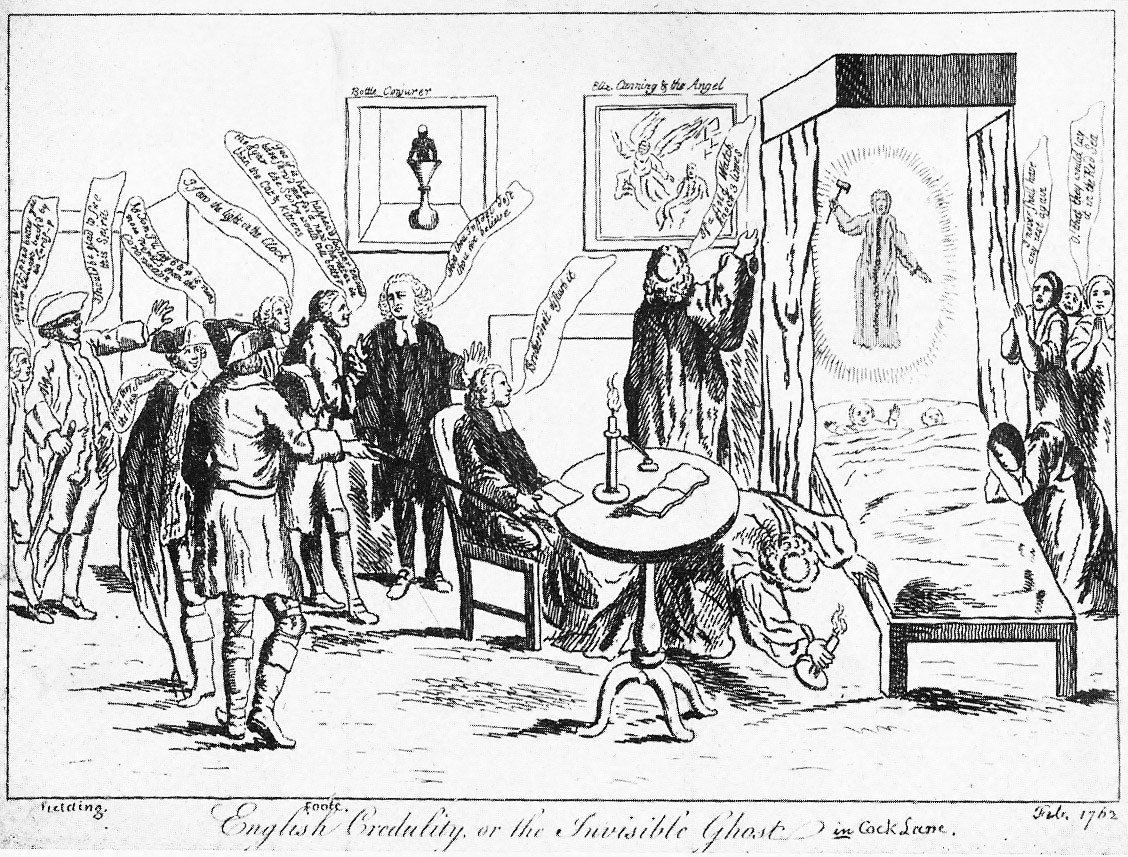
William Hogarth turned the affair into satire. Charles Dickens later referred to the Cock Lane Ghost in several works, including the opening of A Tale of Two Cities. The name became a proverb for public credulity and noisy fraud.
Yet Andrew Lang, writing in the nineteenth century, observed that the case still resisted a complete solution. Colin Wilson later argued that the phenomena resembled other poltergeist outbreaks and that the exposure of some actions need not explain all of them.
The haunting endured because the sounds had become a form of testimony. Through a child’s bed, a dead woman seemed to accuse the living. The knocks did not merely frighten; they demanded judgment.
William Kent, Fanny Lynes and an Impossible Marriage
William Kent came to London from Norfolk and worked as a stockbroker. He had married Elizabeth Lynes, but she died after childbirth, and the infant also failed to survive. Kent then formed a relationship with Elizabeth’s sister Frances—Fanny—Lynes. English canon law treated marriage to a deceased wife’s sister as prohibited affinity, so the couple could not easily regularize their union. They lived together as husband and wife while remaining exposed to gossip and legal uncertainty.
In 1759 they rented rooms from Richard Parsons, parish clerk of St Sepulchre-without-Newgate, in a house at Cock Lane. Parsons borrowed money from Kent, commonly reported as twelve guineas, and the debt later soured their relationship. Domestic intimacy, money and reputation were already joined before the first scratch sounded.
While Kent was away, Fanny shared a bed with Parsons’s daughter Elizabeth. Both heard noises against the wall or bedstead. Fanny joked that the sounds might be a warning connected with her dead sister. When Kent returned, the couple left Cock Lane, partly because of the disturbance and partly because of conflict with Parsons.
Fanny died on 2 February 1760 during a smallpox outbreak. The illness was diagnosed by physicians, and her body was placed in the vault of St John’s, Clerkenwell. Kent believed he had lost a second wife. Parsons, however, still owed him money, and Kent eventually pursued the debt through the courts.
The ghost appeared publicly only after Kent won his action. That timing transformed the haunting into a weapon. A dead woman who could accuse Kent of murder might destroy the creditor who had defeated Parsons in law.
The Child in the Bed
Elizabeth Parsons was about eleven or twelve when the noises returned. They followed her from room to room and were strongest when she lay in bed. Scratches came from boards, knocks from walls and, according to some witnesses, a faint rustling like a woman in silk.
John Moore, a Methodist clergyman, became convinced that the disturbance deserved spiritual attention. He and others developed a language of knocks. One sound meant yes; two meant no. More complicated answers were obtained by reciting letters or asking sequences of questions.
Through this code, the presence identified itself as Fanny. It denied dying naturally. Asked whether William Kent had poisoned her, it answered yes. The method was specified: arsenic in purl, a bitter drink of warm ale and gin. The allegation travelled quickly because it supplied an exact crime and a living murderer.
Elizabeth suffered fits and convulsive movements during sittings. The bed became a public instrument, surrounded by adults interpreting every movement and pause. Darkness was usually required. The child’s body lay at the centre while the dead woman was constructed through questions supplied by the room.
Six Nights of London Fever
Between 12 and 23 January 1762, a series of heavily attended séances turned Cock Lane into a city sensation. Carriages blocked nearby streets. People of rank waited beside artisans and servants. Admission was controlled, and Parsons received money from visitors, further binding the supernatural claim to his financial conflict.
The room was searched before some sittings. Elizabeth’s hands were held. Witnesses listened at walls and beneath the bed. The scratches did not always come, but anticipation often lasted for hours. When a sound finally answered, the crowded darkness converted it into testimony from beyond death.
Prince Edward, Duke of York and Albany, attended one sitting. Horace Walpole took an interest. Samuel Johnson discussed the affair with friends before joining an official test. The presence of eminent spectators made the ghost socially dangerous: the accusation against Kent could no longer be dismissed as neighbourhood gossip.
Kent protested publicly. He produced medical witnesses to Fanny’s smallpox and demanded investigation. His position was agonizing. To defend himself, he had to expose an irregular relationship and the private death of the woman he loved. The ghost turned mourning into cross-examination.
The Promise at the Coffin
Investigators asked the spirit to provide a sign impossible to stage in the Parsons house. It promised that it would knock upon Fanny’s coffin in the burial vault. A committee assembled on 1 February 1762, almost exactly two years after her death.
Elizabeth was first observed at the house of Reverend Stephen Aldrich. The watchers included Samuel Johnson, John Douglas, Lord Dartmouth and other clergy and gentlemen. No convincing manifestation occurred under the stricter conditions. The group then went to St John’s, Clerkenwell.
They descended into the vault and stood among coffins in the cold stone space. Questions were asked. Silence followed. No knock came from Fanny’s coffin. The committee waited, but the promised sign did not occur.
Johnson composed an account stating that the child had some art of producing the noises and that the supposed spirit had failed its own test. His language was measured, but the effect was devastating. London had watched the dead accuse; now distinguished men had watched the grave refuse to answer.
How the Scratching Was Made
After the failed vault test, Elizabeth was placed under closer observation. The noises weakened when her hands and feet were controlled or when she was moved away from familiar beds. Investigators told her that if the sound did not occur by a certain date, her father would be sent to prison.
Under this pressure, she produced a scratch. A small wooden board or similar device was discovered and associated with the method. By concealing it beneath clothing or bedding and rubbing it against the bedstead, she could create sounds that seemed to come from the walls.
The explanation accounted for the most repeatable part of the phenomenon, but the earlier confusion left room for memory to continue arguing. Crowded rooms, darkness and expectation made exact localization difficult. Some witnesses maintained that they had heard sounds at distances or under controls the simple mechanism did not explain.
The public mood turned rapidly. Those who had paid to hear a murdered woman now confronted the possibility that an indebted father, sympathetic clergy and a frightened child had manufactured a capital accusation.
The Trial for Conspiracy
Richard Parsons, his wife, John Moore, servant Mary Frazer and others were prosecuted for conspiracy against William Kent. The proceedings shifted the question from the existence of ghosts to the deliberate injury of a living man’s reputation.
Moore eventually withdrew support and expressed regret. Parsons was convicted and sentenced to imprisonment and the pillory. When he stood exposed to the crowd, spectators did not attack him as pillory crowds often attacked convicted offenders. Sympathy and fascination remained strong; money was collected for him.
The sentence recognized Kent as the victim of a plot. Yet the legal conclusion could not retract the story from London. Pamphlets, poems, engravings and conversations had already separated Scratching Fanny from the people who created her.
Hogarth, Johnson and the Ghost’s Afterlife
William Hogarth placed the Cock Lane Ghost within Credulity, Superstition, and Fanaticism, his 1762 assault on religious enthusiasm. In the print, the ghost joins other public wonders and deceptions, becoming a symbol of a society eager to believe what spectacle confirms.
Samuel Johnson’s involvement gave the affair literary permanence. Later generations enjoyed the image of England’s great lexicographer entering a vault to listen for a ghost. James Boswell preserved Johnson’s comments, and the story followed Johnson into biography.
Charles Dickens repeatedly invoked Cock Lane as shorthand for superstition. In A Tale of Two Cities, the ghost appears among the strange beliefs of 1775. By then, Scratching Fanny was no longer only Fanny Lynes; she was a national reference understood without explanation.
The haunting’s endurance lies in the seriousness of its message. The knocks did not ask for prayer or treasure. They accused a named man of murder. Every answer therefore carried the possibility of execution. The child in the bed became, for several winter weeks, a witness whose authority seemed to come from beneath a church floor.
The Physicians and Fanny’s Death
Kent’s defence rested partly upon the ordinary documentation of death. Fanny had been attended during a recognized smallpox epidemic, and the eruption of the disease was visible. Apothecaries and physicians could testify to her condition. Arsenic poisoning was not a conclusion reached at the time of burial; it arose almost two years later through the knocks.
The ghost’s accusation nevertheless exploited a gap no witness could completely close. Fanny’s body lay in a vault, and Georgian medicine could not produce the certainty expected of modern toxicology. A disembodied claimant appeared to know the method, the drink and the person responsible. For audiences already persuaded that murder victims might return, this specificity outweighed medical certificates.
Kent offered to have the coffin opened. The willingness was risky, both emotionally and socially, but it demonstrated confidence that the body would not reveal poison. The inquiry ultimately relied on the failed coffin knock rather than exhumation. Silence in the vault became the dead woman’s only direct answer under controlled conditions.
Pamphlets and the Speed of the Accusation
London’s print culture carried the case faster than official inquiry could contain it. Newspapers announced sittings, repeated dialogue and reported the names of distinguished visitors. Satirical prints appeared while the investigation was still active. The ghost existed simultaneously in the Parsons bedroom and across thousands of sheets sold in the streets.
Printed versions altered emphasis almost immediately. Some treated Kent as a murderer confronted by providence; others portrayed Parsons as a schemer exploiting religious enthusiasm. The child Elizabeth shifted between victim, medium and accomplice depending upon the writer.
This rapid multiplication explains why exposure did not kill the haunting. The public had already imagined Scratching Fanny as a speaking personality. Once a ghost acquires a name, motive and portrait in print, the mechanism beneath the bed can be revealed without silencing the figure created above it.
The Final Silence
After the trial, Elizabeth Parsons disappeared from public attention. No later haunting followed her with the force of Cock Lane, and Scratching Fanny did not establish a second household. The noises belonged to a particular room, debt and winter.
William Kent survived the accusation, but public vindication could not restore the privacy of Fanny’s death. Her name remained attached not to the smallpox that killed her, but to the ghost London believed had returned to denounce him.
The Narrow Street After Midnight
Modern London has almost erased the setting. Cock Lane survives in altered form, surrounded by traffic and buildings that would be unrecognisable to Parsons, Kent or Elizabeth.
The story remains attached to the winter of 1762, when citizens crossed the city to stand in a dark room and wait for one knock or two. In that pause, the dead appeared capable of entering a dispute over money, sex and reputation.
The committees left unconvinced and the courts punished the conspirators. Still, the Cock Lane Ghost never vanished completely. It became the sound of Georgian London listening at the wall, uncertain whether the next scratch belonged to a child, a grievance or a murdered woman beneath the church floor.