In October 1654, a weaver in the old parish of Glenluce refused the demand of a violent beggar. Soon afterward, the threads on his loom were cut by an unseen hand, stones crossed locked rooms and a voice began speaking from the darkness of the house.
A Weaver in Galloway
Gilbert Campbell lived with his family in Glenluce, in the windswept district of Galloway in southwest Scotland. His trade was weaving, a patient craft of measured tension, ordered threads and repetitive movement. The loom was the centre of the household’s livelihood.
The surviving account was published by George Sinclair, professor of philosophy at Glasgow, who presented it as testimony against those who denied spirits and apparitions. Sinclair said the fuller narrative came from Campbell’s son Thomas, a student of philosophy who returned home and witnessed the disturbance.
The case began with Alexander Agnew, a beggar remembered for blasphemy and later executed at Dumfries. When Campbell refused the alms Agnew demanded, the beggar threatened harm. The words were followed by events that seemed to answer them.
The Loom Is Cut
The first attacks fell upon Campbell’s work. Warp threads were cut after being set upon the loom. New cloth was damaged. Tools and household objects disappeared and returned in unexpected places.
The cuts were not random wear. They appeared repeatedly, sometimes after the room had been watched. The invisible disturbance understood what would injure a weaver most: not a dramatic apparition, but the destruction of the ordered work by which the family survived.
Stones then began to enter the house. They were thrown through rooms without an identified hand and could arrive when doors and windows were secured. The family searched, watched and prayed, but the source remained hidden.
A Presence That Learned to Speak
The phenomena developed into whistles, cries and a voice. The presence mocked the family, threatened Thomas and answered those who addressed it. At times it claimed authority to remain. At other moments it bargained, asking for tools with which it said it would dig a grave and depart.
Ministers came to the house. During prayer the disturbances usually ceased, except for a distant yell or threat. When the prayers ended, the voice returned. It argued with the clergy, challenged their commands and warned that it would set the house on fire.
The exchanges recorded by Sinclair give the Glenluce presence an unusual character. It was not merely noise. It listened to scripture, waited through prayer and chose its replies. It displayed hatred toward Thomas, promising to pursue him to the end of the world.
The Return of Thomas Campbell
Thomas had been away studying in Glasgow. When he returned, the activity focused upon him with renewed force. Clothes were pulled, books disturbed and threats spoken. The presence appeared determined to drive him from the family home.
The ministers refused to surrender the young man. They told the voice that divine protection would preserve both Thomas and the house. The spirit answered with defiance and continued the siege.
The household became a place of constant vigilance. No object was too small to be moved, no hour too quiet for the next sound. The ordinary architecture of the cottage—rafters, doors, loom, beds and hearth—became a network through which the unseen presence could declare itself.
Fire, Stones and Scripture
One of the spirit’s most serious threats was fire. In a seventeenth-century cottage, flame meant not only destruction but the possible death of the entire family. The ministers responded that the Lord would restrain its malice.
The voice sometimes spoke in religious language, claiming a commission from Christ to vex the family. The minister rejected the claim and called it deception. This exchange placed the disturbance inside the theology of Reformation Scotland, where Satan was believed capable of quoting scripture while twisting its meaning.
The Campbell family endured for months and, according to the narrative, for nearly two years. The activity weakened gradually rather than ending in one final exorcism. The voice became less frequent. The stones ceased. The loom remained still.
George Sinclair Preserves the Case
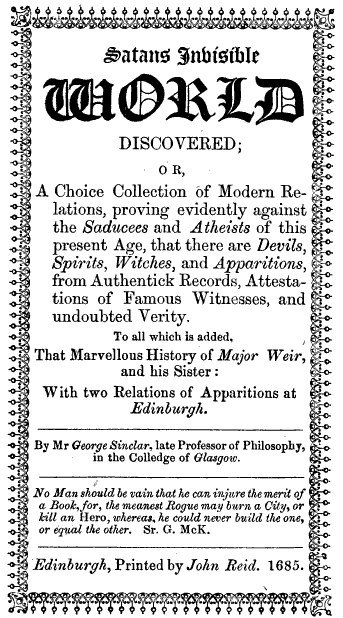
Sinclair first inserted the story into his work on hydrostatics in 1672, then republished it in expanded form in Satan’s Invisible World Discovered in 1685. He believed the case had value because it confronted atheism with testimony from a respectable household.
His book gathered apparitions, witchcraft accounts and demonic disturbances from Scotland and beyond. The Devil of Glenluce became its most memorable domestic haunting because the details were concrete: a named family, a trade, a threat, cut threads and conversations heard by ministers.
The narrative also preserves the voice of the period. The family did not describe an impersonal energy. They believed an intelligent enemy had entered the house, one that hated prayer, understood speech and sought to break both work and faith.
Alexander Agnew and the Threat at the Door
George Sinclair identified the beggar as Alexander Agnew, a man whose blasphemies had already made him notorious in southwest Scotland. Agnew wandered through Galloway demanding food or money and answering refusal with curses. Sinclair reported that he was later executed at Dumfries for denying God and insulting sacred things, a death that fixed him in memory as a man already aligned with darkness.
When Agnew came to Gilbert Campbell’s house in October 1654, the weaver refused the demand for alms. The beggar threatened that the family would regret it. The surviving account does not say that Agnew performed a visible spell. His words remained at the threshold, followed shortly by destruction inside.
In seventeenth-century Scotland, a spoken curse from a feared wanderer was not dismissed as empty anger. Words could carry malice, and malice could invite spiritual agency. When the loom threads were cut, the Campbell family understood the act as an answer to the threat.
The Assault on the Loom
The loom was both tool and order. Warp threads had to remain aligned under tension; a concealed cut could ruin hours of labour and valuable material. Sinclair’s account emphasizes repeated damage to warp and cloth because it struck the family at the centre of survival.
Campbell reset the work and watched. Threads were cut again. Pieces of clothing were damaged. The unseen hand did not merely break objects at random; it selected things that required patience to make and money to replace. The violence was economical before it became spectacular.
Tools vanished and appeared elsewhere. Chests opened. Items were moved between rooms. Stones crossed the interior with no thrower in sight. Family members attempted to guard the house, but the disturbance operated around observation as though it understood where eyes were directed.
The pattern resembled what later writers would call a poltergeist, yet Sinclair’s language was theological. The force was an evil spirit permitted to vex the household. Its intelligence became undeniable to the witnesses when sounds formed words and the house itself began to answer.
Janet at the Well
One of the earliest personal threats concerned Campbell’s daughter Janet. She heard whistling and then a voice that promised to cast her into the well. Water sources were essential and dangerous places around a rural household; a threat at the well carried the possibility of both accident and deliberate unseen attack.
The family tried to keep children from vulnerable spaces. Yet the spirit followed them indoors. Bedclothes were pulled away. Garments were cut while being worn or stored. A hand or arm was reportedly seen, appearing briefly enough to terrify without offering a body to confront.
The presence sometimes requested ordinary things—a belt, bread or a tool—only to turn the request into mockery. It ordered that candles be extinguished, preferring darkness, and threatened fire when resisted. Its speech moved between childish demand and scriptural defiance.
Thomas Comes Home
Thomas Campbell was studying philosophy at Glasgow when word reached him. His education gave Sinclair a witness who could be presented as literate and disciplined rather than ruled by village rumour. Thomas returned to Glenluce and became the principal target.
The spirit threatened to pursue him to the end of the world. It disrupted his books and clothing, spoke near him and appeared angered by his presence. When the family sent the children away, the activity diminished; when Thomas returned, it renewed. This apparent focus convinced observers that the voice chose victims rather than merely inhabiting the building.
Thomas later supplied Sinclair with a fuller narrative. The philosopher-professor used the student’s testimony to defend the reality of spirits against what he saw as the growing impiety of the age. The Devil of Glenluce thus entered print through a chain of educated witnesses: a student describing his home to a professor who wished to prove the invisible world.
The Ministers Enter the House
Local ministers and gentlemen visited during the disturbances. Sinclair names figures including James Bailie of Carphin, Alexander Bailie of Dunragged, Mr Robert Hay and others who heard portions of the phenomena or joined the household in prayer. Their presence elevated the case beyond family testimony.
During worship, the voice often withdrew or reduced itself to a distant cry. When prayer ended, it resumed conversation. The timing was interpreted as evidence that sacred authority restrained but did not immediately expel it. Ministers challenged its claims and forbade the family to bargain.
The spirit quoted or alluded to scripture. It claimed a commission from Christ to trouble the Campbells. The ministers answered that Christ did not commission lying spirits to destroy innocent households. The exchange echoed biblical scenes in which demons recognize holy names yet twist truth.
At one point the voice described itself as being in the bottomless pit. Asked how it could speak in the house, it answered in a manner meant to evade ordinary space. Such replies gave the presence a demonological identity larger than that of a dead beggar. Agnew’s curse may have opened the story, but the speaker claimed an origin beneath the world.
February Nights
The detailed conversations became especially intense in February. On 12 February, witnesses gathered while the voice spoke from different parts of the room. It demanded that a candle be put out. When refused, it threatened harm. Those present searched spaces from which the sound came and found no concealed person.
A hand or arm appeared briefly, then vanished. Stones or objects moved in the sight of company. The presence asked for a spade so it could dig a grave and depart, a promise the ministers treated as deception. It asked for bread and a belt, requests that made no sense for a bodiless being except as tests of obedience.
The watchers attempted to localize the sound. It seemed near the ceiling, beneath furniture or beside a bed, then answered from another point. In a cottage without modern mechanical noise, a speaking voice could be followed closely; its refusal to remain in one place became part of the terror.
Fire in the Campbell House
The threat of burning eventually became physical. Fires appeared in beds or clothing. On 18 September, according to the expanded account, a bed was set alight. Family members extinguished the flame before it consumed the cottage.
Fire transformed persecution into mortal danger. Stone and cut cloth could be endured; an unseen spark among thatch, timber and bedding could kill everyone before help arrived. The family maintained watches and kept water ready while ministers continued prayer.
The spirit had earlier boasted that it would burn the house. Each outbreak therefore appeared as the fulfilment of a stated intention. The voice was not interpreted as describing accidents after they occurred. It announced harm and then seemed to produce it.
Discipline, Fasting and the Synod
The Campbell case reached church authorities. The presbytery and synod treated the events as a spiritual affliction requiring communal humiliation, fasting and prayer. Days were appointed in October 1655 and again in February 1656, according to Sinclair’s chronology.
Reformed Scotland had rejected the elaborate Catholic rite of exorcism, but it did not reject the reality of demons. Ministers confronted the disturbance through preaching, collective prayer, repentance and confidence in providence. The household’s deliverance was expected to come from divine restraint rather than ritual negotiation with the voice.
The activity did not end in one theatrical expulsion. It weakened. Intervals of peace lengthened. The spirit’s replies became less frequent, and the household regained possession of its rooms. This gradual fading gave the case an ending closer to exhaustion than victory.
Sinclair’s Invisible World
George Sinclair first printed the narrative in an unexpected context, attaching it to a scientific work before giving it a more prominent place in Satan’s Invisible World Discovered in 1685. The later book assembled witch trials, apparitions and demonic assaults as evidence against atheists and materialists.
Sinclair was a professor of philosophy and an experimenter interested in mechanics and hydrostatics. To him, investigation of nature did not eliminate spirits. The Campbell case was valuable precisely because it combined physical effects with named witnesses. Cut threads, fire and moving stones were presented as observable consequences of an invisible cause.
The original print tradition preserves vocabulary, social relationships and exact exchanges that later retellings often simplify. It records a weaver’s economic fear, a student’s return from Glasgow, ministers arguing with a voice and a family maintaining worship while their house was attacked.
Glenluce therefore stands at a meeting point between folklore and testimony. The disturbance belongs to a local landscape of curses and wandering beggars, but its survival depends upon a professor who treated it as evidence in a philosophical war over whether anything existed beyond matter.
The Fading of the Siege
Sinclair’s account does not provide the clean ending later ghost stories prefer. No final visible demon crossed the threshold, and no single command ended the activity. Instead, peace returned by degrees. The family passed from nights of constant interruption to longer intervals in which the loom, beds and doors remained undisturbed.
This slow withdrawal was understood as providential restraint. The appointed fasts, the prayers of ministers and the household’s refusal to abandon worship formed the deliverance. The spirit had promised destruction, yet the cottage survived. Thomas remained alive despite the threat to pursue him beyond Scotland.
The lack of a final apparition made the last sounds more disturbing. No witness could know when a thrown stone would be the last or whether a night of quiet meant departure. Only after months of peace could the Campbells believe the invisible speaker had relinquished the house.
Sinclair preserved no triumphant speech from Gilbert Campbell. The weaver returned to work. That ordinary act was the true reversal of the haunting: threads could again be stretched across the loom without an unseen blade cutting through them.
The House After the Voice
The Campbell cottage has not survived as an authenticated haunted monument. Glenluce changed, and the exact location became uncertain. Yet the case left a strong imprint on Galloway folklore and later histories of poltergeist phenomena.
Its horror lies in invasion rather than spectacle. A household built around labour and worship was forced to share its rooms with a presence that could damage, answer and threaten while refusing to show itself.
The Devil of Glenluce did not need a visible form. It occupied the cut thread, the stone striking the floor and the pause after prayer. Sinclair preserved those signs so that the voice in the weaver’s house would continue speaking long after the family itself had disappeared.