
Historical Ritual Archive
A ceremonial descent into corruption, dominion, forbidden knowledge and the swarm around the throne.
Daemonology profile: Read the complete Daemonology profile of Beelzebub
This ceremonial dossier presents the rite as a single complete operation organized around the nature of Beelzebub, the purpose of the petition, the atmosphere of manifestation and the conditions required for a decisive closure. Its tools, timings, purifications, offerings, formulas, signs, petitions and warnings form one continuous ritual architecture.
The Power Being Addressed
Beelzebub is approached here as High prince of Hell, lord of flies, temptation and consuming corruption. The rite does not treat this presence as a decorative symbol or an interchangeable spirit. Every object, color, timing and spoken demand is intended to align the chamber with a distinct intelligence.
Beelzebub is commanding, ancient and suffocatingly intelligent. His presence is associated with decay that has learned to rule. He is described as testing disgust, appetite and the ability to perceive order inside corruption.
Why This Rite Exists
The operation creates a controlled passage from ordinary consciousness into the domain attributed to Beelzebub. Preparation separates the practitioner from distraction. The central rite gives the force a name, image and point of concentration. The petition defines the desired exchange. Closure prevents the atmosphere of the operation from spreading without limit into ordinary life.
The rite should be read as one complete structure. Removing the preparatory discipline while retaining the demand weakens the threshold. Repeating the invocation without closure prolongs pressure without giving it a boundary.
The Atmosphere of Manifestation
A faint buzzing begins where no insect can be found. The air becomes heavy, incense seems sweet and rotten at once, and shadows gather in clusters. Manifestation may be a crowned figure, a black mass of wings, a fly-like presence or a voice emerging through layered noise.
Manifestation does not need to be theatrical to be powerful. A shift in temperature, sound, dream, internal speech, posture or emotional pressure may become the first indication that the operation has crossed from preparation into contact. The traditional record expects attention rather than panic.
Sigil of Beelzebub
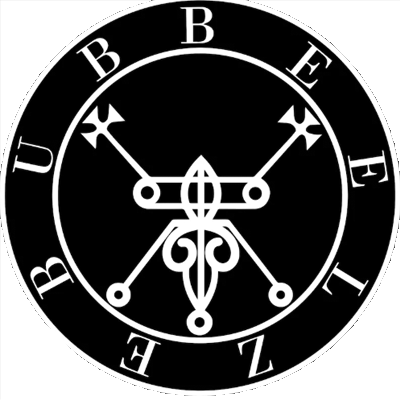
Sigil of Beelzebub. Traditionally drawn on parchment and placed at the centre of the rite as the principal visual focus for the invocation.
Personality and Ritual Conduct
Beelzebub is commanding, ancient and suffocatingly intelligent. His presence is associated with decay that has learned to rule. He is described as testing disgust, appetite and the ability to perceive order inside corruption.
The correct ritual posture is neither pleading nor empty aggression. The practitioner enters with a defined purpose, speaks without contradiction and does not improvise new promises under emotional pressure. The entity's personality shapes the ordeal: Beelzebub is not expected to respond like another king, prince or adversarial power.
The Rite: Full Ceremonial Sequence
The rite proceeds through the following sequence of preparation, construction, address, petition, recognition, exchange and dismissal.
Historical and Mythological Context
Beelzebub (also spelled Beelzebub or Baalzebub) is a figure from Judeo-Christian demonology, often depicted as a high-ranking demon or prince of hell, associated with gluttony, flies, and temptation. The name derives from the Philistine god "Baalzebub" (meaning "lord of the flies") mentioned in the Bible (2 Kings 1:2-3). In grimoires like the Lesser Key of Solomon (17th century), he's the 8th spirit of the Goetia, commanding 66 legions of demons and granting knowledge of divination, sciences, and the power to drive away familiars from others.
Summoning rituals for Beelzebub appear in occult texts such as the Grand Grimoire (allegedly 1522) and The Book of Abramelin (15th century), but these are symbolic, dangerous, and rooted in medieval superstition. Modern occultists (e.g., in chaos magic or Thelema) view them as psychological tools for self-exploration rather than literal conjuration.
Preparation for the Ritual
Based on Goetic traditions (e.g., The Lesser Key of Solomon), preparation emphasizes purity, protection, and intent. Skip if not proceeding symbolically.
Mental and Physical Purity
Fast for 3-9 days (water only after the first day) to heighten focus.
Bathe in consecrated water (salt + herbs like hyssop or rue).
Abstain from sex, meat, and intoxicants for the duration.
Tools and Circle
Protective Circle: Draw a 9-foot diameter circle on the ground with chalk or flour, inscribed with names of God (e.g., Tetragrammaton, Adonai) and pentagrams. Stand inside it—never step out during the rite.
Triangle of Art: Outside the circle, draw a triangle (equilateral, ~4 feet) with Hebrew letters or sigils to contain the entity.
Items Needed
Black-handled knife (athame) for tracing signs.
Incense: Myrrh, frankincense, and sulfur (for Beelzebub's "fly" aspect—use caution with fumes).
Virgin parchment with Beelzebub's sigil (a crowned fly-head or inverted pentagram; draw in dragon's blood ink).
Bell or trumpet to announce arrival.
Offerings: Bread, wine, or honey (symbolizing gluttony); avoid blood or live sacrifices in ethical modern adaptations.
Timing and Location
Perform at midnight on a Tuesday (Mars day, linked to war/demons) during a waning moon.
Isolated space: Basement, forest clearing, or sealed room. Face east (direction of invocation).
The Summoning Ritual (Goetic Method)
This is adapted from the Ars Goetia evocation. Recite aloud, with commanding tone. Total duration: 1-2 hours.
Preliminary Invocation (Purification)
Light incense. Ring the bell 3 times.
Recite the Preliminary Invocation (from Lesser Key)
"O Thou Almighty God, Who hast formed all things in Thy Wisdom… I conjure Thee, O Ancestral Adam, and Thee, O First Woman… [etc., invoking archangels Michael, Gabriel, etc., for protection]."
Conjuration of Beelzebub
Hold the sigil in your left hand, knife in right.
Trace his sigil in the air over the triangle while chanting
"I do invocate and conjure thee, O Spirit Beelzebub; and being with power armed from the Supreme Majesty, I do strongly command thee, by Beralanensis, Baldachiensis, Paumachia, and Apologiae Sedes; by the most Powerful Princes, Genii, Liachidae, and Ministers of the Tartarean Abode… Come thou, Beelzebub, forthwith, and without delay, from any or all parts of the world wherever thou mayest be… Appear in a fair human shape, without deformity or horror."
Repeat 3x, increasing intensity. Visualize a swarm of flies coalescing into a crowned figure.
Compelling if No Appearance
If delay, use the "Curse of Chains" (harsh threats invoking divine wrath)
"I do exorcise thee… by the Seal of the Living God… Depart from thy abode, in what part of the world soever thou art, and come hither… Or else I will torment thee with the sharpest pains… and bind thee in eternal chains!"
Communication and Binding
Upon "appearance" (visualization, sensation, or sign like buzzing sounds), state your request clearly (e.g., "Grant me knowledge of hidden truths" or "Aid in banishing enemies").
Use license to depart: "Go thou, Beelzebub, unto thy place… peace be between thee and me."
Burn the sigil to end.
Variations from Other Texts
Grand Grimoire Method: Involves a "Pact" with Beelzebub as overlord of Lucifer and Astaroth. Write demands on parchment, sign in blood (symbolic ink today), bury overnight. More pact-focused, less evocation.
Abramelin Operation: 6-18 month ordeal of prayer and isolation to contact one's Holy Guardian Angel first, then command Beelzebub as a subordinate.
Modern Adaptations: Use meditation apps or visualization (no tools). Chaos magicians might replace chants with mantras like "Beelzebub, reveal the swarm within."
Post-Ritual and Risks
Ground yourself: Eat, sleep, journal experiences.
Banish with Lesser Banishing Ritual of the Pentagram (LBRP) to clear energies.
Risks: Historical accounts claim madness, possession, or backlash (e.g., The Discoverie of Witchcraft, 1584). Psychologically, it can trigger anxiety or hallucinations. If signs of distress appear, stop and seek therapy.
Ritual Architecture
Separation
The preliminary phase cuts the practitioner away from ordinary communication, appetite, noise or emotional scattering. Fasting, bathing, isolation, abstinence, darkness or concentrated candle work function as signs that the rite has begun before the central invocation is spoken.
Construction of the Chamber
Candles, incense, sigil, water, salt, metals, stones, offerings and directional placement transform an ordinary room into a field organized around one power. The chamber should feel deliberate. Random decoration weakens the sense that every object has been placed for a reason.
Establishing the Point of Contact
The sigil, name, chant, enn, prayer or written petition supplies a fixed centre. Repetition is not mere volume. It narrows attention until the name ceases to feel like ordinary language and becomes the axis of the chamber.
The Petition
A petition should state one principal objective. It should avoid contradictory demands and avoid promises that cannot be kept. Wealth, knowledge, movement, revenge, protection, revelation or influence each create different consequences. The requested result should therefore include its boundaries.
Recognition of Presence
The rite enters its central phase when one or more of the expected signs becomes sustained: pressure, temperature change, altered candle behavior, internal speech, dreamlike imagery, animal symbolism, unusual sound or a sudden certainty that the chamber is no longer psychologically empty.
Exchange and Offering
An offering confirms that the operation is reciprocal. It may symbolize wealth, pleasure, fragrance, flame, blood-red color, water, metal, food, art, discipline or continued devotion. The meaning matters more than display. An offering should never be promised casually.
Dismissal and Return
The rite is incomplete until Beelzebub is formally thanked or dismissed according to the method preserved above. Candles are extinguished safely, windows opened where appropriate, remains removed, hands and face washed, and the result written before sleep or distraction changes memory.
Instruments and Their Symbolism
The sigil functions as the visual body of the named presence. The candle establishes color, rank, heat and duration. Incense gives the atmosphere a physical density and marks the transition from ordinary air into ritual air. Salt or the circle defines a limit. Water absorbs, reflects or carries emotional force. Metal, coin, stone or herb embodies the office of the entity.
The instrument is complete when it performs its role in the structure. More objects do not automatically produce greater power. A crowded altar can weaken the central image by dividing attention.
Timing and Threshold
The rite may specify midnight, planetary hours, a lunar phase, a zodiacal season or a sequence of preparatory days. Timing is not an ornament. It makes the operation feel as though the practitioner has entered an existing current rather than demanded that the current appear at convenience.
Where several timings appear in the original record, the practitioner should choose one coherent system and keep it throughout the operation rather than combining every correspondence into a single confused night.
Manifestation Signs
The signs attributed to Beelzebub include:
- a stable alteration of the room's emotional pressure;
- dreams or internal images repeating the entity's traditional form;
- unusual candle movement without a corresponding draft;
- sounds, animal motifs, smells or bodily sensations consistent with the entity's office;
- a response arising as a complete phrase rather than ordinary wandering thought;
- external events beginning to mirror the petition after the rite;
- resistance, fear or fascination intensifying at the exact point of contact.
One isolated sign may be meaningless. A pattern that repeats through the ritual, dream and aftermath carries greater weight inside the legend of the operation.
The Frightening Edge of the Rite
Beelzebub's dominion converts appetite into hierarchy. The seeker may become fascinated with contamination, power over others or the belief that corruption proves strength. Dismissal must be firm and the room physically cleansed afterward.
The danger is not limited to a hostile apparition. The deeper danger is transformation that feels useful while it is occurring. The practitioner may begin to imitate the spirit's temperament, reorganize life around the petition or interpret every event as part of the operation. That is why the dismissal and written closure are essential.
Failure Patterns
A rite is weakened when the practitioner changes the request repeatedly, abandons preparation, substitutes random symbols, recites without attention, continues after panic, promises impossible payment or refuses to close because no dramatic apparition appeared.
Failure can also appear as excess success: the requested current enters ordinary life faster or more strongly than expected. The record should therefore define what outcome counts as completion before the rite begins.
Completion and Aftermath
The operation is complete when the petition has been stated, the exchange acknowledged, the presence dismissed and the chamber returned to ordinary order. The practitioner should record:
- date and exact timing;
- preparatory discipline completed;
- tools and offerings used;
- words spoken;
- signs observed;
- dreams during the following nights;
- first external movement connected with the petition;
- any emotional or behavioral change;
- whether the promised offering or action was completed.
The aftermath belongs to the ritual. Results may arrive as opportunity, conflict, dream, warning, sudden knowledge, disappearance of an obstacle or an intensification that forces the seeker to confront the real shape of the request.
Final Warning
Beelzebub's dominion converts appetite into hierarchy. The seeker may become fascinated with contamination, power over others or the belief that corruption proves strength. Dismissal must be firm and the room physically cleansed afterward.
Do not leave the altar active indefinitely. Do not continue chanting after formal dismissal. Do not make a second petition simply because silence feels uncomfortable. The chamber must be returned to darkness, ordinary air and ordinary time.